
Hare Krishna, Here is Biography about Bhaktivinoda Thakura by Paṇḍita Sātkari Caṭṭopādhyāya Siddhānta-bhūṣaṇa (3 part)
- A Linguist
- A Rigid Religionist
- Last Words
A Linguist
He was a linguist and knew English, Latin, Urdu, Persian and Oriya besides Bengali and Sanskrit. He had also a taste for history and a keen habit of research. This made him a voracious reader of all the Puranas and Shastras of the Hindu religion as well as the writings of numerous authors of repute in Europe, both of ancient and modern days. He was a member of the Royal Asiatic Society of London. He had thoroughly gone through the Shastras of foreign religions, such as the Holy Bible and the Koran, and he could easily cite any passage occurring in those books whenever there was an occasion to do so. His nature was to leave no stone unturned in mastering whatever subject he took up and he did his duty in that respect to the fullest extent. The works he has left to the world are most precious will no doubt supply materials for the improvement of many thinkers.
A Rigid Religionist
Thakur Bhaktivinoda as a religious man – The religious condition of the Bengali knowing people in the beginning of the 19th Century was in a miserable plight. There were so many from the main stem of religion, each preaching doctrine in its own way, that people were thrown in utter confusion and did not know what the pure religion was. It then became a necessity for a leader to save the good souls who were hankering for their real welfare. To quench their thirst a Bhaktaabatar was badly needed and that abatar appeared in the form of our Thakur Bhaktivinoda. His religious disposition was observed from his very childhood and as he grew older he studied all the religious books of the world and appreciated the doctrines preached by Sri Chaitanya Mahaprabhu as the sublimest of all and the surest path to lead the fallen souls to the feet of God. It is said that he obtained divine inspiration for the welfare of mankind and his fellow brethren, at Dinajpur in 1868 from which time he employed himself vigorously to propagate the religion, the cause of which he had espoused sometime before on a maturer discussion of all the religions of the world. From that time he began to write a number of philosophical books containing the teachings of Sri Chaitanya Mahaprabhu and began, to deliver speeches on philosophical themes for the good of mankind. His mission was fulfilled on his starting the “Nam-hatta” at Nadia and the of Hari was preached in every house in every village of the province of Bengal. The discovery of the birthplace of Sri Chaitanya Mahaprabhu by our Thakur in the Gaudamandal was one of his acts, which history repeated in the action of Sri Chaitanya Mahaprabhu himself in discovering the lila-kshetra of Sri-Krishna in Vrindavan. The establishment of an institution on that discovered Yogapitha, with aid of the public and the Vaishnava world, was also a grand object nobly performed by the Bhakta–abatar. The enlightenment and cultured men of the present age have now learnt to honour the sublimest philosophy which he brought to light and which would have lain buried in darkness, had he not opened their eyes. He was first to start a religious magazine in Bengal so far back as 1880, turning the minds of educated men to the path of religion. He gave to the world the gist of the doctrine of Sri Chaitanya Mahaprabbu the following sloke. We would do better to quote here the precepts of Sri immortal Chaitanya Mahaprabhu which our Thakur precepts wrote in brief:
“Chaitanya teaches us in the first place that the rational attributes of men are not capable of approaching the divine sphere of spirit. Jukti as he styles reason, is quite incompetent in such a matter. Ruchi as he styles the religious sentiment in man, even in a very small quantity, has the power to comprehend it. It is inspiration which can alone give light to spiritual matters. Inspirations coming down from Heaven through purified and blessed souls have exhibited themselves in the form of the Vedas. The Vedas, together with their explanatory notes, the Puranas, are therefore the only evidence in matters of spirit and are eternal in nature. Vedic truth should, therefore be accepted as the only truth in higher matter. Reason, while sincerely helping the inspired truth, may be accepted as auxiliary evidence. The Vedas teach us according to Chaitanya, nine principle doctrines, that is: – 1. Hari (the Almighty) is one without a second 2. He is always vested with infinite power. 3. He is ocean of Rasa. The souls in his Vibhinnangsha or separated part 5. Certain souls are engrossed by Prakriti or his illusory energy 6. Certain souls are released from the grasp of Prakriti 7. All spiritual and material phenomena are Bheda-bhed prakasha of Hari the Almighty 8. Bhakti is the only means of attaining the final object of spiritual existence. 9. Prem in Krishna is alone the final object of spiritual existence.
- Hari the Supreme Being is one without a second. In Aryan theology the creative principle of the Deity is personified in Brahma and the destructive principle in Shiva. Indra is the head of some lower elements of administration. Hence they are not the Almighty Himself but are different representations of different attributes. They have obtained their powers from an original Fountainhead. Hence they are subordinate beings in the service of Hari or Bhagavan. Then again there are three distinct philosophical ideas of the Deity i.e. (i) the idea of the negative Brahma of the Pantheistic School, (ii) the idea of a universal soul, Paramatma of the Yoga School and (iii) the idea of a personal Deity with all His Majesty, might, glory, beauty, wisdom and supremacy combined in the person. The ideas of Brahma and Paramatma are therefore included in the idea of Bhagavan. Spiritually, therefore, Bhagavan is Hari the Supreme Being. Human ideas are either mental or spiritual. The mental idea is defective as it has relation to the created principle of matter. The spiritual idea is the nearest approach to the Supreme Being. Then again the spiritual idea of Bhagavan is of two sorts. In one sort, the person of the Deity is overpowered by His own majesty, and in the other, the personal beauty overpowers all His Majesty. The first idea is represented in the great Narayana of Vaikuntha, who is the Lord of Lords and God of Gods. The second is represented in the All-beautiful Krishna with Radhika, the representative of His Hladini or superior ecstatic energy. Krishna appears as man amongst men and is again generally accepted as God above Gods. Krishna attracts, loves and produces ecstasy in all souls. His person and personal attachments are all purely spiritual and have no relation to the material world. The material senses of man cannot approach Him. It is the spirit in man which can see him direct and commune with him. The soul fettered in matter, has from its own degradation lost its right to see Krishna and his spiritual lila in the spiritual world, but Krishna out of His own supreme Power and prerogative may appear with all his Vrindaban Iila before the eyes of all men. The rational man can hardly conceive and believe Krishna and his lila. As his spiritual essence improves, he sees Him and loves Him with all his heart. In our small compass, we can hardly treat this subject fully and exhaustively. We, therefore, leave this point to our readers with these words:
“Give up the shackles of matter slowly. Cultivate your spirit inwards. Give up prejudices which you have acquired from the so-called rational thinkers, who deny the existence of spirit. Be humble in yourself and learn to respect those who work towards spiritual attainments. Do this with your heart, mind and strength in the company of spiritual people alone, and you will see Krishna in no time. Krishna is not an imaginary Being, nor you have a right to think that is a material phenomenon fancied to be the supreme Being by the fools. Krishna is not understood by the process of distinguishing the subjective from the objective, nor He is to be accepted as an imposition on the people set up by designing men. Krishna is eternal, spiritually true, reflected on the human-soul when relieved of all pressure of gross matter and is the subject of love which proceeds from the soul. Accept Him as such and you will see Him in your soul’s eye. Words fail to describe that transcendental Being. The highest, best and most spiritual idea of the Divinity is in Krishna. To bring arguments against him is simply to deceive one’s self and deprive himself of the blessings that God has kept in store for man. Hence all descriptions of his name, person, attributes and lila should be accepted spiritually giving up the material portion which words must necessarily convey’.
- Hari is always vested with infinite powers. By infinite powers must be meant powers which know no bounds either in space or in time; as His powers alone created space and time. His powers are identified with His person. In material objects, there is a difference between the person and its powers, between the thing and its attributes, its name, its form and action; but it is a spiritual truth that in spirit the thing is identical with its name, form, attributes and action. This truth cannot be subjected to dry reason which deals with gross matter alone. Krishna is Supreme Will in Himself and He exercises His supreme power at His pleasure, which submits to no law, because all law has proceeded from His Will and Power. Power is known from its exercise. In this world we have experience of only three of the attributes of His power. We see the material phenomena and we understand that His power has the attribute to create matter. This attribute is styled in the Vedas as Maya-shakti. We see man and we understand that the supreme power has the attribute to produce limited and imperfect souls. The Shastras call that attribute as Jiva-shakti. We conceive of One who is spiritual and supreme in his realm of eternal spirits. We understand that His power has an attribute to exhibit perfectly spiritual existences. The Vedas call that attribute by the name of Atma-shakti or chit shakti. All these attributes together form one supreme power which the Vedas call as Para-shakti. In fact power (shakti) is not distinguishable from the person of that Being. Still the powers are separately exhibited in their separate actions. This is styled Achintya bhedabhed-prakash or inconceivable simultaneous existence of distinction and non-distinction. Hari being Will above law, excercises His infinite powers, while He Himself remains unaffected. This is not understood, but felt in the soul as an intuitive truth.
- He is the ocean of Rasa. Rasa has been defined to be that ecstatic principle which comprehends sthayi-bhab, bibhab. anubabh, satvic and sanchari. Bibhab is divided into Alambana and Uddipana. Alambana is subdivided in to Vishaya and Asraya. Asraya is that person who has in himself the principle of Sthayi-bhab and Vishaya is that person to whom the sthayi-bhab directs itself. Sthayi-bhab has been explained to be rati or tendency of the pure spiritual heart. By a connection of Asraya and Vishaya the sthayi-bhab arrives at its stage of action. When it obtains its active stage, certain signs are exhibited in the person which are called the Anubhabs. These are theirteen in number. Eight other bhabs exhibiting on the mind are styled satvik-bhab such as tears, shivering, &c. Thirty-three other bhabs such as harsha, Vishad &c., have been shown to sanchari bhabs. These combined in soul form the rasa. This process of exhibition of rasa relates to exhibition of Rasa in man still enthralled in matter. But Rasa itself is an eternal principle identified with the Supreme Hari. Hari is the Ocean of Rasa and in the human soul a drop of the ocean could only be conceived. Rasa naturally is spiritual but in man subjected to Maya, the progenitor of matter, it has been identified, in a perverted state with the sensual pleasure of man in connection with objects, the soul losing itself in mind and the mind acting through the senses enjoying the perverted Rasa in five different objects of the five senses.This is the soul’s going abroad with avidya or ignorance of the spiritual self. When the soul looks inward, it obtains its spiritual Rasa and the perverted Rasa wanes off in proportion to the development of the spiritual Rasa. In spiritual Rasa the souls are towards each other and all towards the All-beautiful, have their unfettered action in Vrindaban, rising above material time and space. Hari or Infinite Supreme Free Will has eternal ecstacy in His Spiritual power or Chit-shakti. The Hladini attribute of Chit-shakti gives Him infinite pleasure. The Sambit attribute of Chit-shakti (spiritual wisdom) produces all bhabs, relations and affections. The Sandhini attribute of Chitshakti produces all existence (other than the free will) including the dhams (abodes), individualities and other substances in connection with the action of the spiritual Rasa. All these exhibitions are from Chit-shakti or the spiritual power. Mayik or material creation including time, space and gross objects, has no place in Chit-jagat or the spiritual world which is all same as Vrindaban. “Maya-shakti” is a perverted reflection of the Chit-shakti. Hence the particularities in the Mayik (material) world have semblance with the particularities in the Chit-Jagat or (spiritual universe), but are not substantially the same. The Chit-Jagat is the model of the Mayik-jagat but they are not identical. We must guard ourselves against the idea, that man has imagined Chit-jagat from an experience of the Mayik-jagat. This idea is pantheistic and it may also be styled atheistic. Reason, not spiritualised, has a tendency to create such a, doubt, but one who has a wish to enjoy spiritual love must give it up as misleading. The eternal Rasa of Krishna exists spiritually in Chit-jagat. To us who arc in the nether there is a screen between our eyes and the great spiritual scene of Krishna lila spiritual scene of Krishna lila. When by the grace of Krishna that screen is drawn up, we have the privilege to see it, and again when it pleases the Almighty to drop the screen the great Vrindavan lila disappears. Taste the subject and your conviction will be the same as mine. Brethren! do not give up, such an important object without due and liberal examination.
- The soul is His Vibhinangsha or separated part. By soul is meant all sorts of souls—whether animal, human or celestial. It must be understood that Mahaprabhu believed the very liberal theory of transmigration of the soul. Certain readers may reject the idea on the ground that certain forms of faith do not support that theory. It is not liberal to reject a theory because it is in antagonism with the dogmas of certain sectarian creeds. Indeed it is a matter which reason can not dare to meddle with. Candidly examining we do not see any strong reason to disbelieve the theory of transmigration. On the other hand, our unprejudiced mind is inclined to stand for it. The belief that the human soul has only one trial in life is evidently illiberal, unjust and contrary to the belief that God is all good. When our spiritual sentiment supports the theory and the Vedas, the receptacles of inspirations; have taught us the fact of continual existence of the soul in different stages in creation we cannot but give up the idea of disbelieving in the theory of transmigration of the soul. However educated and scientific a man maybe, he is always liable to a creeping error. That which holds good regarding a man holds good also regarding a nation or a sect. The soul, according to Chaitanya, is an atomic part of the Divine soul. It is a sort of God’s power to produce beings who are spiritual in essence but liable to be enthralled by Maya when they forget their position as eternal servants of the Deity. God here is compared with the Sun and the souls are said to be the atomic portions of that sun’s ray, unable to stand freely unless they are protected by another competent attribute of God’s power. By the word part is not meant to be portions cut out of a piece of stone by the axe, but is meant to be like one lamp lighted from another, or gold produced from an alchemic stone as believed by the ancients. The souls are also compared with separate atomic emanations of the burning fire. Each soul has drawn from its fountain-head a proportionate share of the attributes and consequently a small proportion of the free will. These souls are naturally located between the Chit-jagat and Mayik-jagat. Those who chose to serve their God were protected from fall by the interference of the hladini attribute of the supreme chit-shakti. They have been admitted as eternal servant of the Deity in various ways. They know not the troubles of Maya and her Karma-chakra or the rotative principle of Mayic action and its result. Those who wanted to enjoy were grasped by Maya from the other side. They are in Maya’s Karma-chakra ending only when they again see their original position as servants of the Deity. These souls whether liberated from Maya or enthralled by her are separate responsible beings depending on the Deity. Hari is the Lord of Maya who serves Him at His pleasure. The soul or Jiva is so constructed as to be liable to be enthralled by Maya in consequence of want of power when unassisted by the Hladini Shakti of the Deity. Hence there is a natural and inherent distinction between God and Jiva, which no pantheistic maneuver can annihilate. Please avoid the misleading question when were these Jivas created and enthralled? The Mayic time has no existence in spiritual history because it has its commencement after the enthralment of Jivas in matter and you cannot, therefore, employ Mayic chronology-in matters like these.
- Certain souls are engrossed by Prakriti or illusory energy. Prakriti, God’s Maya, Pradhan, Prapancha and Avidya are different names of the same principle on account of its different phases and attributes. Maya is not an independent shakti from the Svarup Shakti. She is simply a reflected and outward Phase of the power serving God in executing His penal orders on those who become ungrateful to Him. In fact Maya is in charge of God’s house of correction. Those Jivas in abusing their free will, forgot that they were eternal servants of the Deity and thought of enjoying for themselves were grasred by Maya for their penal servitude and correction. Maya has three attributes Satwa, Raja and Tamas. Those attributes are just like chains used to tie up ungrateful souls. Maya then applied a double case on the spiritual of the soul. The double case is described by-the words linga and sthul. The Mayik existence has twenty four substances: the five elements:— the earth, the water, the fire, the air, and the firmament; the five properties the sound, the touch, the sight, the taste and the smell, and ten Indrias i. e. the five senses; the eye, the ear, the nose, the tongue and the touch and five working organs such as hands, legs etc. These twenty form the sthul or outer case. The mana, the buddhi, the chitta and the ahankar i. e. the mind, the understanding, the attention and the perverted ego, compose the linga deha or the inner case. Then after encasing the spiritual form of the soul Maya employs the fallen souls to work, Mayik work is composed of Karma, A Karma and Vikarma. Karma is conventionally good action done to obtain punya or virtue such as performance of duties enjoined by the Varnasrama dharma of the Smartas. Akarma is ommission to duty. Vikarma is sin or crime. Karma procures heavenly elevation upto the Brahma-loke. Akarma gives an unpleasant state on earth. Vikarma hurls down souls to hell. The fallen souls travel from body to body with their linga deha doing Karma or Vikarma, rising up to the heavens and again coming down at the exhaustion of their virtues, going down to hell and after suffering punishment, again rising up to the platform of work. Thus the state of the fallen souls is deplorable in the extreme. There they enjoy and suffer, massacre and murder, and go on in this state, sometimes smiling as princes and sometimes ruing as sufferers. The world is, therefore, a prison or a house of correction and not a place for enjoyment as some people assert.
- Certain souls are released from the grasp of Prakriti. Jivas are travelling in the path of Mayik existence from time out of mind experiencing all sorts of pleasure and pain. How to get rid of this unpleasant state of existence? No, dharma, performance of duty, yoga, development of powers of the sthul and the linga, sankhya, or the division of substances under their categories and simple knowledge that one is a spiritual being, and vairagya (abnegation) giving up all enjoyments in the world, are not the proper means by which one can actually get what he wants. A man comes in contact with a Vaishnava, whose heart has been melted by Hari-bhakti rasa, it is then that he loves to imbibe the sweet principle of Bhakti by following his holy foot-steps, by constant study of Krishna-Bhakti. He slowly washes off his mayik condition and in the end obtaining his true nature he enjoys the sweetest unalloyed rasa which is the ultimatum of the soul. Satsanga or the company of the spiritual people is the only means to obtain the ultimate object of man. Bhakti is a principle which comes from soul to soul and like electricity or magnetism in gross matter, it conducts itself from one congenial soul to another. The principle of Bhakti is sincere and entire dependence on the Deity in every act of life. The principle of duty is no part of Bhakti as it acts as gratitude for favour obtained and it works like an obligation which is contrary to natural love. The principle of morality in the mortal world, though good in its own way does scarcely give spiritual consequence in the end. Faith in the supreme beauty of the Deity, a desire for the eternal unselfish service of that Being and a consequent repulsion of every other thought of pleasure or self-aggrandizement are the three principles which constitute Shraddha or actual hankering after Bhakti. Bhakti by nature is ananya or exclusive. Is it chance then which brings Bhakti? No Sukriti or good work is the prime moving principle. Good work is of two classes. One class, passing as morals, includes those works which bring virtue and aggrandizement. The other class of good work includes all acts which have a tendency to bring spiritual culture. This latter class of good work or sukriti brings one in contact with a sincere Vaishnav from whom the man at first imbibes sraddha or faith in spirit and being then capable of receiving Bhakti obtains a flash of that principle from the Vaishnav who is the actual Guru of the man.
- All spiritual and material phenomena are Achintya Bhedabhed prokash of Hari the Almighty. Metaphysical discussions are perfectly useless. The Vedas go sometimes to establish that Jiva is distinct from the Deity and sometimes that Jiva is the same as the Deity. In fact the Vedas always tell the truth. Jiva is simultaneously distinct from and identical with God. This is not understood by the rationalist. Hence it must be said that in exercise of his powers beyond human comprehension. God is distinct from Jiva and the world and again identical with them at all times. The Vedanta teaches us the Shakti-parinamvad and not the erroneous Vivartavad of Shankaracharya. Shankar’s teachings are explained in different ways. Some say that the world and Jiva have emanated from God and others establish that Jiva and the world are but developements of the God-head. Sankar inorder to avoid Brahma parinam i.e. transformation of the God-head into the world establishes that Vyas teaches us Vivartavad which is this, that God undergoes no change whatever, but it is Maya which covers a part of the Deity, (Just as a pot encloses a part of the firmament) creates the world; or that God is reflected in avidya or ignorance, while in fact nothing else than God has yet come to existence. These are worthless and abstruse arguments. It is plain that the Vedanta teaches us that God is unchangeable and is never subject to modifications. His power alone creates Jiva and the material world by its own parinam (modification). The example is in the action of the Alchemist’s stone the power of which comes in the form of gold while the stone remains unchanged. Chit-shakti goes in the form of the Chit-jagat with all its particularities of eternal rasa and Jiv-shakti goes in the form of innumerable Jivas, some staying in Vaikuntha as parshadas or angels and others moving in this world in various shapes and forms and under very different circumstances. Mayashakti creates numerous world for the habitations and entertainments of the fallen souls. Vibhartavad is no doubt an error and is quite oppossd to the teachings of the Vedas. Now Shakti parinamvad alone is true and supports the fact that spiritual love is eternal. If Vibhartavad were true the natural consequence would be to declare spiritual love to be a temporary principle.
- Bhakti is the only means of attaining the final object of spiritual existence. Karma as it is, cannot directly and immediaely produce spiritual result. When it does, it does by means of Bhakti. Hence Bhakti is independent and Karma and Gyan are dependent principles. Gyan or the knowledge, that man is a spiritual being, cannot directly bring the ultimate object. When it does, it does with the assistance of Bhakti. Bhakti, therefore, is the only means to obtain the ultimatum. Bhakti is thus defined. Bhakti is cultivation of a friendly sentiment for Krishna, free from all desires other than those for its own improvements, unalloyed by such other ingredients as Karma and Gyan &c.. It will be seen that Bhakti is itself both a feeling and an action. Bhakti has three stages, viz., Sadhan bhakti, Bhab bhakti, and Prem Sadhan bhakti is that stage of culture when the feeling has not yet been roused. In Bhab bhakti the feeling awaken, and in Prem bhakti the feeling is fully set to action. Bhakti is a spiritual feeling towards the spiritual object of love. Sadhan bhakti is of two sorts, one is called the Vaidha sadhan Bhakti and the other is Raganuga Sadhan, bhakti. The word Vaidha is from Vidhi or rule. Where Bhakti is to be roused by the rule of the Shastras, there the Vaidhi bhakti works as long as the feeling is not roused. Where one out of natural tendency loves Krishna. there is a principle called Rag, which is no other than a strong desire to serve the lord of the heart. One who is tempted by the beauty of this process to follow him, has a tendency to cultivate his feeling for Krishna. This is Raganuga Sadhan bhakti. This latter class of Sadhan is stronger than the ‘Vaidhi sadhan.’ Cultivation of the friendly feeling for Krishna is performed in nine different forms.
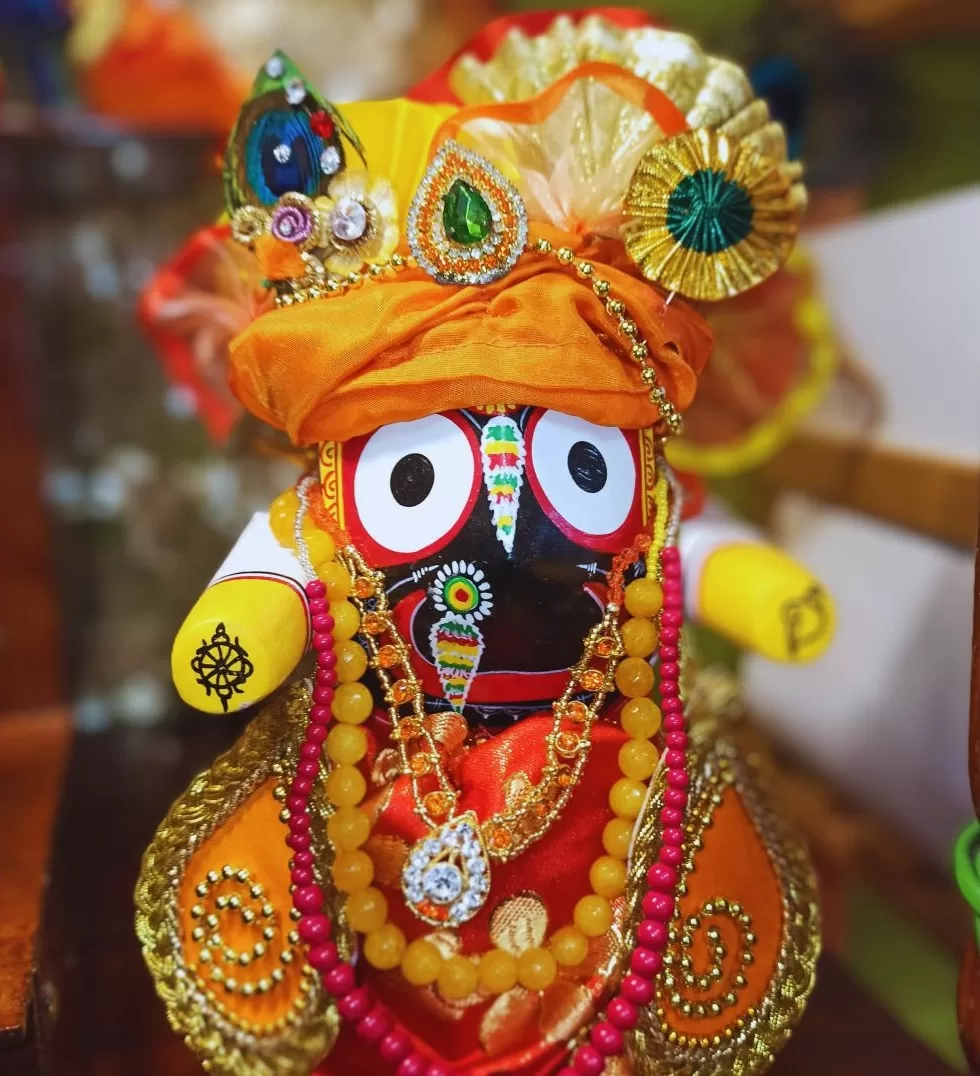
- To hear of spiritual name, form, attribute and lila of Krishna. 2. To utter and sing all those. 3. To meditate on and reiterate all those. Service of His Holy feet. 4. Worship. 5. Bowing down. 6. Doing all that pleases Him. 7. Friendship. 8. Resignation. Of all these forms Kirtan or singing the name etc. of Krishna is the best. Humble knowledge is necessary in these forms of worship and fruitless discussions must be avoided. There are some who start at the theory of worshipping “Srimurti”! Oh they say It is idolatry to worship “Srimurti”! Srimurti is an idol framed by an artist and introduced by no other than Beelzebub himself. Worshipping such an object would rouse the jealousy of God and limit His Omnipotence, omniscience and omnipresence. We would tell them, Brethren! Candidly understand the question and do not allow yourself to be misled by sectarian dogmas. God is not jealous, as he is without a second. Beelzebub or Satan is no other than an object of imagination or the subject of an allegory. An allegorical or imaginary being should not be allowed to act as an obstacle to Bhakti. Those who believe God to be impersonal, simply identify Him with some power or attribute in nature, though in fact He is above nature, her laws and rules. His Holy wish is law and it would be sacrilege to confine His unlimited excellence by identifying Him with such attributes as omnipotence, omnipresence and omniscience, attributes which may exist in created objects such as time, space His excellence consists in having in Him mutually contradicting powers and attributes ruled by His Supernatural Self. He is identical with His All beautiful person having such powers as omnipresence, omniscience and omnipotence, the like of which cannot be found elsewhere. His Holy and perfect person exists eternally in the spiritual world and at the same time existing in every created object and place in all its fulness. This idea excels all other ideas of the Deity. Mahaprabhu rejects idolatry as well, but considers Srimurti worship to be the only unexceptionable means of spiritual culture. It has been shown that God is personal and All- Beautiful. Sages like Vyas and others have seen that beauty in their soul’s eye. They have left us descriptions. Of course word carries grossness of matter, but truth still is perceivable in those descriptions. According to those descriptions one delineates a Srimrti and sees the Great God of our heart there with intense pleasure! Brethren! is that wrong or sinful. Those who say that God has no form either material or spiritual and again imagine a false form for worship are certainly idolatrous. But those who see the spiritual form of the Deity in there soul’s eye, carry that impression as far as possible to the mind and then frame an emblem for the satisfaction of the material eye for continual study of the higher feeling are by no means idolatrous. While seeing a Srimurti do not even see the image itself but see the spiritual model of the image and you are a pure theist. Idolatry and Srimurti worship are two different things; but my brethren you simply confound one with the other out of hastiness. To tell you the truth, Srimurti worship is the only true worship of the Deity, without which you cannot sufficiently cultivate your religious feelings. The world attracts you through your senses and as long as you do not see God in the objects of your senses, you live in an awkward position which scarcely helps you in procuring your spiritual elevation. Place a Srimurti in your house. Think that God Almighty is the guardian of the house. The food that you take is His Prasad. The flower and scents are also His Prasad. The eye, the ear, the nose, the touch and the tongue all have a spiritual culture. You do it with a holy heart and God will know it and judge you by your sincerity. Satan and Beelzebub will have nothing to do with you in that rather all sorts of worship are based on the principle of Srimurti. Look into the history of religion and you will come to this noble truth. The Semitic idea of a patriarchal God both in the pre-christian period of Christianity and Mohammadinism is nothing but a limited idea of Srimurti. The monarchic idea of a love amongst the Ariyan Karma-kandis is also a distant view of the same principle. The idea of a force and Jotirmaya Brahma of the meditators and a formless energy of the Shaktas is also a very faint view of the Srimurti. In fact the principle of Srimurti is the truth itself differently exhibited in different people according to their different phases of thought. Even Jaimini and Comte who are not prepared to accept a creating God, have prescribed certain phases of the Srimurti, simply because they have been impelled by some inward action from the soul! Then again we meet with people who have adopted the cross, the Salgram Shila, the lingam and such like emblems as indicators of the inward idea of Srimurti. Furthermore, if the Divine compassion, love and justice could be portrayed by the pencil and expressed by the Chisel why should not the personal beauty of the Deity embracing all other attributes be portrayed in poetry or in picture or expressed by the chisel for the benefit of man? If words could impress thoughts, the watch could indicate time and sign could tell us a history, why should not the picture or figure bring association of higher thoughts and feelings with regard to the transcendental beauty of the Divine Personage? Srimurti worshipers are divided into two classes, the ideal and the physical. Those of the physical school are entitled from their circumstances of life and state of the mind to establish temple institutions. Those who are by circumstance and position entitled to worship the Srimurti in mind have, with due deference to the temple institutions, a tendency to worship usually by Sraban and Kirtan, and their church is universal and independent of caste and colour. Mahaprabhu prefers this latter class and shews their worship in his Shikshastak, printed as an appendix to Precepts. Worship then without intermission with a feeling of resignation and in a very short time you will be blessed with Prem.
- Prem in God is the final object of spiritual. The Karma-margis declare that enjoyment in this world and in the hereafter is all that requires. Karma or action is of two sorts i.e. Karma done with a view to obtain material result and Karma done with a view to please God. With the Karma-margis both sects of Karma have the object of procuring enjoyment. Here is the line of demarcation between Bhakti and Karma. Bhakti aims at procuring the principle of Priti or prem Bhakti as the final result of all action; while Karma aims at self-enjoyment as the ultimate , action. The Gyan-Margis on the other hand cultivate Gyan or spiritual knowledge to obtain Mukti or salvation as the final aim of cultivation. Mukti is defined to be of two sorts. In one sort of Mukti total absorption lof the soul in God is effected i.e. annihilation of the separate existence of the soul from God. In the other sort of Mukti the soul stands eternally separate from God and when salvation ensues, the soul goes to “Chit-jagat” obtaining salokya or residence in the Chit region of the Deity, sarupya or residence closely by the Deity, sarupya or attainment of a spiritual form like that of God Himself, and sarsti or attainment of powers similar to the powers of God. The latter class of mukti is inevitable when it pleases the Almighty to grant us that State. But then after obtaining that Mukti we serve with priti or pure Love. The first sort of mukti is rejected by the Bhaktas as not worth taking in consequence of its tendency to annihilate the highest principle of love. The second class of mukti cannot be the ultimate object as it acts like an intermediate condition of the soul, Priti there acting as the ultimatum. Mukti therefore, must be treated an intermediate result of our spiritual disenthrallment. Besides that a hankering after mukti spoils the action of spiritual cultivation, being a strong desire for something else than the improvement of “Bhakti”. It has a tint of selfishness which is not in keeping with the unselfish principle of pure “Bhakti”. We must therefore cultivate Bhakti being always from the two contending principle i,e. a desire for Bhakti or selfish enjoyment and desire for Mukti or salvation. We must depend on Krishna to give us mukti or not as it pleases Him. We must pray for continual development of our religious sentiment bhakti alone. Priti or pure love is the final object of our own existence. Rati as explained above is the unit of the principle of pure spiritual love of Krishna. Mixed up ullas (zeal) it becomes priti. Priti creates exclusive love in Krishna and repulsion for things and persons other than Krishna and His connections. When the idea that Krishna is my own is added to priti it becomes prem. Here commences the idea that God is my own Lord and I am His servant. Add confidence to prem and it becomes Pranaya. Here arises the relation of friendship with Krishna. In pranay the idea of respect loses its hold. Add to pranay the idea that Krishna is my exclusive and dearest object of love and it curiously turns out into man. Krishna with all his gratefulness and power exhibits a sort of submission to it. Excessive melting of the heart being added, prem turns out to be sneha. Here ensues the relation of a son and parents, between Krishna and the worshiper. In this stage too much weeping for Krishna, want of satiety with communion and a desire to watch the interests of Krishna naturally occur. Desire added to Sneha is Rag. In this stage a moment’s separation is unbearable. Here commences the relation of husband and wife between Krishna and the worshiper Distress attending upon want of mutual interview is happiness. Rag again seeing its object as new at very moment, and being itself new at every moment converts itself into anurag. In this stage reciprocal subjection and a strong desire to accompany the lover everywhere are the principal features. Anurag infinitely rising in an astonishing state, amounting as if to madness, becomes mahabhab. This is indescribable! From rati to mahabhab, the whole principle is what we have called sthayi-bhab. Added to vibhab anubhab, satwika, and samchari the sthayi-bhab becomes Krishna-prem rasa the eternal ecstasy or beatitude. We have a perverted picture of this noble rasa in human life, as human life in the thraldom of maya is but a perverted reflection of the spiritual life. When the soul alone acts towards its proper object, the spiritual hero Krishna, the rasa is pure , when the mind and the senses act upon a wrong object, rasa is degraded and becomes hateable. The perverted rasa gives clue to the idea of the noble spiritual rasa to man in general; hence these arguments and descriptions have been attempted in words which correspond with words directly meaning the features of the perverted rasa. We ask our readers to take care to make a nice distinction between spirit and gross matter, otherwise a fall is inevitable. One who studies the name, forms, attributes and the lila of Krishna as described in the Srimad Bhagabat with a sincere heart, mind and strength in the company of one who has realized the spirit, is expected to know it by the influence of bhakti. One who is apt to rationalize everything closely does scarcely acquire the truth in matters of spirit, as by law of God reason in its present state can never reach the sphere of the spirit. It is needless to go further on this subject. Those who will have the opportunity to go as far as we have stated, will make a further enquiry from their heart and the All Beautiful Lord will then help them to realize the spirit and to rise higher and higher in its realm. But as long as the mind is confounded with spirit there is no way to rise beyond matter and its relations. The great mistake that most of the western philosophers have generally made is to identify the mind, the perverted ego (ahankar) with the soul or spirit. We are sorry for that.
A Summary:
To summarise, man in his present state has three different principles in One sthul principle or gross matter composing his body. The linga principle or sublimated matter appearing in the form of mind, attention, rationality and the perverted ego by which one confounds himself with the material world. This state has been caused by the influence of Maya or the illusory energy with the object of correcting the soul in his wrong intention to enjoy, in consequence of forgetfulness of his nature as God’s servant. Man in fact is solely independent of Maya and her connections. The only way to get rid of the present difficulty is the influence of pure bhakti imbibed from a true bhakta. Bhakti as a means elevates the man upto the All-beautiful Krishna and again, as an end, maintains him with eternal Krishna-prem. While located in the Mayik world man must live peacefully with the object of cultivating the spirit. In his society he must lead a pure life. Avoid sins and do as much good as he can to his brother man. He must be himself humble, bearing difficulties of life with heroism, must not brag of any goodness or grandeur, he has and must treat every one with respect due to him. Marriage with a view to peaceful and virtuous; life and with a view to procreate servants of the Lord is a good institution for a Vaishnab. Spiritual cultivation is the main object of life. Do everything that helps it and abstain from doing anything which thwarts the cultivation of the spirit. Have a strong faith that Krishna alone protects you and none else. Admit him as your only guardian. Do everything which you know that Krishna wishes you to do and never think that you do a thing independent of the Holy wish of Krishna. Do all that you do with humility. Always remember that you are a sojourner in this world and you must be prepared for your own home. Do your duties and cultivate bhakti as a means to obtain the great end of life, Krishnapriti. Employ your body, mind and spirit in the service of the Deity. In all your actions, worship your Great Lord.”
Last Words
To enable our noble readers to get a glimpse into the life of Thakur Bhaktivinoda, and to form an idea of the philosophy of the school of Sri Chaitanya Mahaprabhu, we place this account in their esteemed hands and rely on them to help us in the further propagation of religion, which our Thakur proved to mankind to be the supreme of all the religions of the world and the only religion of the soul.
The End