Hare Krishna, Lesson from Dharmavira Maharaja How to chant 64 rounds Maha-mantra Hare Krishna
With additional information regarding what Srila Prabhupada said about japa in Nectar of Devotion and what Srila Sanatana Goswami said about different kinds of japa and their benefits ~
Hare Krishna!
Firstly I’d like to introduce myself. My family descended from Vishakapatanam in South India and I was born in South Africa. I met my spiritual master in 1975 in Durban, South Africa and was formally initiated by him in 1977.
My present mission is to assist my spiritual master, Srila Bhaktivedanta Swami Srila Prabhupada founder of ISKCON, in preaching the message of the most merciful incarnation of the Lord, Gauranga Mahaprabhu.
When Srila Prabhupada first came to the West, he requested his disciples to chant 64 rounds or 100,000 holy names and this was also Gauranga Mahaprabhu instruction to everyone. In fact Gauranga Mahaprabhu would only eat in the homes of devotees who chanted 100,000 names of the Lord.
This was also taught by Srila Bhaktisiddanta Saraswati Thakur, the founder of the Gaudiya Matha and Guru of Srila Bhaktivedanta swami and son of the seventh goswami Srila Bhaktivinoda Thakur.
But Srila Prabhupada discovered that his disciples from the West could not chant 64 rounds so he reduced the chanting to 32 rounds, but when he found out they could not chant even that he told them 16 rounds minimum.
Today some members think that this is the maximum but these 16 rounds was only to start you into the process of chanting with the understanding that as you get the taste for the holy names which is the sound vibration of the Lord and non-different from Him, you would gradually increase from 16 rounds to 64. This 64 rounds would take approximately 5 hours and 30 minutes.
Srila Prabhupada said after practicing chanting for some time, one should be able to chant one round in 5 minutes. So sixteen rounds in 1 hour and 20 minutes. Most members say they cannot chant one round in 5 minutes.
I will tell you why you cannot chant 1 round in 5 minutes: because you are not performing japa but kirtan. Japa is chanting within the mind for one’s own purification and if you do japa you would easily be able to chant one round in 5 minutes.
At that time the chanter attains the perfection of the goal upon which he or she has fixed his or her mind.
Some members say that Srila Prabhupada chanted loud but that was only to teach the process. You would have noticed Srila Prabhupada would chant very fast and this is how chanting should be done without a gap so unnecessary thoughts do not enter the mind.
Some members say chanting loud will benefit others as who hear, which I agree if it was pure chanting, that is, chanting without offenses. Nam aparadha chanting (chanting with offenses) will not be of much benefit even to you what to speak of others.
When there is imperfect chanting of the holy names the chanter does not receive the full benefit which awards the chanter seven types of perfection.
- Chanting cleanses the mirror of the heart
- Extinguishes the blazing forest fire of material existence
- Gives pure love of Godhead
- Reveals transcendental knowledge
- Grants ocean of unlimited happiness
- One relishes the complete and unlimited taste of the holy names at every moment
- Completely bathes the body, mind and soul
One may argue that one has been chanting for many years but has not received these benefits. The reason why you have not received the benefits is only due to nam aparadha chanting.
My two shiksha disciples who are working class chant 64 rounds, Vraja Bihari das and Tungavidya devi dasi. Therefore I cannot see why you cannot chant 64 rounds too, my friends.
—
Before I continue to explain verses of Siksastakam, I would like to address some points that some readers have raised regarding japa and what Srila Prabhupada said in the ‘Nectar of Devotion’ on japa:
“When a mantra or hymn is chanted softly and slowly, that is called JAPA. The same mantra, when chanted loudly, is called KĪRTANA. For example, the mahā- mantra (Hare Kṛṣṇa, Hare Kṛṣṇa, Kṛṣṇa Kṛṣṇa, Hare Hare/ Hare Rāma, Hare Rāma, Rāma Rāma, Hare Hare) when uttered very softly only for one’s own hearing is called JAPA. The same mantra, when chanted loudly for being heard by all others, is called KĪRTANA. The mahā-mantra can be used for japa and kīrtana also. When JAPA is practiced it is for the personal benefit of the chanter, but when KĪRTANA is performed it is for the benefit of all others who may hear.” [Srila Prabhupada, ‘Nectar of Devotion’, Ch.9, Japa]
Secondly I would like to inform you what Srila Sanatana Goswami said about japa in his book ‘Hari-bhakti-vilasa’ in the 17th vilasa which explains the chanting of japa.
17/155
narasimhe-trividho japa-yajnah syat tasya bhedan nibodhata | vacikas ca upamsus ca manasas ca tridha matah | trayanam japa-yajnanam sreyan syad uttarottarah ||155||
“One should understand that japa is of 3 types – vacika japa, upamsu japa and manasa japa – each one being progressively better than the previous one.”
This basically means that vacika japa is the least superior and manasa japa is the most superior.
17/156
yad ucca-nica-svaritaih spashta-sabdavad-aksharaih | mantram uccarayed vyaktam japa-yajnah sa vacikah ||156||
“Vacika japa refers to chanting that is sometimes loud and sometimes soft with each syllable prounced very distinctly.”
This kind of japa is the lowest chanting of japa of the three mentioned. 17/157
sanairuccarayenmantramishadaushthaupracalayet|kincicchabdamsvayamvidyadupamsuhsajapahsmritah||157||
“Upamsu japa refers to chanting that is sometimes loud and sometimes soft and yet the syllables of the mantra may not be distinctly discerned.”
17/158
dhiya yad akshara-srenya varnad varnam padat padam | sabdartha-cintanabhyasahsa ukto manaso japah||158||
“Manasa japa refers to chanting japa while one mentally chants the mantra while meditating on its meaning.”
17/159
tatracayajnavalkyah-upamshu-japa-yuktasyatasmac-chata-gunobhavet|sahasro manasah prokto yasmad dhyana-samo hi sah ||159||
“Upamsu japa awards awards one hundred times more merit than vacika japa and manasa japa awards one a thousand times more merit because it is as good as meditation.”
17/ 163
kim canyatra-manasahsiddhi-kamaistupushti-kamairupamshukah| vacikomaranoccateprashastojapairitah||163||
“Those who desire to attain perfection should practice manasa japa […]” 17/ 176
athalaksajapanmantridevavat modate divi kotijaptena mantrena muktibhagi bhavennarah
“By chanting a mantra one hundred thousand times one will enjoy residence in heaven and by chanting a mantra 10 million times one will become eligible to achieve liberation.”
—
Further, in the book ‘Jaiva Dharma’ written by Srila Bhaktivinoda Thakura it is said that:
First you should cultivate the realisation of your pure spiritual identity by practicing Sri Krishna nama purely, then your spiritual function known as jaiva dharma will be clearly revealed.
We should constantly practice chanting hari-nama with great enthusiasm. By chanting hari-nama regularly, you will develop strong attachment for Sri Krishna nama within a short time, and you will directly experience Goloka Vrindavan.
Chanting hari-nama as recommended by Sri Gauranga Mahaprabhu is the foremost of all the limbs of bhakti and yields the quickest results.
This is also confirmed by Sri Krishna das Kaviraja in the Chaitanya Caritamrita
(Antya 4.70-71) that the nine processes of devotional service is all included in the chanting of the holy names of Sri Krishna.
Reference: Jaiva Dharma, chapter 2
In my next lesson I will explain how to chant without offenses and become ecstatic.
—
Note: On Gaura-pūrṇimā of 2004, on the full moon day in the month of Phālguna, Sriman Aniruddha Prabhu took the vow of chanting three hundred thousand (300,000) holy names daily, and now he chants five hundred thousand (500,000) names daily.
Biography of Sriman Aniruddha dasa Adhikari – download here!
—
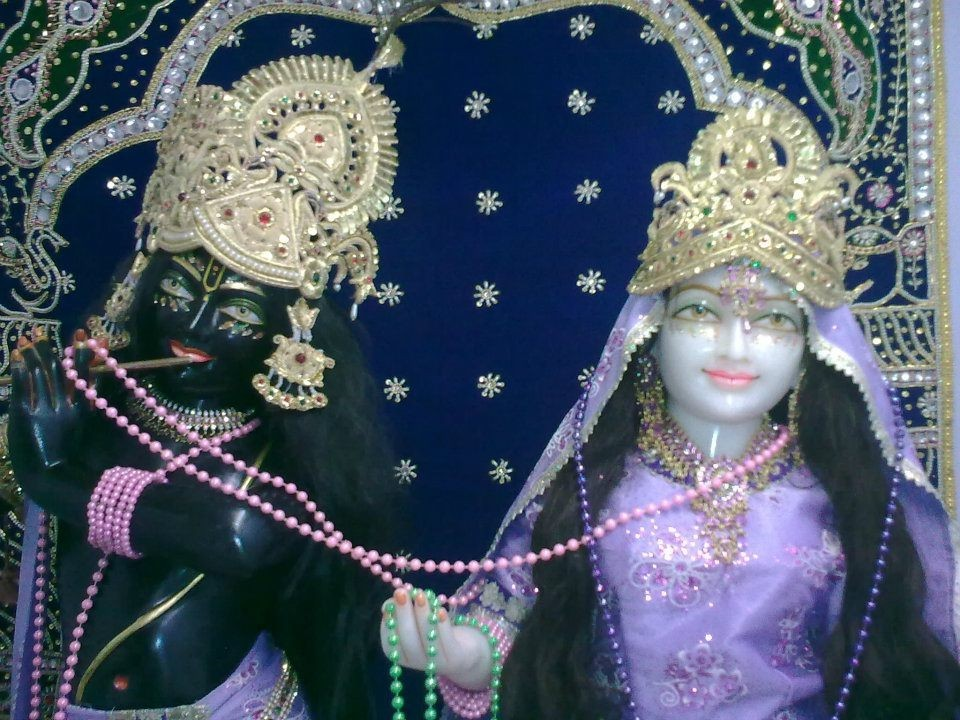
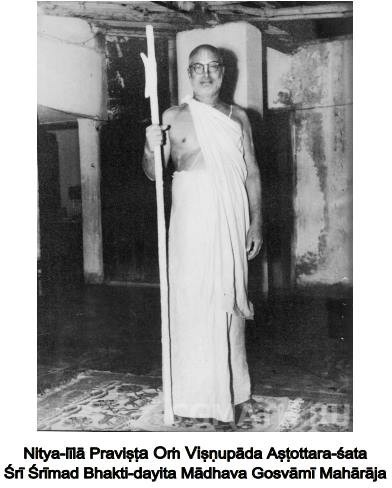
Inthesepictures:
- THESE LIFE SIZE RADHA-GOVINDA DEITIES ARE A GIFT FROM GAURANGA MAHAPRABHU TO DHARMAVIR DAS PRABHU
- ŚRĪ ŚRĪMAD BHAKTI DAYITA MĀDHAVA GOSVĀMĪ MAHĀRĀJA,THE DISCIPLE OF SRILA BHAKTISIDDHANTA SARASVATI THAKUR AND THE SPIRITUAL MASTER OF SRIMAN ANIRUDDHA DASA ADHIKARI.