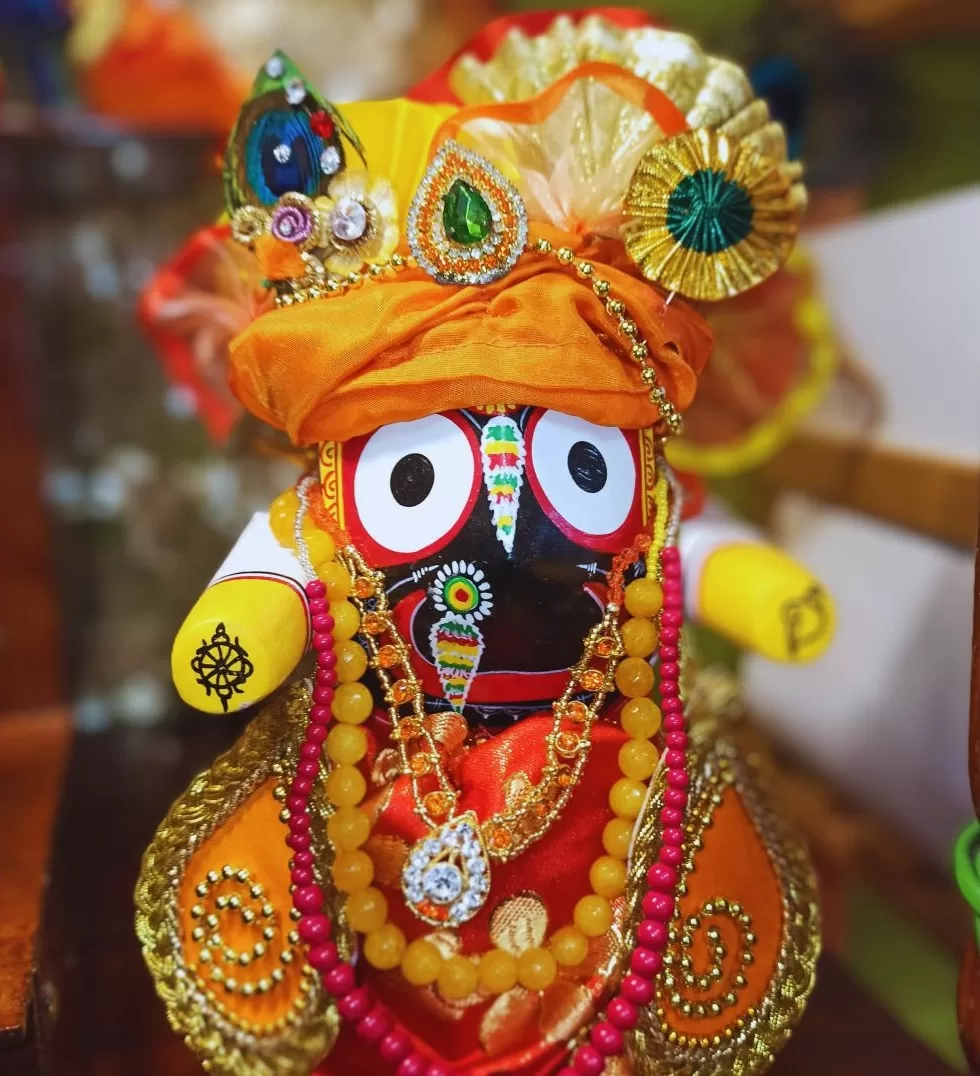

Hare Krishna, Here is Biography about Bhaktivinoda Thakura by Paṇḍita Sātkari Caṭṭopādhyāya Siddhānta-bhūṣaṇa (2 part)
- More Literary Productions
- The True State
- Foundation Of Namhatta
- Nam Prachar
- A Fitting Ceremony
- Other Works
- Last Days In Nadia
- Residence Of Puri
- Renunciation
- A Sanyasi
- A Paramhamsa, Four Years In Samadhi
- The Great Ascension
- A Suitable Memorial
- A Social Benefactor
- A Political Thinker
- A Saint In Morals
- A Great Literateur
- List of Works
More Literary Productions
From Barasat, he was transferred to Serampore. Here he composed and published his masterly writing “Sri Chaitanya Mahaprabhu”. In 1883 he received in English the work “Nityarup Sangshapanam”. By Pandit Upendra Mohan Goswami which he published in an extra English issue of the Sajjan-toshani. This work has tried to prove the eternal spiritual form of the Diety. The reviewer translated the following slokes which created a short thrilling sensation in his heart.
Let crowded sins repeat my trial scenes!
And lead me on from woe to woe!
Care I for that? If Love of God alone!
Would bless my heart wherever I go!
The Holy seat of love is Vrindavan,
Where matters laws have no domain!
Ah! when my painting soul shall find its rest!
In that eternal real again!
He closed the review by giving table showing the general ideas of God explaining how man in his progression from gross nature to pure spirit has to pass through these ideas. In 1883 he started in the heart of Calcutta a society under the name and style of Sri Bishwa Vaishnava Sabha for the propagation of Pure Hari Bhakti. Many eminent persons in the city joined this society whose sittings were in Sarkar’s Lane, and committees were formed with assigned duties. As he was anxious to visit the land of his Lord he was trying for a transfer to the head-quarters of the Nadia District, to gain this end he declined to accept the offers of the Personal assistantship to, the Chief Commissioner of Assam and the office of the Minister of Tiperrah State, both the offices bearing a very high emolument for any Indian officer of his time. Such was his eagerness to see the birth place Of Sri Chaitanya Mahaprabhu that he even applied to Government for pension with a view to retire from the service, but his application was not accepted. Thus failing in his effort to be relieved of his official duties, he at last arranged for a mutual exchange with another officer of his position to go to Krishnagar, and he effected this in December 1887 to his great rejoicing. Having once been stationed at a place close to Nabadwipa, he did not allow any holiday to pass without making a local enquiry of the different Lila-kshetra of Sri Sri Chaitanya Mahaprabhu. It was to his great astonishment that he found the present site of Nabadwipa to be a town of less than a hundred years standing and there were people still living then who declared that in their boyhood they re-moved to this new town from the old site which was at Bablaari. He at once commenced a vigorous enquiry to find out the truth of the matter but could not easily escape from the hands of the people of the place who tried to make him believe that ‘the birth-place of Chaitanya was at that town; but on careful enquiry they came forward to convince him that the birth place was lost in the bed of the Ganges. Not satisfied with this explanation he himself set out to discover the Yogpitha. After experiencing great difficulties he came to know a place which was being adored by Siddha Babajis as true birth place of Sri Chaitanya Mahaprabhu and which was then in possession of Muhammadans.
The True State
Local enquiries from the Muhammadan population and corroborative statement from the quinquennial map of the time of Gunga Govinda Singh (16) showing the name of “Sri Mayapur” at last helped him to discover the real site of the birth place. The result of the enquiry led to the production of his valuable work “Nabadwipa Dhama Mahatmya.” As he was not keeping good health at Krishnagar he requested the Government to transfer him to a good healthy station, and he was moved early in 1889 to Netrokona and Tangail where from he came to Burdwan and for a time to the and the Kalna Sub divisions.
(16) Gangagobinda Singh-Naib Diwan of the Khalsa and the founder of Paikpara Raj family. Flourished in the latter part of the eighteenth century.
Foundation Of Namhatta
During his stay at Kalna he, with a view to settle in Nadia after his retirement, acquired by purchase a plot of land at Sri Godrooma Dwipa, commonly known as Swarapganj, where he established Namhatta in 1890. The next year when he was transferred to Dinajpur he took up writing annotation of Srimad Bhagabad-gita with the commentaries of Sri Baladeva Vidyabhushan and published it.
Nam Prachar
In 1891 he took furlough for two years with the object of preaching Harinam to mankind for their welfare and worked for Namhatta at Sri Godrooma. Many branches were also opened in different centres in various districts of Bengal to preach Harinam regularly, and the name of God rang loudly where in the ears of the people. It was a grand object and it proved a great success for the tide continued for many years, even long after the period he was called back by Government to do the responsible public duties and when he could himself devote little attention to his own mission, in spite of his strong desire to do so.
During this period he undertook to write annotations of Sri Chaitanya Charitamrita, in which work he put his hands sometimes in 1886 at the special request of the well-known patron of learning, Srijukta Rai Yatindra Nath Chaudhuri, M. A. B. L. Zamindar of Taki, but could not complete it at that time. Now the work was complete, within a short time and the publisher was able to put in the market the best authoritative edition of that work. In April 1883 at the request of Sir Henry Cotton the then Chief Secretary to the Government, he rejoined the office at Sasaram where he had to tide over political difficulty, which then appeared in the province, in quelling disturbances which arose out of animosity between the Hindus and the Muhammadans for killing cows by the latter. He had to try that case under trying circumstances but finally he obtained thanks from the Lieutenant Governor and was reposted to Krishnagar during the cold weather of that year.
The next year was a memorable year in the history of the Vaishnava world, and Thakur Bhakti-Vinode was the prime-mover of the event which recorded in golden characters in the history of Vaishnavism in India.
A Fitting Ceremony
It was in this year that the birth place of Sri Chaitanya Mahaprabhu, which was up for lost, by the world for many generations and which was discovered with great difficulty by Thakur Bhakti-vinode, came to light and was commemorated. Thousands of visitors were present at the spot on that eventful day and the gathering was no less but even greater than the congregation which met at Kheturi some 400 years ago. Just after his retirement from Government service Thakur Bhaktivinode went from to door, in a spirit of perfect humility with a view to giving this enterprise a firm footing. What did the “Amrita Bazar Patrika” say of him in their daily issue of the 6th December, 1894?
“Babu Kedar Nath Dutt, the distinguished deputy magistrate who has just retired from the service is one of the most active members. Indeed, Babu Kedar Nath Dutt has been deputed by the committee to raise a subscription in Calcutta and elsewhere and is determined to go from house to house, if necessary and beg a rupee from each Hindu gentleman for the noble purpose. If Babu Kedar Nath Dutt, therefore really sticks to his resolution of going around with a bag in hand, we hope, no Hindu gentleman, whose house maybe honoured by the presence of such a devout to Bhakta as Babu Kedar Nath Dutt, will send him away without contributing his mite, However humble it maybe, to the Gaur Vishnupriya Temple fund”.
Truly Thakur Bhakti-Vinode honoured the houses of many persons for the fulfilment of the noble object undertaken by him. He went to such persons to whom he would not have gone but for this mission, as he had himself plenty, to live on and spend his days in the devotion of God with as good a position as any worldly man of honour can have. His labour was not without its fruits and sum which he raised, contributed much to the erection of a pucca structure on the holy spot at Sri Mayapur. The institution which he started at the Yogapitha has been a great boon to the world and is now maintaining its own position by public subscription, with H. H. The Maharaja of Tippera, at the head.
Other Works
The work of Nam Prachar was also in full swing and it spread fast into the distant corners of the globe. The Smaran Mangal Stotra with preface in English containing the life and precepts of Sri Chaitanya, came out from his pen soon after and found its place in all the learned institutions of both the hemispheres. The following remarks appeared in the Journal of the Royal Asiatic Society, London:
“Under the title of Sri Gauranga Lila Smarana Mangal Stotram, the well known Vaishnava Sri Kedar Nath Bhaktivinode, M. R. A. S. has published a poem in Sanskrit on the life and teachings of Chaitanya. It is with a commentary, also in Sanskrit, in which the subject further elucidated is preceded by an introduction of 63 pages in English in which the doctrines taught by Chaitanya are set out in somewhat full detail; this position more especially as against Shankar and the Advaita Vedantists, is explained at length. The little volume will add to our knowledge of this remarkable reformer and we express our thanks to Bhaktivinode for giving it to us in English and Sanskrit rather than in Bengali, in which language it must necessarily have remained a closed book to European students of the religious life of India.”
The above remarks produced, on its publication, a great effect on the mind of many educated and enlightened persons, and shortly appeared several editions on the life of Chaitanya in English. Of these the “Lord Gauranga” by our ablest follower, Shishir Kumar Ghose, was appreciated by the people and even distant America hailed it with rejoicing. Thakur’s “Life and Precepts of Chaitanya” though in itself a little bit of work, continued to be admired by the western thinkers and writers. This is evident from the following comments made in discussing the claims of the mighty reformer of Nadia to a universal place, by that erudite scholar Mr. R. W. Frazer, late of the Madras Civil Service:
“Five Hundred years have passed away since the time Chaitanya spread a faith in the saving grace of Krishna throughout the land, nevertheless down to the present day, the same spirit that inspired Chaitanya continues still to dwell among his followers. In an interesting account of the life and precepts of Chaitanya lately published by his devout and aged follower, Sri Kedarnath Dutt Bhaktivinode, it can be read how this spirit preserves its vitality undiminished amid the changes that are sweeping over the land. This exponent of the hopes of the present followers of the teachings of Chaitanya declares his firm faith, that from a devoted love to Krishna, a love like that of a girl for a loved one, shown by constant repetition of his name, by ecstatic raputerus, singing, calm contemplation and fervours, a movement will yet take place to draw to the future church of the world, all classes of men, without distinction of caste or clan to the highest cultivation of the spirit. This church it appears, will extend all over the world, and take the place of all sectarian churches, which exclude outsiders from the precincts of the mosque, church or temple. The spirit that is to animate this new church is to be founded on the principle that spiritual cultivation is the main object of life. Do everything that keeps it and abstain from doing anything which thwarts the cultivation of the spirit. A devoted love to Krishna is to be the guiding light as preached by Chaitanya. Having a strong faith that Krishna alone protects you and none else. Admit him as your only God can do everything which you know Krishna wishes you to do and never think that you do a thing independent of the holy wish of Krishna. Do all you do with humility. Always remember that you are a sojourner in the world and you must be prepared for your own home. The simple piety of this latest preacher of the teachings of Chaitanya holds that Chaitanya showed in his character, and preach to the world, the purest morality as an accompaniment of spiritual improvement. Morality as a matter of course will grace the character of a bhakta (one who has faith). The perplexing question of idolatry receives its usual explanation in the following manner: those who say that God has no form, either material or spiritual and again imagine a false form for worship are certainly idolatrous. But those who see the spiritual form of the deity in their souls eye, carry that impression as far as possible to the mind, and then frame an emblem for the satisfaction of the material eye, for continual study of the higher feelings are by no means idolatrous”. (A Literary History of India pp.349–51)
The more the name of Chaitanya with that of Hari was preached, the merrier was our Thakur. He thereafter made annotations of the “Sri Brahma Samhita”, the “Sri Krishna Karnamrita” and gave to the world his immortal and most precious works “Sri Hari Nam Chintamani” and “Sri Bhajan Rahashya”. He also edited, with annotations “Srimad Bhagabatarka Marichimala” containing – all the slokas of the Srimad Bhagabata pertaining to the Vaishnava philosophy. His pen was never tired and produced other Vaishnava philosophical works. He also made annotations and translations of many works written by Goswamis. Most of his works were published in his well-known periodical “Sajjan-toshani”. As on the one hand, he was busy with his pen, so on the other, he was equally engaged in preaching Harinama and Vaishnava philosophy by making circuits of several districts. His personal appearance in the villages produced marvellous effects on the people who showed little scruple in believing the noble doctrine preached by him.
Last Days In Nadia
To maintain the Nadia centre he built a house at Sri Godrooma which he styled “Sri Swananda Sukhada Kunja”. Here in this abode the preaching of Harinam continued in full swing.
Residence Of Puri
It was in the beginning of the present century that he chose to live at Puri and built a house on the sea beach there. Though this place is the most sacred one in India in the eyes of the Hindus on account of its being the seat of Jagannath, godless persons can be found here in any number. Such impious men tried to disturb our Thakur but happily their efforts proved futile. Many good souls got spiritual inspirations from him and were saved.
Renunciation
Men with honesty of purpose sought his blessing which they readily obtained and when he retired to the fourth or the last stage of life by abnegating the world in 1908 he entertained the solicitations of several persons whom he made his disciples. Among these the most note-worthy was Babaji Krishnadas who was admitted to be our Thakur’s constant attendant and to serve him in all respects till the last day.
A Sanyasi
Though he was leading the life of a Sanyasi he could not avoid men of all descriptions who constantly visited him; but we dare say none of them had to return without receiving his blessings.
A Paramhamsa, Four Years In Samadhi
Seeing that his works were complete, he shut himself up in 1910 and spent about four years in the perfect state of Samadhi. These days were very happy for him as he could thus shun the turmoil and bustle which are the concomitant parts of human life in the material world.
The Great Ascension
Thus having satisfied himself that his mission bore at least some good to the world, he passed away for the eternal bliss of Golaka, by casting a gloom on the Vaishnava world, on the day of the commencement of the Dakshinayan in 1914, according to the solar calendar, and the day which is observed by Vaishnavas as one on which Sri Sri Gadadhar made his disappearance in the calculation of the lunar calendar. His absence was deeply felt by all true bhaktas at first but when they found that they were unceasingly carrying his holy influence with them, since his departure, they no more had any cause of sorrow. Here we quote a stanza written by our Thakur sometime in 1871 on the samaj of Haridas on the seashore at Puri, to explain what influence a Vaishnava carries in this world even after his departure from it:
“He reasons ill who tells that Vaishnavas die
When thou art living still in sound!
The Vaishnavas did to live and living try
To spread a holy life around“
Our Thakur’s immortal work will no doubt spread around a holy life for the human welfare. As the Dakshinayan fell in, his samadhi ceremony was naturally delayed till the Uttarayan came when his last remains were placed at his Nadia seat, “Sri Sri Swananda Sukhada Kunja,” in the midst of Sankirtan made by his disciples.
A Suitable Memorial
It was a pleasant clear day and a grand Vaishnava mahotsbab was held with the greatest solemnity in which thousands took part and our Thakur’s presence amidst them was perceived by all. On that day a committee was constituted under the style of ”Sri Thakur Bhakti-Vinode Memorial-Committee” with the object of undertaking the following:
The construction of a suitable Samadhi temple.
2. The publication of his complete philosophical works.
3. The circulation of the precepts and teachings of Sri Chaitanya Mahaprabhu which prepared the way of all devotees for the attainment of spiritual existence, this being the sole aim and end of our Thakur’s life and the maintenance of the spiritual institutions established by him.
4. The establishment of a chair for the teaching of the deep philosophy of the school of Sri Chaitanya Mahaprabhu.
It is now the business of the Committee to fulfil the above objects with the utmost sincerity and it is expected fervently that the aid and cooperation of all persons having noble views and generous hearts for the spiritual welfare of their brethren will not be withheld. Having got glimpse into the life of the saint we may now see his character from various aspects and study him from social, political, moral, literary and religious points of view.
A Social Benefactor
Thakur Bhakti-Vinode as a social man has shown to the world the true interpretation of the aphorism “Society friendship and love.” Divinely bestowed upon man,” by his personal example. As a social man he left no stone unturned to alleviate the position of his own people in society and was the first and foremost to open the eyes of countrymen to see the hidden passages in the Shastras relating to society in India. He was a great lover of his own people as of others and spent a large sum of money and devoted much of his valuable time in publishing a genealogical table of the family to which he belonged, with a descriptive account of his forefathers and of his race in general in plain Sanskrit verse. Here he had to meet opposition from unscrupulous persons, but the arguments set against his writing having no foundation on the Shastras and merely based on unreliable sources, were of no avail and finally he won the day when the Bangadeshiya Kayastha Sabha followed the line of his argument about a dozen of years ago. He was never a miser in showing respect to the Brahmans and always held that esteemed class with that amount of veneration which is to be found in any other man of honour among the Hindus. It was never heard that any Brahman ever went away from him disheartened; and he who once called on him, was sure to be seen meeting him again with a smiling face. He equally befriended the other castes and especially when he preached Harinam every one however high or low he might have been, in society or in wealth was nearest and dearest to him. He had practically no enemy in the world. as he did not cherish any kind of animosity against others. Rather those who tried to be enemy out of jealousy or with a view to thwarting him from his righteous path, were in the long run ashamed of their conduct and in most cases craved his pardon which was never refused. His universal brotherhood made him the friend of the needy and he was ever eager for procuring the greatest welfare of the people of the world. Whoever once came in contact with him, could not but go without some sort of good to himself. To speak of him in concise language is to call him an ideal man in society. He was never proud and his amiable disposition was a characteristic feature in his life. He never uttered any word to any body, which wound one’s feeling. He did not chastise any one unless and until he was perfectly confident that he had a right over him to do so for his welfare, and on the other hand he who received a warning from him always thought himself gratified. He had not the least shadow of vanity and was totally devoid of quarrelling habit. Being a scion of an opulent and well-known ancient family of Calcutta and having held an office of position and good emoluments, under the benign Government, he was not wanting in friends and acquaintances among men of light and leading throughout the length and breadth of Bengal, Bihar and Orissa. His profound knowledge of philosophy endeared him to all educated men and his devout bhakti made him the friend both of the highest and the poorest classes of people.
A Political Thinker
Thakur Bhakti-Vinode as a political man – we cannot say that our Thakur was ignorant of politics and that he only restricted himself to the fringed area of religion. He meddled in politics since the days of his youth, and was ever a staunch supporter and admirer of the British rule. In his official capacity he was always taken into confidence by the superior officers of Government, as he was himself well Conversant with the policy of Government. He had witnessed the hard days of the mutiny and while in office, he assisted the Government in quelling all sorts of unprincipled disturbances and especially rendered the most valuable assistance in suppressing a general rise of the Oriyas under one Bishikishan in most trying circumstances and regardless of his own life. His administrative ability was marked even by the ruling chief of Tippera. His Highness Maharaja Birchandra Manikya Bahadur and his son H. H. Maharaja Radha Kishore Barma Manikya Bahadur always esteemed his counsels on political matters and respected him as a friend and an honorary adviser of the state. The Government of Bengal also on more than one occasion wanted to vest him with honours and titles but he humbly declined the same each time on the ground that such honours would, instead of doing good, stand against his holy mission. Even so late as 1897, when the epidemic known as plague raged furiously in the heart of Calcutta, his advice was valued and adopted by Sir John Woodburn. Our Thakur never swerved from the path of duty entrusted to him by the Government and had ever been a loyal, faithful and devout public servant.
A Saint In Morals
Thakur Bhakti-Vinode as a moral man — Never was a man found more strict in the observance of the moral duties than our Thakur. From his very infancy till his last day he was a great advocate of truth and never allowed his associates to deviate from the path of duty, which he himself observed with more than strict accuracy. He avoided companies whenever he had the least suspicion of evil motives in them and never harboured them so long they did not come to repentance. He had to encounter unpleasantness on many occasions in the execution of public duty under the Government, by refusing to accept any present from any person. Similar difficulties he had to face in refusing unjust requests from persons though they were nearest and dearest to him. He was above corruption. He never supported the least shadow of immorality and never crossed the threshold of any place which he knew to be immoral. He had great dislike for theatres as these were places where public women were brought in to take part in the play. He knew that common people, who cared little for religion and who had generally happy-go-lucky days to spend, were apt to go astray in the broad wilderness of the world if he himself refrained from showing them the proper way by his own example. Example is better than precept and so his absolute distaste for anything immoral helped many good souls to open their eyes and also persons already in confusion to correct themselves. When the well-known dramatist, Girish Chandra Ghosh, came to request him for presiding over the gathering on the opening day of his well-known play “Chaitanya lila”, he had to politely decline the offer. He was a complete abstainer and a perfect teetotaler and never chewed even a betel. In other words he was completely devoid of luxury which is everyday enjoyed by ordinary men. He had for him very little want and led most simple life throughout his career. The word “debt” was, as it were, unknown to him and he was very prompt in making payments. He was always true to his word, and punctuality was at all times specially observed by him. He always showed a brave front in every thing and was never a coward. He never countenanced any underhand work in business, and whatever he did, he did openly for the good of his fellowmen. We may without hesitation call him morality incarnate, as his was an exemplary character. He came to the world with a moral obligation to it and on his passing from it, he fully repaid that obligation.
A Great Literateur
Thakur Bhakti-vinode as a literary man – For the brain was the main food of his life. Literary habit he had from his very early age. Before he was eighteen he was author of, “Poriade” a work in English verse describing the wanderings of Porus who met Alexander the Great in pre-Christ days. The Style and rhyme in which those books were written, were very lucid and clear and most melodious. His earlier writings appeared in the “Literary Gazette” and the “Hindu Intelligencer“. Even the clubs and the British Indian Society found him, in the fifties, discussing various subjects. Before he was twenty five came out from his pen two Bengali poems “Vijanagram” and “Sanyasi” which were composed in a style which enabled Byron to eclipse Scott. The rhyme and style in which these two books were written showed a complete departure from the then existing mode of writing and it gave birth to a new way of writing poetry in the Bengali language. Before he was thirty, he delivered long speeches, of one on “The Bhagabat” in English at Dinajpur, drew the mind of many enlightened persons to the philosophical teachings inculcated in that mighty book. A Sanskrit work entitled Datta Kaustuva, a treatise on philosophy, came to light soon after. He also prepared an Urdu translation of the Manual of the Registration Department which was gladly accepted by the Government and circulated throughout the United Provinces of Agra and Oudh. He wrote at that time a few other works assuming the name of Sri Sachchidananda Premalankar, and these books, we know had a huge circulation. A few years after he styled himself as a Saragrahi Vaishnava and contributed much to the Vaishnava literature under that style. A specimen of his writings of that period can be seen from the following stanzas:
Alas, for those that spend their days
In festive mirth and joy!
The dazzling deadly liquid forms
Their heart for ever employee!!
The shining bottles charm their eyes
And draw their hearts embrace!
The slaves of wine can never rise
From what we call disgrace!
Was man intended so to be
A brute in work and heart?
Should man the Lord of all around
From common sense depart?
Man’s glory is in common sense
Dictating us the grace,
That man is made to live and love
For thee thy sire on High has kept
A store of bliss above,
To end of time, thou art, Oh! His
Who wants but purest Love.
Oh love! Thy power and spell benign
Now melt my soul to God!
How can my earthly words describe
That feeling soft and broad!!
Enjoyment-sorrow,-what but lots
To which the flesh is heir?
The soul that sleeps alone concludes
In them it hath a share!!
Ah then! my friends no more enjoy
Nor weep for all below: –
The woman, wine and flesh of beasts
No love on thee bestow
But thine to love the brother man
And give thyself to God,
And God doeth know your wages fair;
This fact is true and broad!!
Forget the past that sleeps, and never
The future dream at all,
But act in times that are with thee
And progress the shall call!!
But tell me not in reasoning cold,
The soul is made alone
By earth’s mechanic, lifeless rules
And to destruction prone!
My God who gave us life and all
Alone the Soul can kill,
Or give it all the joys above
His promise to fulfil!
So push thy onward
March O Soul!
Against an evil deel
That stands with soldiers-hate and lust!
A hero be indeed!!
Maintain thy post in spirit world
As firmly as you can,
Let never matter push thee down,
O stand heroic man!
Sharagrahi Vaishnav soul!
Thou art an angel fair;
Lead, lead me on to Vrindavan
And Spirit’s power declare!!
These rests my soul from matter free
Upon my Lover’s arms,
Eternal peace and Spirit’s love
Are all my chanting charms!!
The above stanzas not only show us how melodious were the writings of our Thakur but they do something more. Each line in the above stanzas is fully fraught with ideas conveying a world of philosophy. These lines are very simple in appearance but practically not so to a man of meditation. They not only throw light on morality but help people to make progress in the spiritual world too.
List of Works
A list of works of him which we have already seen is given below in chronological order of their publication.
1850 – HARI KATHA, (Bengali verse)
1851 – BATTLE BETWEEN ADYASAKTI AND SHUMBHA & NISHUMBHA, (Bengali verse)
1855 – Contributions of articles to the Periodicals and Magazines commenced from this year
1857 – PORIADE, BOOK I (Book in English)
1858 – PORIADE BOOK II (Ditto)
1860 – MATHS OF ORISSA, (Prose in English) |
1863 – VIJANAGRAMA, (Poem in Bengali), SANYASI, Ditto, OUR WANTS, (Prose in English)
1866 – BALIDE REGISTRY, (in Urdu), SPEECH ON GAUTAMA, (Prose in English)
1869 – SPEECH ON BHAGABAT, (Prose in English)
1870 – GARBHA STOTRA VYAKHYA or Sambhandhatatwa Chandrika, (in Bengali Prose)
1871 – REFLECTIONS, (Poem in English) Stanzas on the samaja of Haridas on the Sea-shore at Puri and several pamphlets in English such as “The Temple of Jagannath at Puri” and “The Akhras in Puri” &c.
1874 – DATTA KAUSTUVAM, (A philosophical work in Sanskrit)
1876 – DATTA VAMSHA MALA, in Sanskrit slokas and a geneological table of the Datta family of Bali Samaj
1878 – BUDDHA VIJAYA KAVYAM, in Sanskrit verse (incomplete in MS)
1880 SRI KRISHNA SAMHITA, (in Sanskrit slokas with introduction, translation and the slokas and conclusion in Bengali)
1881 – KALYAN KALPATARU (in Bengali verse),
SAJJANA TOSHANI, (A monthly periodical in Bengali: began to be published from this year. There are 17 volumes of this work).
1883 – Review of Nitya Rupa Samsthapanam (in English Prose)
1886 – Srimad Bhagabat-gita with commentaries of Shri Bishwanath Chakravarti, his annotation Rasika Ranjana in Bengali.
Sri Chaitanya Shikshamrita (in Bengali Prose).
Shikshastaka, his Sanskrit annotation “Sanmodan”
Manas-shika, his translation in Bengali Poetry.
Bhabali, with his Sanskrit annotation
Prema Pradipa (a philosophical novel in Bengali Prose.
Edited by Sri Vishnu Sahasranama with commentaries of Sri Baladev Vidyabhushan.
1887 – Edited Sri Krishna Vijaya by Gunaraj Khan,
Sri Chaitanya Upanishad with his Sanskrit annotation
1888 – Vaishnava Siddhanta Mala in Bengali
1890 – Srimad Amnaya Sutram in Sanskrit with his own annotation in Bengali,
Sri Navadwip Dhama Mahatmya (in Bengali poetry)
1891 – Srimad Bhagabad-gita with commentaries of Sri Baladeva Vidyabhusha, his annotation Bidwat Ranjana in Bengali.
Started the work of Namhatta for preaching Harinama by lectures and etc., and published in transactions in Dramas of which five pamphlets came out one after another.
1892 – Being the guts of Vaisnava Siddhanta Mala published in connection with the work of Namhatta – Hari-nama, Nama, Namatattwa Shikshastaka, Nama Mahima, Nama Prachara
SRI MAHAPRABHU’S SHIKSHA-In Bengali prose
1893 – TATTWA-VIVEKA- or Sri Sachidanandanubhuti in Sanskrit with his own explanations in Bengali.
SHARANGATI (in Bengali Verse)
SHOKASATANA Ditto
JAIBA-DHARMA (in Bengali Verse)
1894 – Tattwasutra-in Sanskrit with his own annotation in Bengali. Istopanishad- his own annotation “Vedharkadidhiti” in Bengali Tattwa Muktavali- or Mayavada Shatadushani, his translation in to Bengali.
1895 – Sri Chaitanya Chartamrita,- his Amrita Prabaha Bhasya in Bengali.
1896 – Sri Gauranga Smarana Mangala Stotram- in Sanskrit with the life and Prospects of Sri Chaitanya in English Ramanuja Upadesha- and ARTHA PANCHAKA, his translation into Bengali.
1897 – Sri Brahma-samhita,- his annotation “Prakashini” in Bengali.
Sri Kalyan Kalpataru (revised)
1898 – Sri Krishna Karnamritam- by Sri Billwamangala Thakur, his annotation in Bengali.
Sri Upadeshamritam-by Sri Rupa Goswami, his annotation Pijusha Varshini Vritti in Bengali.
Edited Madhwa Bhashya of Srimad Bhagabad-gita,
Sri Bhagabaddhamamritam-by Sri Sanatana Goswami, his annotation in Sanskrit and Bengali.
Sri Bhakti-Siddhantamritam-by Sri Sanatana Goswami, his annotation in Sanskrit and Bengali.
Sri Bhakti-Siddhantamritam-by Sri Sanatana Goswami, his annotation in Sanskrit and Bengali.
1899 – Sri Bhajanamritam-Sri Nrahari Thakur, his annotation in Bengali.
Nabadwipa Bhaba Tarangrini (in Bengali poetry).
Datta Vamsha Mala (thoroughly revised and enlarged)
1901 – Sri Bhagabatarka Marichinmala, his annotation in Bengali.
Sri Sankalpa Kalpadruma, his Bengali translation.
Edited Padma Puranam-(complete in Sanskrit).
1902 – Sri Bhajana Rahasya – in Bengali poetry with references of Sanskrit slokas).
Vijanagrama and Sanayasi (thoroughly revised)
1904 – Edited Satkriya Saradipika by Gopala Bhatta Goswami – a Vaishnava Smriti.
1905 – Sri Chaitanya Shikshamrita (thoroughly revised and doubly enlarged)
1906 – Edited Premabibarta by Jagadananda.
1907 – Swaniyanama Dwadasakam,-a voluminous work left unfinished.
Besides the works mentioned in the above list he wrote numberless articles in his own periodical “Sajjantoshani” as well as in other periodicals. He was also editor of the “Vishnupriya Patrika” when that saw the light. We can even trace many of his works, which are existing without any acknowledgement of his authorship. His pen was never idle and many a night saw him engaged in his library after he had performed a hard laborious midday duty in the office, which latter alone makes one easily exhausted. He had a fine mode of delivering speeches and his lectures were so greatly attractive that he could keep the audience, whatever be their number, absolutely dumb-founded. His speeches were all very fluent and argumentative from the philosophical point of view, and he had a nice way of joining the links of their subject matter.