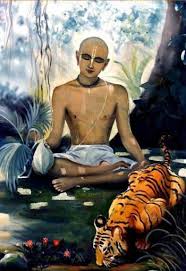
Hare Krishna, today article: Thakur Haridas (part 6) is from Bhaktisiddhanta Saraswati Prabhupada
Prayers
Śrī Guru-Praṇāma:
oṁ ajñāna-timirāndhasya
jñānāñjana-śalākayā
caksur unmīlitaṁ yena
tasmai śrī-guruve namaḥ
“I offer my respectful obeisances unto my spiritual master, who with the torchlight of knowledge has opened my eyes, which were blinded by the darkness of ignorance.”
Two important verses:
suna suna nityananda, suna haridasa
sarvatra amara ajna karaha prakasa
prati ghare ghare giya kara ei bhiksa
‘bala krsna, bhaja krsna, kara krsna-siksa’
“Listen, listen, Nityananda! Listen, Haridasa! Make My command known everywhere! Go from house to house and beg from all the residents, ‘Please chant Krishna’s name, worship Krishna, and practise what Krishna teaches.’” (Sri Chaitanya-bhagavat, 2.13.8-9)
harer nāma harer nāma
harer nāmaiva kevalam
kalau nāsty eva nāsty eva
nāsty eva gatir anyathā
“In this age of quarrel and hypocrisy, the only means of deliverence is the chanting of the holy names of the Lord. There is no other way. There is no other way. There is no other way.”
Mahā-mantra Hare Kṛṣṇa:
Hare Kṛṣṇa Hare Kṛṣṇa
Kṛṣṇa Kṛṣṇa Hare Hare
Hare Rāma Hare Rāma
Rāma Rāma Hare Hare
Thakur Haridas (part 6)
Journal ‘The Harmonist’ Edited by Śrīla Bhaktisiddhānta Sarasvatī Ṭhākura (No. 7, Vol. XXV, December 1927)
At the village of Chandpur situated at the confluence of the Triveṇī near Huglī there lived the multimillionaires Hiraṇya and Govardhana Majumadars who were the glory of the kāyastha community. They were the greatest friends and patrons of the brāhmaṇas resident at Navadvīpa. Raghunātha, son of Govardhana and heir of the two brothers, was at this time a mere child.
This great personage later became famous in the community of Vaiṣṇavas under the appellation of Śrī dāsa Gosvāmī. Śrī Ṭhākura Haridāsa on the occasion put up at the house of Balarāma Ācārya who was the family priest of the Chandpur Majumdars. Śrī Balarāma was a great pet of Ṭhākura Haridāsa and highly favoured by him. The saintly Ṭhākura occupied a lonely thatched hut of Balarāma’s house and received the prasādam of Kṛṣṇa at the house of Bhaṭṭācārya.
One day Balarāma took Ṭhākura Mahāśaya to the hall of public assembly of the Majumdars. The two brothers showed him every respect. Certain of the paṇḍitas who were present in the assembly asserted that the effect of sin is destroyed by the power of the Name, while several others held that by means of the Name freedom from misery is obtained. On hearing this Ṭhākura Haridāsa said that the destruction of sinfulness and emancipation from sorrows are not the results of the taking of the Name.
The Name is like the sun. Love at the feet of Kṛṣṇa is aroused on the appearance of the Sun of the Holy Name. As with sun-rise the fear of thieves, ghosts and demons is ended, the destruction of sinfulness is similarly an attendant circumstance on the appearance of the Name, and emancipation is another such secondary result, this later being comparable to the disappearance of darkness at sun-rise. The trivial fruit of freedom from misery is obtainable even from the dim reflection of the Name (nāmābhāsa).
Hearing those words of Ṭhākura Haridāsa a brāhmaṇa of the name of Gopāla Cakravartī, an employee of the Majumdars, whose official duty was to carry letters and cash and who happened to be present, flew into a rage and spoke with great chagrin, “Is it possible that freedom from misery which is not attainable in crores of births and not even by Brahmā, can be had, as this person affirms, by the mere dim reflection of the Name?” Haridāsa said, “Why do you entertain any doubt about it? The śāstras state that freedom from misery is the result of the dim reflection of the Name.”
The insolent brāhmaṇa, Gopāla, replied, “If it can be proved that there are no statements in the śāstras to the effect that emancipation is the result of the dim reflection of the Name, would you lay wager that you will cut off your own nose?” Haridāsa signified his cordial agreement even to such a proposal. But the better-informed persons in the assembly, and even the Majumdars themselves, were very much pained and humiliated by the behavior of Gopāla. Śrī Balarāma Ācārya sharply rebuked Gopāla for insulting a sādhu. The Majumdars dismissed Gopāla from their service for his offensive conduct against the great saint.
Ṭhākura Haridāsa without being sorry at such discourtesy said, “Gopāla has done no wrong. He is ignorant and his mind is given to casuistry. By the methods of casuistical argument the glories of the Name cannot be known. I have no desire that anybody should be sorry because of me.” Although the great devotee Haridāsa was in every way prepared to forgive Gopāla, God did not allow him to escape the punishment of his offence.
Before three days had passed Gopāla was afflicted with leprosy. The prominent nose of Gopāla became the special seat of the foul disease. The fingers of his hands and feet shriveled up. By this event all the people of the locality were filled with astonishment. Ṭhākura Haridāsa returned again to Śāntipura.
After some time Ṭhākura Haridāsa journeyed to East Bengal. At the village of Harinadī he came across a very rude brāhmaṇa who behaved most insolently towards him. At the present day there is a village of the name of Harinadī in the District of Jessore. In Barisal there is another well-known village of the same name. We are unable to decide which of them was the village to which Ṭhākura Mahāśaya paid this visit. The brāhmaṇa in question opposed the kīrtana of Ṭhākura Haridāsa which the Ṭhākura used to chant with a loud voice.
The idea of the brāhmaṇa was that one who chanted the Name performed the function of the Guru and such function was the monopoly of the brāhmaṇa caste. He had heard that Ṭhākura Mahāśaya was sprung from a non-Hindu yavana family. He pretended to think that if the Name of God uttered by the Ṭhākura’s mouth ever reached his ear-holes the latter’s observance of the rules of varṇāśrama would thereby be rendered impossible.
This embodiment of arrogance born in the brāhmaṇa caste, therefore, presenting himself before the Ṭhākura said, “Mantras have to be repeated mentally. Who taught you to take the Name of Hari loudly against the rules of the śāstras? I ask you to make a proper answer publicly before an assembly of paṇḍitas.”
Haridāsa replied, “I have learnt the truth regarding the Name of Hari from the lips of paṇḍitas such as yourself. I am telling you what I have heard. The śāstras say that he who chants the Holy Name loudly is a hundred times worthier than one who repeats the Name mentally. As a matter of fact the śāstras highly praise him who chants the Name with a loud voice.” The brāhmaṇa being dissatisfied with these words of the śāstras asked for the reason of such śāstric injunctions.
Haridāsa rapt in Kṛṣṇa-bliss continued, “Listen, brāhmaṇa. By hearing only once the Name of Kṛṣṇa, animals, birds and insects attain the blessed region of Śrī Vaikuṇṭha. He who repeats the Name of Kṛṣṇa in a low tone does good only to Himself; but he who chants the transcendental Name with a loud voice benefits all the hearers of the world. It is for this reason that in estimating the effect, the chanter of kīrtana with a loud voice has been held worthier than the mental reciter.”
The brāhmaṇa on hearing this argument and the statements of the śāstras was maddened with anger and began to utter foul words against the Ṭhākura. “It is,” he said, “a proof of the special sanctity of this Age that Haridāsa born in a non-Hindu yavana family is the expounder of the Veda and philosophy. When such perversion of manner is to be found even at this beginning of the Age of Evil there is no knowing what profane absurdities will occur in the future. You loiter from door to door and feast on sumptuous dishes. If the explanation offered by you turns out to be false your nose and ears should be cut off.”
The magnanimous saint relapsed into silence at these words and as he was leaving the place began loudly to chant the saṁkīrtana of Hari. The śāstras mention endless torments at the hands of Yama (the upholder of the Divine Law) of those paṇḍitas who have the nature of rākṣasas.
They are severely denounced by all godly persons and are shut out of the community of the good on account of their aversion to Viṣṇu in lieu of their endeavor to secure praise as so-called brāhmaṇas by their hostility to Vaiṣṇavas. Although Ṭhākura Haridāsa did not mind the insult that was offered by this sinful brāhmaṇa, yet by the severe decree of Providence the nose of the brāhmaṇa fell off due to an attack of small-pox. By hostility to Vaiṣṇavas the Vaiṣṇava does not suffer in any way; but on the contrary great harm befalls the enemies of the Vaiṣṇavas.