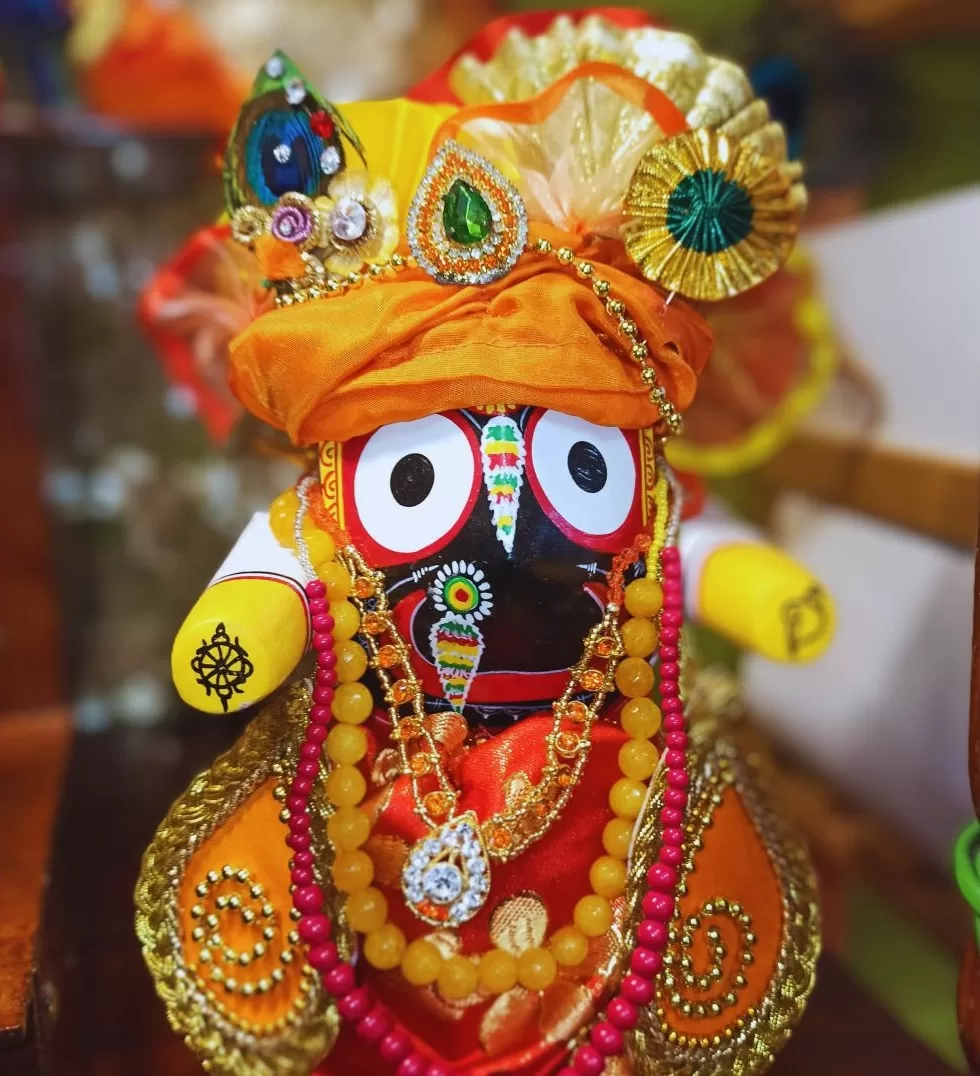

Hare Krishna, in Thuesday (4.2) we have here appearance day of Srimad Advaita Acharya (plenary expansion of Sri Maha Vishnu)
Because Advaita Acharya worshipped the Supreme Lord Krishna, at his request he appeared in this world in the form of Lord Caitanya Mahaprabhu and it is only by his grace that we have the opportunity to participate in the chanting of the holy names, the Hare Krishna Mahamantra, the sankirtana movement.
Advaita Acharya ki JAYA
Biography is from site: www.shyamdasbaba.com
vraje avesha-rupatvad vyuho yo api sadashivah
sa evadvaita-gosvami caitanyabhinna-vigrahah
Sadashiva, an expansion of the supreme lord in Vraja, is here known as Advaita Acharya. He is non-different from Chaitanya.
(Gaura-ganoddesha- dipika 76)
yash ca gopala-dehah san vraje krishnasya sannidhau
nanarta shri-shiva-tantre bhairavasya vaco yatha
ekada karttike masi dipa-yatra-mahotsave
sa-ramah saha-gopalah krishno nrityati yatnavan
nirikshya mad-gurur devo gopa-bhavabhilashavan
priyena nartitum arabdhash cakra-bhramana-lilaya
shri-krishnasya prasadena dvi-vidho abhut sadashivah
ekas tatra shivah sakshad anyo gopala-vigrahah
In Vraja, he took the form of a cowherd boy and danced alongside Krishna. This is stated by Bhairava in the Shivatantra: Once, during the Divali festival in the month of Kartik, my guru Shankaradeva saw Krishna dancing with Balaram and the cowherd boys. He became desirous of becoming a cowherd boy himself and he began to dance, spinning like a whirling wheel for Krishna’s pleasure. Thus, by Krishna’s mercy, Sadashiva plays two different roles in Vraja, in one he is Shiva himself, in the other, he is a cowherd boy.
(Gaura-ganoddesha-dipika 77-80)
Advaita-tattva
In Chaitanya Charitamrita, Krishnadas Kaviraj quotes the following evidence from the diary of Svarupa Damodar to describe the ontological principle of Advaita Acharya:
maha-vishnur jagat-karta mayaya yah srijaty adah
tasyavatara evayam advaitacarya ishvarah
advaitam harinadvaitad acaryam bhakti-shasanat
bhaktavataram isham tam advaitacaryam ashraye
Mahavishnu is the master of the universe, which he creates through his power of Maya. Advaita Acharya is the incarnation of this form of the supreme Lord. He is known as Advaita because he is none other than Hari, as Acharya because he is the preceptor of devotion. I take shelter of the supreme Lord Advaita Acharya who is the incarnation of a devotee.
(Chaitanya Charitamrita 1.1.12-13)
Srila Bhaktivinoda Thakur has written, Maya has two functions, and Maha Vishnu appears in two ways according to those functions. When he is within the material world as creator, he is the universe’s effective cause (nimitta-karana) in his form as Vishnu. In the unmanifest material energy (pradhana), appearing in the form of Rudra, he has a second identity as Advaita.
Bhaktisiddhanta Saraswati Goswami Thakur has also written about Advaita Acharya in his Anubhashya to Chaitanya Charitamrita 1.6.12: Lord Advaita Acharya is Maha Vishnu. He is the supreme preceptor. Vishnus activities are auspicious because of his existence as the owner or master of the universe. He is the root source of all auspiciousness. Anyone who cannot understand that the complications which are ever-present in the material universe are beneficial in a way which is pure, eternal, complete and free is deprived of his true spiritual activity, devotion to Krishna.
Advaita Acharya was also known as Kamalaksha:
The well-being of the universe is in Advaita. He is the abode of all auspicious qualities. His activities are the eternal source of welfare for the world, so he was given the name Mangala Advaita, the abode of virtue, is a portion (amsha) of Mahavishnu; his full name is thus Advaita because he is not different from him. He is the noblest personality in the universe, the spiritual master of the Vaishnavas; he thus has two names which come together as Advaita Acharya. Because in appearance he has eyes like lotus flowers, he also has the name Kamalaksha.
(Chaitanya Charitamrita 1.6.12, 26. 30-31)
Vrindavan Das Thakur has also described Advaita as both the foremost of the Vaishnavas and as Shankara:
Residing in Nabadwip is the foremost of the Vaishnava, the most fortunate of all people, Advaita Acharya. He is the chief amongst the gurus in knowledge, devotion and renunciation. He especially teaches devotion to Krishna in the same way that Shankara did.
(Chaitanya Bhagavat 1.2.78-9)
Advaita’s Appearance
Advaita Acharya appeared in the village of Navagrama near the city of Sylhet as the son of the Varendra Brahmin Kubera Pandit and his wife Nabha Devi, on the seventh day of the waxing moon in the month of Magh. Kubera Pandit is identified in the Gaura-ganoddesha-dipika (v. 91) with the original god Kubera, who was Mahadevas friend and leader of the Guhyakas.
Kubera Pandit, a devotee of Nrisingha, resided in the village of Navagrama near Sylhet in Bangladesh. He was a greatly fortunate follower of the path of devotion; he knew nothing other than the lotus feet of Krishna. His devoted and faithful wife was named Nabha Devi. She is worshipable to the whole world for she is the mother of Advaita Prabhu.
(Bhakti-ratnakara 5.2041-3)
On the seventh day of the waxing moon in the month of Magh, the great ocean of joy overflowed. In that auspicious moment, the moon of Advaita descended in the blessed womb of Nabha Devi. In his ecstasy, Kubera Pandit gave in charity to the Brahmins and the poor. He tiptoed to the birthing room and his heart was filled with gladness upon seeing his son’s face.
All the villagers came running to his house and said to each other, What pious works did this Brahmin do that in his old age he has been blessed with such a jewel of a son? The gods rained down flowers without being seen. There is nothing with which this scene can compare. Ghanashyama sings of this great auspicious occasion when a joyous uproar rang around the earth. (Bhakti-ratnakara 12.1759-62)
In the Gaudiya Vaishnava Abhidhana, Advaita’s birthplace is given as Laura Gram. It is also said there that Advaita Prabhu left Laura to go to live in Sylhet and then from there moved to Shantipur. He also had a home in Nabadwip. His full name was Sri Kamalaksha or Kamala Kanta Vedapanchanana. His birth took place in 1434 AD and he disappeared in the year 1559, at the age of 125 years.
Jahnava Matas diksha disciple Nityananda Das wrote in his Prema-vilasa that Advaita’s birthplace is to be found in Shantipur. He writes that Advaita studied the Veda and other scriptures with the scholar Shantacharya, who lived in the Phullabati section of Shantipur and earned from him the title acharya. Advaita’s life has been described in several Bengali books, including Advaita-mangala, Advaita-vilasa and Sitacaritra. In the Advaita-vilasa it is written, The lord remained on this earth for a century and a quarter, performing unlimited pastimes.
Advaita Prabhus Travels
When Kubera Pandit and Nabha Devi disappeared, Advaita went to Gaya on the pretext of performing the appropriate rituals of mourning, and thence continued on a pilgrimage tour of all of India’s holy places. When he came to Vrindavan, he became absorbed in the worship of Krishna, but through his meditation, he was able to understand that Krishna was about to appear in Nabadwip.
While on this pilgrimage tour, he came to Mithila where he met the poet Vidyapati. This encounter is beautifully described in the Advaitavilasa. Advaita Prabhu finally returned from Vrindavan to Shantipur after spending several days in Nabadwip. The people of Shantipur had been suffering from his separation for a long time and were very happy to see him back.
Advaita had two wives; one was named Sri, the other Sita. In the Gaura-ganoddesha-dipika, it is written that the divine Yogamaya took the form of Advaitas wife Sita, and that Sri is her prakasha expansion.
(Gaura-ganoddesha-dipika 86)
Advaita Acharya also had two residences, one in Shantipur, the other not far from Srivasas home in Nabadwip-Mayapur. His heart was greatly pained at seeing that the people of the world were devoid of any devotion to Vishnu and were as a consequence greatly suffering the pains of material life. Overwhelmed with compassion, he began to teach the Bhagavad-gita and Bhagavat, explaining that the purport of the scriptures was to engage in devotional service to Krishna.
At about the same time, Madhavendra Puri had a dream in which Govardhanadhari Gopal commanded him to find sandalwood paste for the deity service. Madhavendra then started out for Puri, taking the road through western Bengal. While there, he stopped at Advaitas house in Shantipur. Advaita became convinced to accept Madhavendra Puri as his guru when he saw his devotional ecstasies, even though he himself is an expansion of the supreme lord. He underwent this ritual in order to demonstrate to the conditioned souls the necessity of accepting a spiritual master.
Madhavendra Puri arrived in the house of Advaita Acharya. When Advaita saw Puripada´s prema, he felt a deep inner joy. So, he took care to receive the mantra from him, after which Madhavendra left to continue his voyage to the south.
(Chaitanya Charitamrita 2.4.110-1)
It is said that Mahaprabhu is the main trunk of the wish-fulfilling tree of devotion, as well as the gardener who enjoys and distributes the fruits of the tree. Though the tree was planted in Nabadwip, it grew in Purushottam Dham (Puri) and Vrindavan, expanding into an entire orchard producing many, many fruits of love. Madhavendra Puri is said to be the first seedling, which eventually grew into this tree.
Isvara Puri was the nourished form of this seedling. Mahaprabhu, though himself the gardener, also became the trees main trunk through his inconceivable energies. Advaita and Nityananda were the two secondary trunks into which the main trunk divided.
(Chaitanya Charitamrita 1.9.21)
The Cause of the Lord´s Incarnation
Sri Krishna Chaitanya Mahaprabhu is the main body of the devotional movement, and Advaita and Nityananda are the limbs. All three of them became incarnate, along with Srivasa and other devotees, in order to preach devotion to Hari. All those who were senior to Gauranga appeared on this earth prior to him. Advaita appeared along with the other elderly members of Chaitanya’s retinue and when he did so, he observed that the sinfulness of the age of Kali had reached a disturbing limit and that the world was entirely devoid of devotion to Krishna.
He thought that a partial incarnation of the lord would not be sufficient to completely bring about the welfare of the earth in this state. He thought, the world will only benefit if the Supreme Personality of Godhead himself descends to the earth. So he began to worship Krishna’s lotus feet with Ganges water and Tulasi leaves, shouting and pleading to the lord to become incarnate. With roars of love (prema-hunkara) Advaita showed his desire for the lord of Goloka to descend to the earth.
He constantly offered water from the Ganges and tulasi manjaris while meditating on Krishna’s lotus feet, at the same time calling to Krishna with loud roars. This is the way that he caused Krishna to descend. This, then, is the chief reason that Krishna Chaitanya became incarnate on this earth. He who is the bridge of justice descends at the wish of the devotee.
(Chaitanya Charitamrita 1.3.107-9)
Advaita Acharya dwelt in Shantipur. His body is the reservoir of devotional nectar and is not different from that of Chaitanya. Chaitanya, whose spotless fame has filled the earth, was brought down to this earth by him. My Advaita is not different from Gauranga, and his wife Sita is the mother of the universe. His roars brought Gauranga into this world and then he glorified him everywhere.
(Bhakti-ratnakara 12.3753-6)
All glories to Advaita Acharya, the most merciful, whose roars brought about Gauranga´s incarnation. Whoever takes shelter of his lotus feet will obtain the great prize of love for Gaura.
(Bhakti-ratnakara 12.3761, 3764)
He constantly served Krishna with great enthusiasm, offering Ganges water and Tulasi manjaris. Absorbed in thoughts of Krishna, he worshiped him by roaring his name, the sound of which filled the entire universe, reaching up to Vaikuntha. Lord Krishna heard the sound of these roars of love and made himself visible to humanity, for he is controlled by his devotee.
(Chaitanya Bhagavat 1.2.81-3)
Prior to Mahaprabhu’s appearance, Nityananda Prabhu also descended on the thirteenth day of the waxing moon in the month of Magh, into the family of Hariai Pandit and Padmavati in the village of Ekachakra in Rarha, bestowing upon them the opportunity to serve him in the vatsalya-rasa.
Meanwhile, eight daughters were born to Jagannath Mishra and Sachi Devi, all of whom died before their son, Vishvarupa, Nityananda Prabhu´s other self, took birth. Subsequently, on the full moon evening of the month of Phalgun, the source of all avatars, Gauracandra, made his appearance. After the appearance of Sri Chaitanya, Sita Devi took Advaitas’s permission to come with gifts to Nabadwip from Shantipur to see the most wonderful child. When she saw him, she blessed him by placing unhusked rice and durva grass on his head.
Advaita Acharya’s wife was a respectable and noble woman name Sita Thakurani. Taking permission from her husband, she went to Nabadwip bearing gifts to see the crown jewel of infants.
(Chaitanya Charitamrita 1.13.112)
Advaita Acharya established a tol for teaching Sanskrit in Nabadwip-Mayapur and started to engage in a deep study of the scriptures. Every day, Mahaprabhu’s older brother Vishvarupa used to go to Advaita’s house after bathing in the Ganges to listen to him lecture. On certain occasions, when Advaita was engaged in performing his puja, Vishvarupa would explain to everyone present there that devotion to Krishna was the ultimate purport of all the scriptures.
When Advaita heard him speaking in this way, he got up from worshiping his deity and embraced him. Sachi regularly sent little Nimai at lunchtime with something for Vishvarupa to eat. When Advaita Prabhu saw Nimai´s beautiful face he became enchanted but was unable to recognize him as his worshipable Lord, the Supreme Truth.
In the meantime, Vishvarupa had secretly decided that he would renounce family life out of a realization that the material world is temporary and that a human beings only real duty is to worship the lord. When he saw that his parents were starting to make wedding plans for him, he quickly left home and took sannyasa, after which he was known by the name Shankararanya. Sachi, Jagannath and other devotees all lamented his loss. Advaita too was pained by Vishvarupas’s departure, but pacified everyone by saying that Krishna himself would appear soon to eradicate everyone’s distress.
After Vishvarupa’s abandonment of the hearth, Sachi and Jagannath became afraid that Nimai would follow his example and so they put a stop to his education. Later, however, when they heard Nimai speaking sweetly in the mood of Dattatreya, they decided it would be better to send him back to school. Jagannath Mishra left this world not long after Nimai was given the sacred thread and had become fully absorbed in his studies.
While Mahaprabhu was still fully devoted to his pastimes as a scholar, his marriage to Ballabha´s daughter Lakshmipriya was arranged. In those days, Advaita was holding Bhagavat lectures and kirtan at his house in Nabadwip. All the devotees including Advaita were very enthused about the singer Mukunda Datta’s voice. On one occasion Isvara Puri came to Advaita’s house while on a visit to Nabadwip. From his vigorous appearance, Advaita was able to recognize that he was a Vaishnava sannyasi. Later, Gauranga also met him.
At that time, Isvara Puri arrived in Nabadwip in a most discrete manner. Constantly preoccupied with the taste of Krishna devotion, he was single-minded, dear to Krishna and compassionate. No one was able to recognize him because he was not dressed as a sannyasi, until one day, by chance, he arrived at Advaita’s house.
(Chaitanya Bhagavat 1.11.70-72)
Advaita Tests Mahaprabhu
When Gauranga returned from Gaya in a changed mood, Advaita, Srivasa and the other devotees were overjoyed. In due course, Nityananda Prabhu arrived in Nabadwip after having toured the sacred pilgrimage sites and there he met Nimai. One day at Srivasa´s house, Mahaprabhu indicated that he wanted to perform the Vyasa Puja to Nityananda. On the eve of this puja, Mahaprabhu showed everyone that Nityananda was Baladeva and then, repeating the words, Naria, Naria, revealed that Advaita had caused him to descend to the earth by calling him.
It is due to Advaita that I have become incarnate, for Naria´s roars rang in my ears. I was lying in the Milk Ocean, but Naria´s roar woke me up and brought me down here.
(Chaitanya Bhagavat 3.9.297-8)
After the Vyasa Puja had come to an end, Mahaprabhu took on the mood of the supreme lord and sent Ramai Pandit, Srivasa Pandit’s brother, to fetch Advaita from his house in Shantipur by telling him of the Lord’s divine manifestation: Advaita Prabhu has brought Hari, the Lord of Goloka, to this earth by his cries and by worshiping him with Ganges water and Tulasi. Nityananda Prabhu has also made his auspicious appearance in Nabadwip. So Advaita Acharya and his wife should come immediately to Srivasa Angan, bringing all the paraphernalia for worship with him. Ramai immediately carried out Mahaprabhu’s order and took his message to Advaita Prabhu.
As soon as Advaita heard that Mahaprabhu had publicly revealed his divine identity, he and Sita Devi immediately set off, bringing their son Achyutananda and some other associates. But rather than going directly to Srivasa´s house, Advaita decided to test Mahaprabhu by hiding in Nandanacharya’s house. He told Ramai not to tell Mahaprabhu, but the lord, who knows the heart of all, was able to see through Advaita´s plan.
As Mahaprabhu sat on the altar and revealed his own deity to everyone, Nityananda held the royal parasol while Gadadhara and the other devotees engaged in a variety of services. This time, when Mahaprabhu sent Ramai to Nandanacharya’s house to fetch Advaita, Advaita realized that Mahaprabhu was omniscient and hesitated no longer.
In the company of his wife, he joyfully prostrated himself before the lord, speechless before the manifestation of the lords divine power. He washed the lords lotus feet and then worshiped him with the five ingredients (pancopacara), using the following mantra to do so:
namo brahmanyadevaya go-brahmana-hitaya ca– I pay my obeisances to Krishna Govinda, the lord of the brahminical society, to him who is the source of the cows and the Brahmins welfare, and who is the source of the entire universes well-being.
Mahaprabhu then commanded Advaita Prabhu to get up and dance. Advaita started to dance madly until he was completely intoxicated in a way that astonished all the watching devotees.
Krishnadas Kaviraj has written:
There is one Mahaprabhu or supreme lord, and two other prabhus, or lords. The two other prabhus serve the lotus feet of Mahaprabhu. These three personalities belong to the category of the all-worshipable; the fourth category is the devotee who is the worshiper. Srivasa and the millions of other devotees belong to the category of the pure devotees. Gadadhara Pandit and others are considered to be incarnations of the Lord’s energies or shaktis. They are counted as his intimate devotees. (Chaitanya Charitamrita 1.7.94-7)
These are the Pancha Tattva, who include Gauranga Mahaprabhu, the form of a devotee; Nityananda Prabhu, who is the bhakta-Svarupa; and Advaita Acharya, the incarnation of the devotee. These three are considered to be prabhu-tattva or Vishnu-tattva, the category of the lord. Advaita is an incarnation of Mahavishnu, he belongs to the category of Vishnu-tattva, but because he took on the mood of a devotee so he is called bhaktavatara, the incarnation of a devotee. Because Gauranga, Nityananda and Advaita all belong to the category of Vishnu-tattva, Tulasi leaves are offered to their feet. Without Advaita’s mercy, one can never attain the service of Chaitanya and Nityananda.
daya koro sitapati advaita gosani
Be merciful, Advaita Prabhu, husband of Sita! On the strength of your mercy, I will attain Chaitanya and Nitai.
(Narottama Das Thakur)
Advaita Acharya´s glories and his activities have been described extensively in Krishnadas Kaviraj´s Chaitanya Charitamrita, Vrindavan Das´s Chaitanya Bhagavat, Narahari Chakravarti’s Bhakti-ratnakara, as well as in works such as Advaita-vilasa, etc. Those who wish to have a deeper knowledge of his life should consult these books. We can only give an abbreviated biography in this book and such an extensive account cannot be given here. We have only set out to remember the main pastimes Advaita engaged in.
Advaita and Hari Das Thakur
By his pastimes, Advaita Prabhu revealed that a Vaishnava is praiseworthy and worthy of worship, no matter what his family background. Namacharya Hari Das Thakur was born in a Muslim family in Burihan village in the district of Jessore, but later came to live in the village of Phuliya near Shantipur where he would come to associate with Advaita Prabhu. He was staying in a grotto where he was engaged in solitary devotional practices.
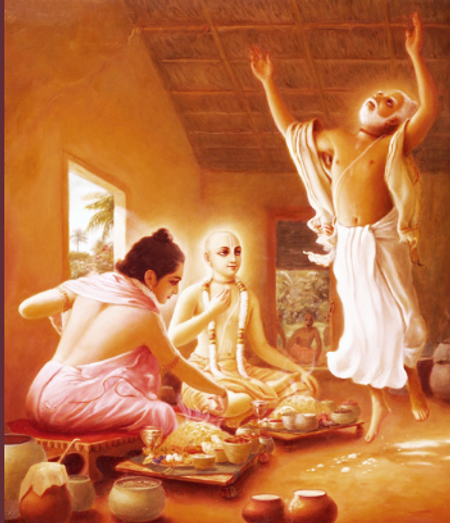
This was after he had spent time preaching the glories of the Holy Names at the Chandpur house of Raghunatha Das Goswami´s father and uncle, Govardhana and Hiranya Majumdar. Advaita used to invite Hari Das to come to his house in Shantipur to take prasad. This made Hari Das Thakur feel somewhat uneasy. However, Advaita Prabhu, the teacher of the people, claimed that his behavior was in conformity with all the scriptures, for to feed a great devotee like Hari Das is equal to the feeding of millions of Brahmins. In order to demonstrate this, he honored Hari Das by giving him the plate offered in the shraddha ceremony.
On the annual date set aside for offering oblations to the forefathers, a householder Vaishnava offers all kinds of foodstuffs to the Lord and then invites Brahmins and Vaishnavas to take prasad. The mahaprasad is given to the guest of honor and Advaita Prabhu chose Hari Das for this special treatment.
Advaita said, Please don’t be afraid. I shall only do what is accepted in scripture. If you eat, it is as though ten million Brahmins had eaten. After saying these words, he gave him the shraddha plate to eat.
(Chaitanya Charitamrita 3.3.219-20)
One of the branches of the Chaitanya tree is Hari Das Thakur, whose activities are amazing. He would unfailingly chant 300,000 names of the lord every day. I only give an indication here of his unlimited virtues; Advaita Acharya honored him by giving him the shraddha plate.
(Chaitanya Charitamrita 1.10.43-4)
The Sons of Advaita
Although six sons were born to Advaita Acharya, the incarnation of Maha Vishnu, he indicated that some of them had understood the essence of spiritual life and some had not. Those who simply claimed to be his followers but showed no affection for Gauranga were the latter; those who were attached to Mahaprabhu in ever-increasing affection were the former. These included Achyutananda, Sri Krishna Mishra and Gopal Mishra, while Balaram, Svarupa and Jagadisa belonged to the category of those who did not recognized Chaitanya.
Achyutananda was the oldest brother and Sri Krishna Mishra and Gopal Mishra followed his lead. The Chaitanya Charitamrita (Cf. 1.12.12) compares the two groups to the wheat and chaff.
Bhaktisiddhanta Saraswati also writes in his Gaudiya-bhashya to the Chaitanya Bhagavat (2.10.162), If someone takes Advaita Acharya to be the best of all the Vaishnavas, then he can be called a Vaishnava. On the other hand, if someone considers him to be the object of all religious life, the vishaya Krishna, and Sri Krishna Chaitanya Mahaprabhu to be his devotee, or ashraya, then he will never be able to attain Krishnas lotus feet.
The Lord Punishes Advaita
It is also said that Mahaprabhu taught Advaita the real meaning of the Bhagavad-gita.
Vishvambhara explained the true understanding of the Gita to Advaita, he hid the gates which held back the understanding of bhakti.
(Chaitanya Bhagavat 2.10.166)
Another wonderful pastime was prepared by Advaita in order to show the fallen jivas how auspicious it is to receive punishment from the lord, or from the guru or a Vaishnava. How fortunate is a devotee who is chastised by his guru! This is described in the seventeenth chapter of the Chaitanya Charitamrita, about which Bhaktivinoda Thakur has made the following comments in his Amrita-pravaha-bhashya: Advaita Acharya is the godbrother of Mahaprabhu’s guru, Isvara Puri.
For this reason, Mahaprabhu treated Advaita as his elder and spiritual master, even though Advaita considered himself to be Mahaprabhu’s servant. Advaita was pained to see Mahaprabhu treat him with such respect and so, in order to seek out the merciful punishment of the lord returned to Shantipur and began to explain the path of knowledge to a few unfortunate individuals.
When the Lord caught wind of this, he became extremely angry and went to Shantipur to give him a good thrashing. When he was thrashed in this way, Advaita danced for joy, saying, Look. My desires have been fulfilled today! Mahaprabhu was previously miserly with me, treating me as his respectful elder. Now he has acted toward me as though I were his servant or disciple, by trying to save me from the heresy of mayavada. When the lord understood that this had all been a ruse on Advaitas’s part, he was embarrassed but pleased with him.
The Lord treated Advaita with the respect deserved by a guru. This caused the Acharya great distress, so he adopted a ruse of teaching the path of knowledge. Mahaprabhu became angry and scorned Advaita, causing him great bliss. When he saw his satisfaction with the turn of events, the Lord became ashamed and was merciful to him.
(Chaitanya Charitamrita 1.17.66-8)
“Previously Mahaprabhu would honor me. This made me unhappy, so I thought that if I start giving lectures on the Yoga-vashishtha, explaining mukti as the supreme goal of life, the lord would become angry and insult me.
Sachidevi and Advaita
Because Advaita Prabhu was very emotional about the condition of the fallen souls, Mahaprabhu could not forgive even his mother when she looked askance at him. On one occasion, through chastising her, he warned all devotees of the danger of offences to the Vaishnavas. If Sachi, who is the essence of motherly affection, the incarnation of Yashoda Devi, cannot be forgiven an offence to the Vaishnava, then what chance do others have? By the same lila, Chaitanya also showed that in order to become free of Vaishnavaparadha, one should beg for forgiveness from the Vaishnava one has offended.
When Vishvarupa came to the conclusion, after studying with Advaita Prabhu, that the world is a temporary place and the only real duty of humankind is to worship the supreme lord, he left home and took sannyasa. Sachi Mata, though troubled by his departure, was wary of insulting Advaita for the role he had played in it, knowing him to be a Vaishnava, and took consolation in Nimai´s presence at home.
But when she saw that Nimai too was going constantly to associate with Advaita, leaving his wife Lakshmipriya alone at home, she began to think that Advaitas’s name was really unsuitable, that rather than unifying people as it would indicate, he split them apart. Advaita would thus be a more appropriate name. This old gosai goes by the name Advaita, but he should be called Dvaita.
One son of mine, as beautiful as the moon, has left home because of him, and he hasn’t let me keep the other one settled. No one has mercy on me who am now without anyone in this world. He may be one (advaita) with the world, but I see him as maya (dvaita).
(Chaitanya Bhagavat 2.22.114-6)
Because of her affection for her son, Sachi mentally criticized Advaita in this way and no one knew except for her son, Gaura Hari, who is the indweller of all beings. On the day of the mahaprakasha in the house of Srivasa, when Mahaprabhu was fulfilling the desires of every one of his devotees by allowing them to see his divine form for twenty-one hours, Srivasa asked him whether Sachi Devi could also be blessed with this divine vision. Mahaprabhu answered, My mother has committed an offense against Advaita Prabhu, so I will not show her this form.
When the devotees told Sachi what her son had said, she immediately went to Advaita and begged him for forgiveness. After Advaita had heard Sachi’s confession, he began to glorify her as the one who had carried the supreme lord of all creation in her womb. He continued to do so until he became unconscious from the overwhelming love that he felt. Only when he fell unconscious could Sachi finally take the dust of his lotus feet and thus be free from her offense.
Mahaprabhu was satisfied with his mother and showed her his glorious, divine form. Another important lesson we can draw from this story is that Vaishnavas are never proud. Even though she had given birth to Lord Gaurahari, Sachi had no inflated pride as a result. As soon as she became aware of having committed an offense, she immediately went without any hesitation to Advaita and prayed to be pardoned.
! For more Biography look here!
!For more Articles look here!
!Continue here!
