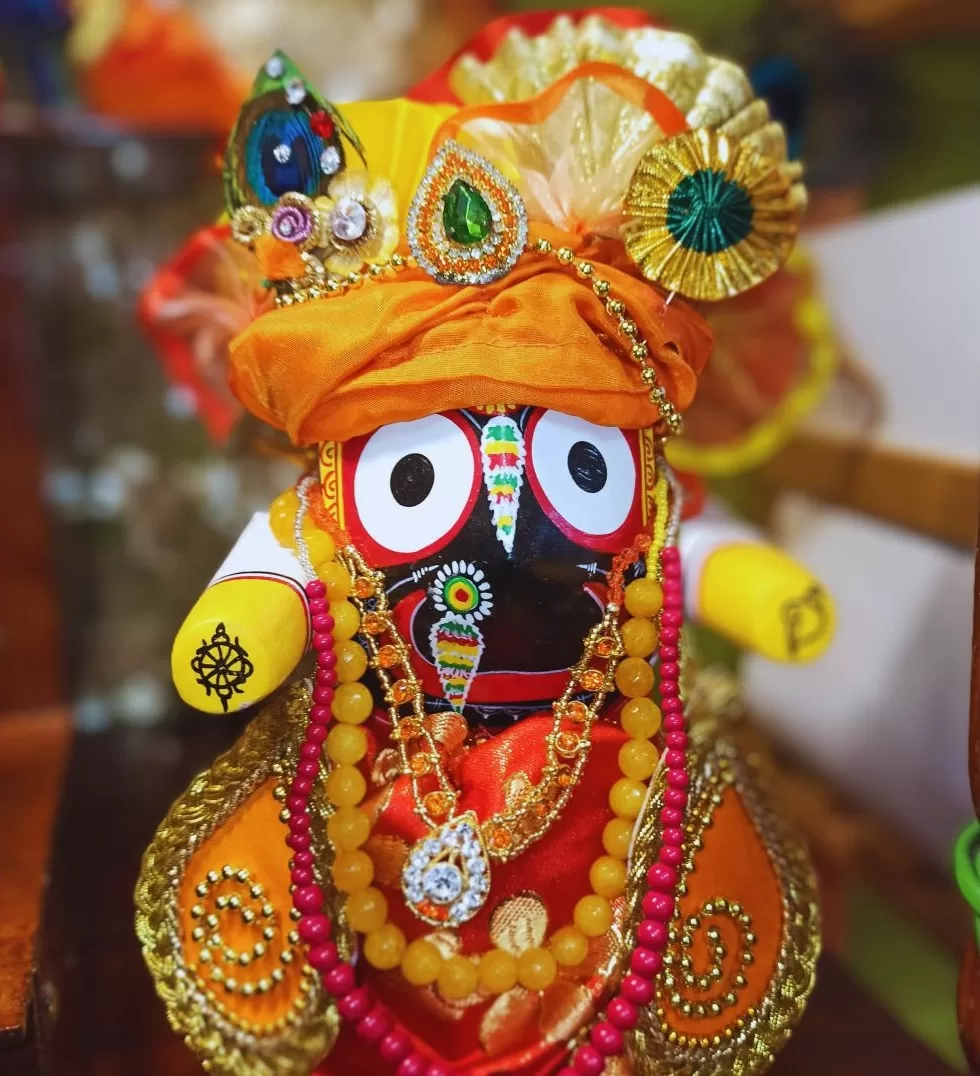

Hare Krishna, in Thuesday (4.2) we have here appearance day of Srimad Advaita Acharya (plenary expansion of Sri Maha Vishnu)
Because Advaita Acharya worshipped the Supreme Lord Krishna, at his request he appeared in this world in the form of Lord Caitanya Mahaprabhu and it is only by his grace that we have the opportunity to participate in the chanting of the holy names, the Hare Krishna Mahamantra, the sankirtana movement.
Advaita Acharya ki JAYA
Biography is from site: www.shyamdasbaba.com
The Lord Comes to Shantipur
Advaita Acharya was Mahaprabhu’s associate in sankirtan, both in Srivasa´s house and in the streets of Nabadwip and along the shores of the Ganges.
Everyone sang together in great joy, Krishna Rama Mukunda, Murari, Vanamali! Holding on to Nityananda and Gadadhara, Advaita, like a lion ran in every direction.
(Chaitanya Bhagavat 2.23.29-30)
The lord danced along the banks of the Bhagirathi while all around him all the people sang the names of Hari. Advaita Acharya preceded him, dancing ecstatically with a small group of devotees.
(Chaitanya Bhagavat 2.23.202-3)
After Mahaprabhu had taken sannyasa from Keshava Bharati in Katwa, he became overwhelmed with love for Krishna and started to run toward Vrindavan. With the help of some cowherd boys, Nityananda Prabhu tricked him into coming to the banks of the Ganges. Nityananda wanted to show him to the people of Nabadwip and wanted to bring him to Shantipur.
When Mahaprabhu saw the Ganges, he thought that it was the Yamuna and became ecstatic. Meanwhile, Advaita had heard that Nityananda had brought Mahaprabhu there and came by boat across the river with new clothes for him. Mahaprabhu was astonished to see Advaita, wondering how he could have known that he was in Vrindavan.
Advaita answered by saying that Vrindavan was there wherever Mahaprabhu went and that the western flow of the Ganges was the Yamuna. When he heard these words, Mahaprabhu realized that he had been tricked to coming to the western bank of the Ganges across from the town of Shantipur. Advaita had him take a bath and dressed him in the new cloth and then took him to his house where he stayed for several days.
When Sachi and the people of Nabadwip heard that Gaurahari was at Advaita´s they all came there to visit him. Seeing him in his dress as a sannyasi, they were felt joy mixed with separation. Sita Thakurani prepared an immense meal and served it on whole leaves from seed-banana trees. As Mahaprabhu and Nityananda ate, Advaita Acharya talked and joked with them.
This has been extensively described in the Chaitanya Charitamrita´s Madhya-lila, chapter 3. Mahaprabhu afterwards also ate foodstuffs prepared by Sachidevi in order to ease the suffering he had imposed on her by his departure. The reunion of devotees turned into a great festival, and Advaitas house in the town of Shantipur was transformed into the city of Vaikuntha.
Everyone was dancing and singing the names of Hari. Advaita’s house became the city of Vaikuntha.
(Chaitanya Charitamrita 2.3.156)
Advaita Goes to Puri on the Annual Pilgrimage
When Mahaprabhu was saying his goodbyes to the devotees, he set off to Puri or Nilachala to live there at the behest of his mother. Advaita and the residents of Nabadwip were once again hurled into the ocean of separation from their lord. These events took place in the year 1510. It was probably three more years before the devotees went to Puri during the caturmasya period to visit him there at the time of the Rathayatra.
The first year, Advaita and the other devotees went to Nilachala to see Mahaprabhu’s lotus feet. They witnessed the Rathayatra and then stayed for four months, passing the time in kirtan and dancing in great joy. When the time came for them to depart, the lord told everyone to return every year to see the Rathayatra festival. And so the yearly trips to Puri to see the lord became an institution.
(Chaitanya Charitamrita 2.1.46-49)
Of the last 24 years of Mahaprabhu’s life, six were spent in traveling to and from Puri, while he spent the last eighteen there without ever leaving. During the six years that he was traveling, the Bengali devotees would first find out whether he was present in Puri before going. During the eighteen years of Mahaprabhu’s permanent stay in Puri, the annual trips became a matter of course.
After Mahaprabhu arrived in Puri, returning from Vrindavan, he never again left in the eighteen remaining years of his life. The devotees came from Bengali every year, meeting with the Lord and staying for the four months of the rainy season.
(Chaitanya Charitamrita 2.1.249-50)
All of Mahaprabhu’s servants, Advaita, Nityananda, Mukunda, Srivasa, Vidyanidhi, Vasudeva and Murari, went every year to meet with the lord, staying in Puri for four months. The lord enjoyed a multitude of pastimes with these devotees during this time.
(Chaitanya Charitamrita 2.1.255-6)
The time for Rathayatra came around again and the devotees started off on the annual pilgrimage to Nilachala. They were following the lord’s order to come every year to see the Rathayatra festival. With Advaita Acharya at their head, all the devotees set off toward Nilachala.
(Chaitanya Charitamrita 3.8.4-6)
Advaita Acharya would go every year to Puri and stay for the full four months, participating with Mahaprabhu in lilas such as the cleaning of the Gundicha temple, the water sports in Narendrasarovara, Jagannath’s Rathayatra, etc. The best of Advaita´s three orthodox sons, Achyutananda, who was totally devoted to Gauranga, was also present there, as is attested by the fact that his name is mentioned as the leader of the sixth kirtan group at the Rathayatra, which was from Shantipur. Another of Advaita´s sons, Gopal Mishra, is also named in this list. Advaita himself was the principal dancer in the first kirtan group led by Svarupa Damodar.
In the third year, the wives of the Bengal devotees accompanied them, bringing various gifts for Mahaprabhu’s service.
Advaita went first to Sachi Mata’s house to take her leave. Then he departed with the assembly of devotees. They brought with them all the edibles they knew formerly brought pleasure to the Lord. They performed sankirtan the entire length of the route, purifying everything on their way. All the people of the three worlds were sanctified by the devotees joyful calls of Hari! Hari! In a mood of ecstasy they all went to see Chaitanya, accompanied by their wives and sons, their male and female servants.
(Chaitanya Charitamrita 3.8.39-43)
In the third year, all the devotees from Bengal decided to go to Nilachala. They went in a group to Advaita Acharya’s house, and he happily agreed to go with them to see the lord. That year, all the wives of these saints went also, the mother of Achyuta accompanying Advaita Acharya.
(Chaitanya Charitamrita 2.13.12-13, 21)
Krishnadas Kaviraj has written about a wonderful pastime with Advaita´s son Gopal Mishra in the twelfth chapter of Chaitanya Charitamrita´s Adi-lila. During the cleaning of the Gundicha temple, Advaita and Mahaprabhu were satisfied to see the deep absorption of Gopal in dancing and singing before them. When Gopal Mishra suddenly fell unconscious, Advaita became very anxious and took his inert body in his lap, chanting the Nrisingha mantra.
Despite the various mantras that Advaita uttered, Gopal did not return to consciousness. All the devotees began to cry for him, but Mahaprabhu, who takes away the distress of his devotees, touched Gopal over the heart and said, Get up, Gopal and chant Hari Hari! Gopal immediately returned to consciousness and stood up. The devotees shouted the names of the Lord in relief and joy.
Kamala Kanta Vishvasa
Advaita Acharya had a disciple name Kamala Kanta Vishvasa who wrote to King Prataparudra establishing that Advaita was the supreme lord, but then asked him for money for him. When Chaitanya heard about this, he punished Kamala Kanta by refusing him access to the Gambhira. Kamala Kanta was disturbed by this punishment, but Advaita explained to him that to be punished by Mahaprabhu was a cause for rejoicing and that he was most fortunate.
Bhaktivinoda Thakur has made the following comment on this story, which is found in the twelfth chapter of the Adi-lila: Kamala Kanta first proved that Advaita was the supreme lord, but then begged for money from the king on Advaita´s behalf. This action was very displeasing to Chaitanya. Even though the Advaita Acharya is God himself, he is in this world playing the part of a man in order to teach.
For an acharya to beg from a king to free himself from debt is considered to be shameless behavior. One should entirely abandon the desire for material and if the desire for material well-being is taken to the point of begging from a foreign king in order to become free of a debt, then one’s spiritual life will certainly go to ruin. Kings are by nature materialistic. If one eats the food of a materialistic person, his mind becomes clouded over.
When one’s mind is clouded over, then he can no longer remember Krishna and his life is wasted. Such begging is therefore a prohibited action for everyone, but is especially so for those who are in the position of acharya. It is the acharya’s duty to instruct people in the Holy Names, but he should not take money in return for such instruction. If he does so, he becomes an offender to the Holy Name rather than an initiator in the Name. If an instructor of the Holy Names becomes a money collector, then it is a matter of shame and his religious reputation will be ruined.
In the third year when the Bengal devotees came with their wives and gifts of various food preparations that were dear to the lord, he mercifully ate all these offerings out of his affection for them. One day, Mahaprabhu was invited to eat at Advaita´s residence. This time, Advaita himself did the cooking and his wife assisted him by cutting the vegetables and gathering the ingredients.
It was Advaita´s secret wish to be able to feed Mahaprabhu alone. It so happened that on that day the weather turned bad and due to a storm, all the sannyasis who normally came with Mahaprabhu on such occasions were unable to accompany him. Mahaprabhu thus arrived by himself, to Advaita´s great satisfaction, for he was thus able to serve him the meal in complete privacy.
He praised the god Indra as a servant of Krishna who fulfilled the wishes of his devotees. Mahaprabhu was aware of the Advaita´s mood and praised him by saying, Krishna himself fulfills your desires, so what is unusual about Indra carrying out your orders?
(Chaitanya Bhagavat 3.9.60-72)
Mahaprabhu himself glorified Advaita and described the underlying truth of his nature in the following way:
Advaita Acharya is God himself. As a result of his association, I have become purified. Because there is no one equal to him in devotion to Krishna, nor in knowledge of the scriptures, he is called Advaita Acharya. By his mercy, even the mlecchas become devotees of Krishna, who can describe the extent of his powers or his devotion?
(Chaitanya Charitamrita 3.7.17-9)
Mahaprabhu had Rupa and Sanatan Goswamis meet with Advaita and Nityananda in Puri and asked the two prabhus to bless the brothers. Raghunatha Das Goswami received Mahaprabhu’s leftovers by the grace of Advaita Prabhu. He was the object of Advaitas affection because his father, Govardhana Mishra, had served him honestly.
His father always rendered service to Advaita Acharya, therefore the acharya was pleased with him. By the grace of the acharya, Raghunatha obtained the lord’s leftover plate and was able to have darshan of the lord for five or six days.
(Chaitanya Charitamrita 2.16.225-6)
The words that Mahaprabhu spoke to Advaita when he was about to leave Puri show just how much affection he had for him:
Acharya Gosai came here to show his mercy for me. I am bound in debt to his love and there is no way that I can repay him. He has abandoned his wife, children and home for my sake, traveling a long and difficult way to come here. I am living here in Nilachala without moving. I make no effort on your behalf. I am a monk and I have no wealth what I could give you to make good my debt? My only possession is my body, which I give you. I will sell it to whomever you wish.
(Chaitanya Charitamrita 3.12.70-74)
Advaita’s Riddle
When he returned to Nabadwip from Puri, Advaita Acharya met Jagadananda Pandit who had previously been sent there by Mahaprabhu. Advaita was very happy to have his association. When Jagadananda finally asked permission of Advaita Prabhu to return to Nilachala, Advaita gave him a message in the form of a riddle to take back to Mahaprabhu. The riddle was comprehensible to no one but Mahaprabhu himself. The message was as follows:
Tell the Lord that I pay him a million obeisances and that I humbly submit to him the following: Tell the madman that everyone has gone mad. Tell the madman that they are no longer selling rice in the market. Tell the madman that the crazies are no longer good for anything. Tell the madman that this is what the madman said.
(Chaitanya Charitamrita 3.19.19-21)
Bhaktivinoda Thakur explains this riddle in this way: Tell Mahaprabhu that everyone has become intoxicated with love for Krishna and so in the marketplace of love, no one is buying the rice of Krishna prema any longer. Tell Mahaprabhu that the crazies (aul) are so intoxicated with love that they are no longer involved in their material duties. Tell Mahaprabhu that Advaita said this in a state of complete intoxication of prema. In short, the message was that the purpose for which Mahaprabhu had been called to earth by Advaita had been completed. Now the lord may do as he wills.
Sarvabhauma Bhattacharya has also written several poems glorifying Advaita: Advaita-dvadasha-nama-stotra, Advaitashtakam and Advaitashtottara-shata-nama-stotra.
Advaita, the avatar of Mahavishnu, appeared in this world on the seventh day of the waxing moon in the month of Magh. This tithi is also known as Advaita-saptami.
[Excerpted from “Sri Chaitanya: His Life & Associates” by Srila Bhakti Ballabh Tirtha Maharaj]

:::::::::::::::::::::::::::::::::::::::::::::::::::::::::::::::::::::::::::::::::::::::::::::::::::
Śrīla Advaita Ācārya
[February 19, 2021 is the appearance day of Śrīla Advaita Acharya in Vṛndāvana, India. The following is an excerpt of a bhāva anuvāda of a discourse by Śrīla Bhakti Vijñāna Bhāratī Gosvāmī Mahārāja on August 30, 2014. Editors’ input: Additional text has been included in square brackets to facilitate the flow of content.]
THE ECSTASY OF ADVAITA AND HARĪDĀSA
When Śrī Caitanya Mahāprabhu appeared in this world, Śrīla Advaita Acharya began to dance in great ecstasy on the roof of his house. Nāmācārya Śrīla Haridāsa Ṭhākura also felt great jubilation. Śrīla Advaita Acharya thought, “There surely must be some extraordinary cause, otherwise, how is it possible that both of us are experiencing jubilation within our hearts?”
Later, after Śrīla Advaita Acharya received news of Mahāprabhu’s appearance, he approached His home. Śrīmatī Sītā-devī arrived in a palanquin, offering a tiger’s claw as well as many other gifts for the newborn child. She also made arrangements so that no witch could cast a spell on the newborn child; it was for this reason that He was named Nimāi [after the bitter Neem tree as a protection against evil influences, so that He would not also die prematurely like his sisters did before His advent.]
NITYĀNANDA TRICKS ŚRĪ CAITANYA-DEVA
After taking sannyāsa, Śrī Caitanya-deva wandered here and there for three days intoxicated in ecstatic love and desiring to go to Vṛndāvana. At that time, Śrī Nityānanda Prabhu told a few cowherd boys to point towards the south when Śrī Caitanya-deva inquired about the direction to Vṛndāvana [to misdirect Śrī Caitanya-deva to Śāntipura] and sent word to Śrīla Advaita Acharya [about Śrī Caitanya-deva’s imminent arrival].
Śrīla Advaita Acharya arrived in a boat with a new set of saffron clothes, which took Śrī Caitanya-deva [who had arrived there as part of Nityānanda Prabhu’s plan.] by surprise. Śrī Caitanya-deva asked Śrīla Advaita Acharya, “I am in Vṛndāvana. How is it that you are also here?” Śrīla Advaita Acharyaa replied, “Mora bhāgya gangā tire tāhāra āgamana – It is my good fortune that you have come to the bank of the Ganges.”
Then Śrī Caitanya-deva asked, “So did Nityānanda lie to Me when He said I was in Vṛndāvana and could now bathe in the Yamuna?” Śrīla Advaita Acharya replied, “No, he did not lie because in Prayāga there is a confluence of three rivers – Gaṅgā, Yamuna and Sarasvatī. Yamuna flows in the west and Gaṅgā in the east, and because You took Your bath on the western side, you have indeed bathed in the Yamuna.”
ADVAITA’S FEAST
Saying thus, Śrīla Advaita Acharya brought Śrī Caitanya-deva to his home where he made arrangements for a variety of sumptuous preparations. His wife Śrīmatī Sītā-devī was an expert cook who could immediately make a variety of preparations. There is a beautiful narration of this pastime in Śrī Caitanya-caritāmṛta.
Śrī Caitanya-deva said, “Give Me only a few preparations on a separate leaf. Why have you arranged for these three leaf plates?” He was told, “These are for You, Nityānanda and for Your worshipable Lord. “Mahāprabhu said, “I cannot accept so many offerings.” Śrīla Advaita Acharya then replied, “In Nīlācala, You savor fifty-six varieties of offerings [Endnote 1].
Besides this, You also accept bhoga at the places of soḍasa mātrika [16 different kinds of goddess like Cāmuṇḍā-devī, Vaiṣṇavī-devī, Jwala Mukhī-devī and so on] and the mahīṣīs. I have prepared an ordinary feast because I cannot cook elaborately; I am just a poor brāhmaṇa.” Furthermore, Śrīla Advaita Acharya added, “What is served as the first helping, You should honor completely, and for the second serving, You should do the same. You may take only half of the third serving and leave the rest.”
THE TRANSCENDENTAL LOVING QUARREL
Then Nityānanda Prabhu began a prema kalāha [loving quarrel] with Śrīla Advaita Acharya. He said, “I have been fasting since the past three days but, despite your invitation, should I remain fasting on the fourth day as well? What you have offered is not enough for Me.” On one hand, Mahāprabhu is saying this is too much, and on the other, Nityānanda Prabhu is saying it is too little.
Śrīla Advaita Acharya pleaded, “I am a poor brāhmaṇa so please be satisfied with whatever I could prepare and offer.” Nityānanda Prabhu said, “Because you have invited Us for lunch you are obliged to feed Us as much as We would like to eat.” Later, as if He were angry, Nityānanda Prabhu threw a handful of rice and said, “Enough is enough, now take away the leaf plate.” This is His pastime.
Śrīla Advaita Acharya said, “[Śrī Caitanya-deva] Prabhu is a sannyāsī, He is not at fault, however, as far as this avadhūta [Nityānanda] is concerned, no one is aware whose disciple He is or what caste He belongs to, yet He eats in everyone’s homes! It is improper for me to sit with Him because I am householder brāhmaṇa.
Prabhu will not accrue any fault because a sannyāsī is not affected by anna doṣa, but I am not a sannyāsī, I am a householder.” Nityānanda Prabhu said, “You have committed an offence, therefore you must invite a hundred sannyāsīs and feed them sumptuously to atone for your offence.” Then Śrīla Advaita Acharya said, “I invited one and became unsettled, so why would I invite a hundred?
I will not invite even one.” [Advaita Acharya replied, “I shall never again invite another sannyāsī, for it is a sannyāsī who has spoiled all My brahminical smṛti regulations.” Śrī Caitanya-caritāmṛta Madhya 3.101] Although externally they appeared to be quarreling, in reality, they were glorifying each other. It is called vyāja-stuti – to glorify indirectly.
ŚRĪ CAITANYA-DEVA CALLS FOR ADVAITA
Although Bhagavān rarely reveals Himself, He descended after being obliged by Śrīla Advaita Acharya’s invocation. Later, when Mahāprabhu exhibited His aiśvarya form during His śata-prahariyā-māhābhāvā’, He sent a message for Śrīla Advaita Ācārya in Śāntipura through Śrīrāma Paṇḍita to present himself along with his consort Śrīmatī Sītā-devī. Śrīla Advaita Ācārya, however, told Śrīrāma Paṇḍita to inform Mahāprabhu that he had not come. Śrīrāma Paṇḍita was in a great dilemma, ‘How can I speak a lie to Prabhu [Śrī Caitanya-deva] and at the same time honor Śrīla Advaita Ācārya’s order?’ This was his dilemma.
Upon Śrīrāma Paṇḍita’s arrival however, Śrī Caitanya-deva Himself said, “Śrīla Advaita Acharya wants to test My Godhood, therefore he is hiding.” In this way, Śrīrāma Paṇḍita’s dilemma was resolved, and he didn’t have to lie. Śrī Caitanya-deva ordered, “Go and bring him”. When Śrīla Advaita Acharya arrived, Śrī Caitanya-deva asked him to perform His worship.
Does anyone speak like this? Śrī Caitanya-deva said this only to Śrīla Advaita Acharya, because he had worshiped Him with Gaṅgā water and tulasī while fervently praying for His descent. He did so as he observed that people in general were no longer taking the name of Bhagavān. Only those who were very pious would utter the name of Govinda or Puṇḍarīkākśa and that too, only while taking bath.
ADVAITA’S ELIGIBILITY TO MAKE MAHĀPRABHU DESCEND
Our Śrīla Rūpa Gosvāmī has said:
(Bhakti-rasāmṛta-sindhu,1.2.234)
[Therefore material senses cannot appreciate Kṛṣṇa’s holy name, form, qualities and pastimes. When a conditioned soul is awakened to Kṛṣṇa consciousness and renders service by using his tongue to chant the Lord’s holy name and taste the remnants of the Lord’s food, the tongue is purified, and one gradually comes to understand who Kṛṣṇa really is.]
Bhagavān’s name, form, qualities, pastimes, associates and abode are beyond the comprehension of the materially contaminated senses; so how can one realize them? They will be revealed only to the service-inclined senses. According to the eligibility of the servant, the requisite knowledge to serve Bhagavān will be revealed. Śrīla Advaita Acharya had the eligibility to summon Bhagavān, forcing Him to descend, and Śrīmatī Sītā Devī served that Bhagavān in all respects.
SĪTĀ SUPPORTS ADVAITA
Śrīmatī Sītā Devī would accompany her husband to Jagannātha Purī. They would purchase Jagannātha prasāda and also make various preparations at home. So, when Śrī Caitanya-deva made the rule that He would take only one fourth of whatever was offered to Him for prasāda, all the devotees became disheartened. However, there were no rules or restrictions as far as the invitations of Śrīla Advaita Acharya and Śrīla Sārvabhauma Bhaṭṭācārya were concerned.
Once Śrīla Advaita Acharya told Śrī Caitanya-deva, “Please come along with Your shadow”. Meaning: ‘You come all alone, don’t bring any other sannyāsīs with You.’ So what could be done? Suddenly, strong winds and heavy rains blew, and all the others accompanying Mahāprabhu were lost. Eventually, Śrī Caitanya-deva arrived to Śrīla Advaita Ācārya’s house alone. Śrīla Advaita Ācārya was very pleased with Indra saying, “You have performed a good deed. You have helped me like a friend.” Then, Śrī Caitanya-deva said, “Now you have become the servant of Indra because you are praising him so much.”
I remembered this pastime as [it shows how] Śrīmatī Sītā-devī would gladly join her husband in cooking a variety of dishes like piṭhā and serve Mahāprabhu sumptuously and thus please Him. Śrīmatī Sītā-devī would support Śrīla Advaita Acharya whole-heartedly. That is why their invitation had no restrictions and Śrī Caitanya-deva praised their efforts very much.
SURRENDER MAKES ONE FEARLESS
When Śrīla Advaita Acharya offered the ‘śrāddha-pātra’ (offering of oblations to the forefathers) to Nāmācārya Śrīla Haridāsa Ṭhākura, Śrīla Haridāsa Ṭhākura expressed some inhibition, “You belong to the society of brāhmaṇas and by this act of offering me the ‘śrāddha-pātra’ [Endnote 2], all will blaspheme you and this I cannot bear.” Śrīla Advaita Acharya replied, “I will conduct myself in line with the opinion of the scriptures.” He did not bother with the opinion of the worldly people. Similarly, it is observed that even Śrīla Vṛndāvana dāsa Ṭhākura didn’t care for public opinion. Why is such a thing possible for them? Because they are surrendered to Bhagavān, they have no fear.
Śrīla Vṛndāvana dāsa Ṭhākura challenged the entire society by propagating the glories of hari-bhakti. For this reason, he is hailed as ‘Patita-pāvana Śrīla Vṛndāvana dāsa Ṭhākura’, the redeemer of the fallen. Like him, Śrīla Advaita Acharya claimed, “Whatever I do, has its foundation in the scriptures.” Saying this he assured Nāmācārya Śrīla Haridāsa Ṭhākura that there was no cause of worry. And in all of Śrīla Advaita Acharya’s activities, his wife, Śrīmatī Sītā-devī, supports him. So by the principle of śakti śaktimatayor abheda [the energetic and the energy are non-different], she has half the share in all of his activities.
Endnote 1
Śrī Caitanya-caritāmṛta Madhya 3.75 – Purport by Srila Bhaktivedānta Svāmi Mahārāja.
In this connection Advaita Acharya referred to Caitanya Mahāprabhu’s eating at Jagannātha Purī. Lord Jagannātha and Śrī Caitanya Mahāprabhu are identical. Advaita Acharya pointed out that in Jagannātha Purī Caitanya Mahāprabhu ate fifty-four times a day, and each time He ate many hundreds of pots of food.
Endnote 2
Śrī Caitanya-caritāmṛta, Antya 3.222 – Translation and Purport by Srila Bhaktivedānta Svāmi Mahārāja.
tumi khāile haya koṭi-brāhmaṇa-bhojana eta bali, śrāddha-pātra karāilā bhojana
“Feeding you is equal to feeding ten million brāhmaṇas,” Advaita Acharya said. “Therefore, accept this śrāddha-pātra.” Thus Advaita Acharya made him eat.
Śrāddha is prasādam offered to the forefathers at a certain date of the year or month. The śrāddha-pātra, or plate offered to the forefathers, is then offered to the best of the brāhmaṇas in society. Instead of offering the śrāddha-pātra to any other brāhmaṇa, Advaita Acharya offered it to Haridāsa Ṭhākura, considering him greater than any of the foremost brāhmaṇas.
This act by Śrī Advaita Acharya proves that Haridāsa Ṭhākura was always situated in a transcendental position and was therefore always greater than even the most exalted brāhmaṇa, for he was situated above the mode of goodness of the material world. Referring to the Bhakti-sandarbha, text 177, Śrīla Bhaktisiddhānta Sarasvatī Ṭhākura quotes the following statements from the Garuḍa Purāṇa in this connection:
brāhmaṇānāṁ sahasrebhyaḥ satra-yājī viśiṣyate satra-yāji-sahasrebhyaḥ sarva-vedānta-pāragaḥ
sarva-vedānta-vit-koṭyā viṣṇu-bhakto viśiṣyate vaiṣṇavānāṁ sahasrebhya ekānty eko viśiṣyate
“A brāhmaṇa qualified to offer sacrifices is better than an ordinary brāhmaṇa, and better than such a brāhmaṇa is one who has studied all the Vedic scriptures. Among many such brāhmaṇas, one who is a devotee of Lord Viṣṇu is the best, and among many such Vaiṣṇavas, one who fully engages in the service of the Lord is the best.”
bhaktir aṣṭa-vidhā hy eṣā yasmin mlecche ’pi vartate sa viprendro muni-śreṣṭhaḥ sa jñānī sa ca paṇḍitaḥ tasmai deyaṁ tato grāhyaṁ sa ca pūjyo yathā hariḥ
“There are many different kinds of devotees, but even a Vaiṣṇava coming from a family of mlecchas or yavanas is understood to be a learned scholar, complete in knowledge, if he knows the Vaiṣṇava philosophy. He should therefore be given charity, for such a Vaiṣṇava is as worshipable as the Supreme Personality of Godhead.”
na me ’bhaktaś catur-vedī mad-bhaktaḥ śva-pacaḥ priyaḥ tasmai deyaṁ tato grāhyaṁ sa ca pūjyo yathā hy aham
Lord Kṛṣṇa says, “Even if a nondevotee comes from a brāhmaṇa family and is expert in studying the Vedas, he is not very dear to Me, whereas even if a sincere devotee comes from a low family of meat-eaters, he is very dear to Me. Such a sincere pure devotee should be given charity, for he is as worshipable as I.”
! For more Biography look here!
!For more Articles look here!
