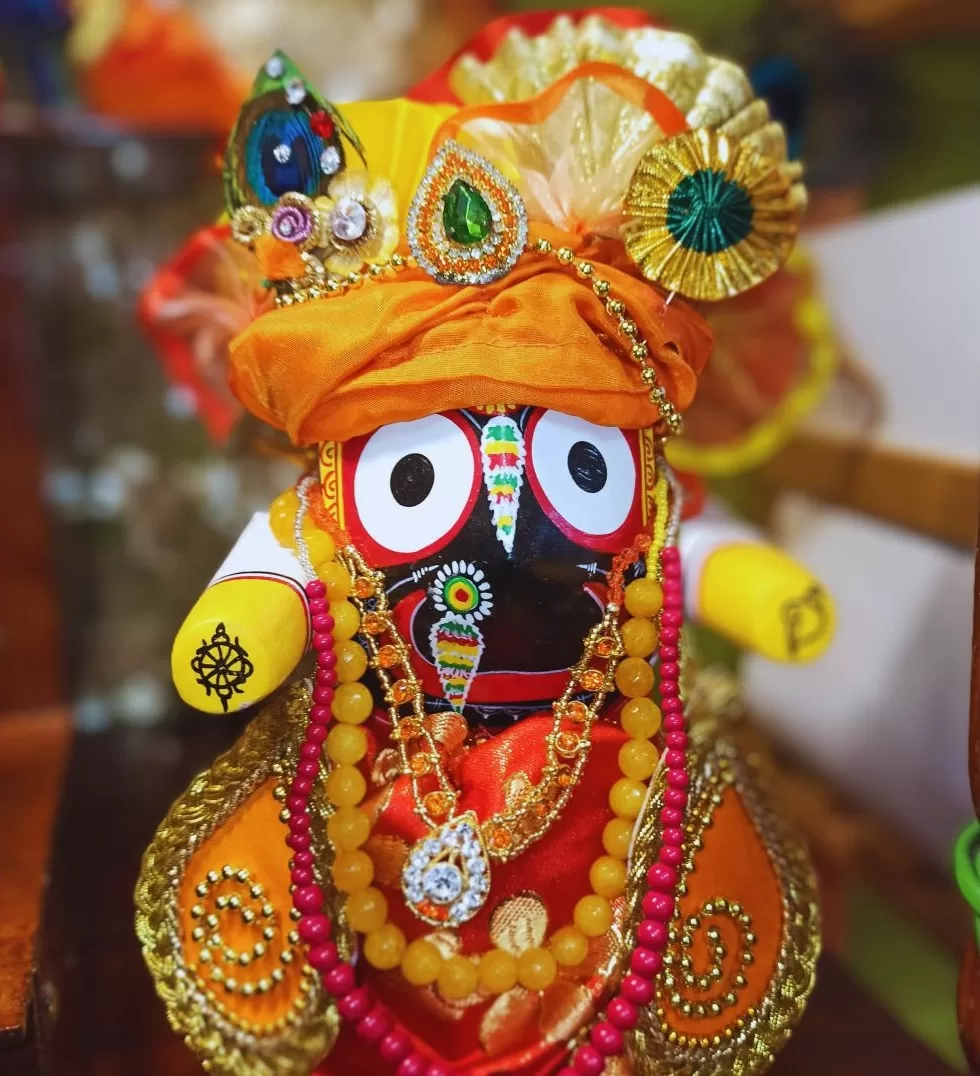
Hare Krishna, today we have appearance day of Narottam Das Thakur. Here is biography about him!
Narottam Das Thakur was the embodiment of the message of Caitanya Mahaprabhu, elaborated in the teachings of the six Goswamis of Vrindavana.
He conveyed love for God through memorable poems and lived that love in the same poetic way. He was the perfect devotee, the exemplary messenger of the Divine, whose characteristics the six Goswamis described every time their quill touched palm leaf. Jiva Goswami said of Srila Narottam, “You are the manifestation of Mahaprabhu’s love, and with this love you will flood the entire universe.”
Caitanya Mahaprabhu had on several occasions prophesized that soon a great devotee by the name of Narottam would be born. When Mahaprabhu visited Rupa and Sanatan Goswami in Ramakeli. He looked into the deep blue water of the river Padma and fervently shouted “O Narottam!, O Narottam!”
Later when the Lord bathed in the river, He is said to have deposited His “prema” or love for Godhead in the waters of the river and predicted that one day in the future this love for Godhead will be absorbed by Narottam, who will then freely distribute it to the world. Nityananda Prabhu also forewarned the devotees that there would soon appear a great devotee whom Caitanya Mahaprabhu will invest His love with and that this shall be carried out when Narottam bathes in the waters of the Padma River and thus causing it to overflow.
Narottam Das Thakur appeared to this world around the same year that Sri Caitanya Mahaprabhu left this world, around 1534 on the full moon month of Magh (January- February). As the Lord had previously predicted, Narottam appeared in Kheturi, an area close to present day Bangladesh. He became the only son of a great king, Krishnananda Datta and his wife Narayani Devi. As a baby Narottam refused to partake of grains offered to him in Annaprasan, a religious ceremony marking the first grains being eaten by a child. Only after a devout Vaishnava gave the baby food first offered to the Lord (prasadam), did Narottam accept to eat.
As he grew, Narottam became a brilliant student, mastering all forms of literatures; yet, his favorite pastime at the time was to engage himself continuously in hearing the pastimes of Sri Caitanya Mahaprabhu from an elderly Brahmin. On the verge of becoming a teenager, Narottam received the vision of Lord Nityananda in his dream ordering him to take a bath in the Padma River, which he complied.
As he took his bath in the holy river, the waters of the river overflowed and Narottam took on a vital transformation, both physically and spiritually. His once dark complexion became golden and his demeanor was that of one filled with love of God. This place, called the “Prem Tali Ghata” is a place of pilgrimage today for all Vaishnavas of the world.
After this incident, Narottam cried day and night in separation from the Divine Couple, Sri Radha Krishna. Seeing their son in such a demeanor, the worried parents feared that their only son, who had no inclination for material wealth would leave them without an heir to the kingdom. So they locked Narottam in and kept guards to watch on him. As his reputation as a boy-saint spread far and wide, an influential governor requested the audience of Narottam.
Finding this an opportunity to escape, Narottam fled from the guards and ran straight to Vrindavana.
The journey to Vrindavana was arduous considering that he was reared as a prince who was pampered by his parents and thus, Narottam became tired. Seeing His devotee in such a state, the Lord, appearing as a golden skinned Brahmin supplied him with milk, which rejuvenated young Narottam.
Arriving in Vrindavana, Narottam was greeted by many senior devotees including Jiva and Lokanath Goswami. Of all the exalted Vaishnavas, Narottam held a great liking to Lokanath Goswami. Out of humility, Lokanath Goswami had vowed not to accept disciples,
yet Narottam didn’t give up, he served his future guru continuously for over a year when finally, Caitanya Mahaprabhu appeared to Lokanath and ordered him to accept Narottam as a disciple. Narottam was then initiated by Lokanath Goswami and as per his instructions enlisted as a student of Jiva Goswami. He would soon became one of his best pupils, the two others being the greatly exalted Shrinivas Acharya and Shyamananda Pandit.
Following the instructions of Jiva Goswami to spread the holy name, Narottam Das Thakur returned to his birth place, Kheturi, where he was greeted by great ecstasy by his relatives. He actively preached here, inspiring many great artists and writers to become devotees.
Soon thereafter, Narottam became the single most famous guru in the whole of Bengal accepting as disciples even Brahmins and thus showing that birth (Narottam was not born in a Brahmin family) was no qualification or dis-qualification in the spiritual realm. He would accept 123 disciples, who under the able guidance of their exalted spiritual master would soon inundate Kheturi and the vicinity with the love of Godhead.
On of the most enduring contributions of Narottam is the festival in Kheturi which is an historic event in the annals of Vaishanava history. As per the instructions of his Guru, Narottam inspired his disciple and wealthy cousin Santosh Datta, to construct a magnificent temple with Radha Krishna and Gaura-Visnupriya Deities. The festival attracted all the prominent Vaishnavas of the time and was presided by Jahanva Ma, the widow of Nityananda Prabhu.
The pre-eminent position offered to her clearly refuted the second-tier position traditionally awarded to women in religion. The festival, held on Gaur Purnima (appearance day of Mahaprabhu) was replete with kirtans, discussions, debates and prasadam. It is heralded as the single most important spiritual event of that scale at the time.
Narottam Das Thakur came to be known as a prolific and eloquent writer.
Devotees and scholars alike praise his literary works such as Prarthana and Prema-bhakti-candrika even today. Srila Bhaktisiddhanta Saraswati Thakur, the spiritual master of Srila A.C. Bhaktivedanta Prabhupada, used to urge his disciples to know, practice and realize the teachings presented in Prarthana and Prema-bhakti-candrika. These two most prominent works of Narottam Das Thakur are filled with heart felt humility, eagerness and anxiety for devotional perfection, and according to Saraswati Thakur, can grant one perfection.
Srila Gaura Kisora Dasa Babaji, the spiritual master of Saraswati Thakur used to carry only these two books with him wherever he went and everyday sing one of these songs by Narottam. Once requested to explain how to develop love of God, the Babaji replied by saying it costs only five annas, the cost to purchase the books mentioned above. Srila Visvanatha Cakravarti Thakur has accepted the songs of Narottam Das Thakur on par with the Vedas, that they are Vedic evidence.
It is described that Narottam, feeling acute separation from his Lord went into trance at the home of Ganga-Narayana, on of his disciples. At this time some caste Goswamis (Brahmins by virtue of birth only) appeared and started to ridicule Narottam. Hearing such blaspheme, Narottama’s disciples prayed that he come back and show some mercy on the cast Goswamis. Soon a golden Brahmin tread appeared on the body of Narottam, who awoke from his trance. The awestruck caste-conscious Brahmins soon afterwards prayed for forgiveness.
Later when he was to actually disappear, Narottam told his disciples to take a bath in the Ganges with him. Thereafter, he told his disciples to pour the water of the Ganges over his body. As they were thus proceeding, their guru’s body transformed into milk and mixed with the waters of the Ganges. His bereaved disciples filled a jog with the milk and enshrined in the samadhi (tomb) of Narottam Das Thakur, which came to be known as Dugdha-samadhi or the tomb of milk and is an important pilgrimage site for all Gaudiya Vaishnavas.
! For more Biography look here!
!For more Articles look here!
