Hare Krishna, today article:
Authority to Make a Statement on the Disciplic Succession is from Bhakti Pramode Puri Gosvami
Prayers
Śrī Guru-Praṇāma:
oṁ ajñāna-timirāndhasya
jñānāñjana-śalākayā
caksur unmīlitaṁ yena
tasmai śrī-guruve namaḥ
“I offer my respectful obeisances unto my spiritual master, who with the torchlight of knowledge has opened my eyes, which were blinded by the darkness of ignorance.”
Two important verses:
suna suna nityananda, suna haridasa
sarvatra amara ajna karaha prakasa
prati ghare ghare giya kara ei bhiksa
‘bala krsna, bhaja krsna, kara krsna-siksa’
“Listen, listen, Nityananda! Listen, Haridasa! Make My command known everywhere! Go from house to house and beg from all the residents, ‘Please chant Krishna’s name, worship Krishna, and practise what Krishna teaches.’” (Sri Chaitanya-bhagavat, 2.13.8-9)
harer nāma harer nāma
harer nāmaiva kevalam
kalau nāsty eva nāsty eva
nāsty eva gatir anyathā
“In this age of quarrel and hypocrisy, the only means of deliverence is the chanting of the holy names of the Lord. There is no other way. There is no other way. There is no other way.”
Mahā-mantra Hare Kṛṣṇa:
Hare Kṛṣṇa Hare Kṛṣṇa
Kṛṣṇa Kṛṣṇa Hare Hare
Hare Rāma Hare Rāma
Rāma Rāma Hare Hare
Authority to Make a Statement on the Disciplic Succession
Article, Śrīla Bhakti Pramoda Purī Gosvāmī Mahārāja
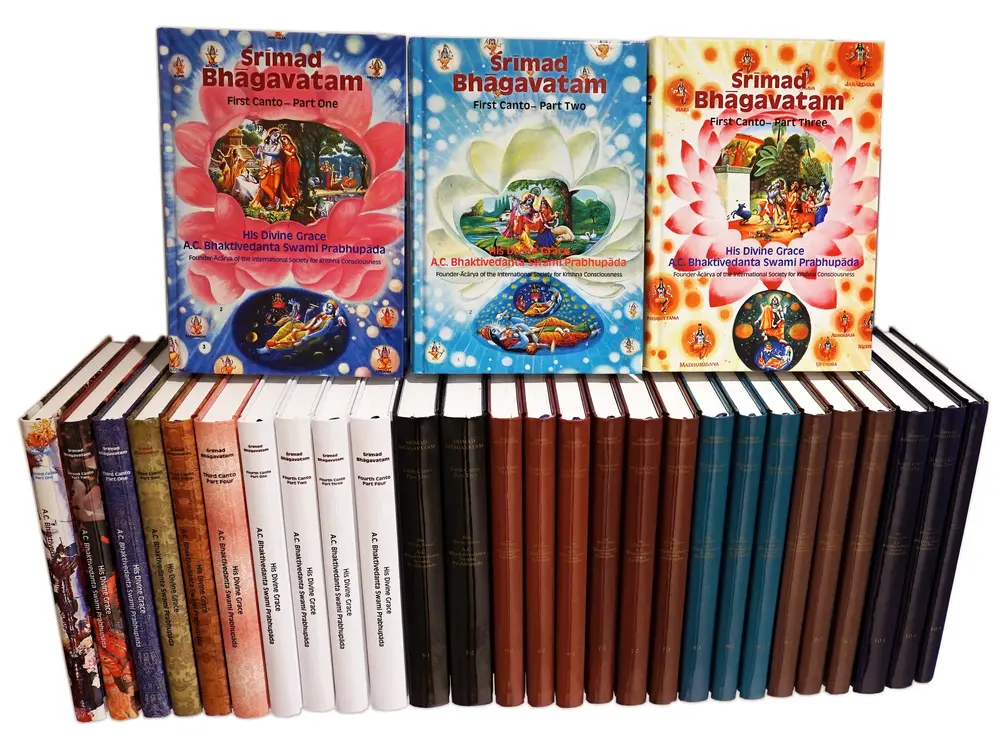
Śrī Caitanya Mahāprabhu recognized the Bhāgavatam to be the genuine commentary on the Vedānta and thus considered it unnecessary to write a separate explanation of the Brahma-sūtras. The Garuḍa-purāṇa in particular states that the Bhāgavatam is the explanation of the Vedānta-sūtra, the Mahābhārata and other historical epics; it gives the meaning of the Gāyatrī mantra and all the Vedic literature.
However, there came a time when, by the wish of the Lord, the ācāryas of the Rāmānuja sampradāya in the Galtā village of Jaipur created a lot of trouble by denying the validity of the Gauḍīya school, which managed the service to the Govindajī deity in Jaipur, saying that it had no historical basis. They accused the Gauḍīyas of not having a tie to any one of the four Vaiṣṇava disciplic successions.
Though the King of Jaipur was a Gauḍīya Vaiṣṇava, he was troubled by their arguments. Word came to Viśvanātha Cakravartī in Vṛndāvana, who was the most prominent ācārya of the Gauḍīya school at the time. Due to his advanced age, however, Viśvanātha was unable to defend the sampradāya’s reputation, but sent his dear student, Baladeva Vidyābhūṣaṇa and a disciple, Kṛṣṇadeva Sārvabhauma, in his place.
When the king saw these two poverty-stricken monks, he had his doubts that they would be able to debate with the learned scholars of the Rāmānuja sampradāya. However, his anxiety was soon dispelled when he witnessed the profound scholarship of the two ascetics. Nevertheless, it was decided that until the Gauḍīya school had a commentary of its own on the Vedānta… it would not be accepted as a legitimate sampradāya.
Baladeva asked the accusers for some time—seven days according to some, three months according to others, to write a Gauḍīya commentary on the Vedānta. He then went to the Govindajī temple and prayed earnestly to the Lord, ‘O Lord, O Govindajī! I am a follower of your dear companions, Svarūpa Dāmodara and Rūpa Gosvāmī. Please preserve their spiritual descendants and the honor of their line.’
On the first two nights, Baladeva received only minimal directions from the Lord and was not satisfied with what he had heard. On the third night, however, the Supreme Lord gave him his full mercy and reassured him that he would be able to achieve his goal. In a very short time, Baladeva completed writing his commentaries on the Upaniṣads, Vedānta-sūtra, Bhagavad-gītā and the Bhāgavatam. He named his exposition of the Vedānta-sūtra, Govinda-bhāṣya. This seems indeed appropriate, for it was by Lord Govindajī’s blessings and inspiration that Baladeva was able to accomplish this task.
The scholars of the other sampradāyas were astonished by the quality of Baladeva’s commentary and were mollified by it. As a result, all opposition to accepting the Gauḍīyas as a separate school or sampradāya stopped. This was the playful Lord Hari’s tricky way of bringing into existence a commentary on the Vedānta-sūtras that would give joy to the Gauḍīya Vaiṣṇavas. It is said that whenever the Lord does anything, he accomplishes many purposes by it.
We believe that Baladeva Vidyābhūṣaṇa… is sufficient authority to make an official statement on the disciplic succession and that his word should satisfy any honest and intelligent person that the Gauḍīya sampradāya is genuine.
An excerpt from an article, ‘Sampradāya-Praṇāli’ by Śrīla Bhakti Pramoda Purī Gosvāmī Mahārāja originally published in Caitanya-vāṇī 19.5, pp. 84-89.