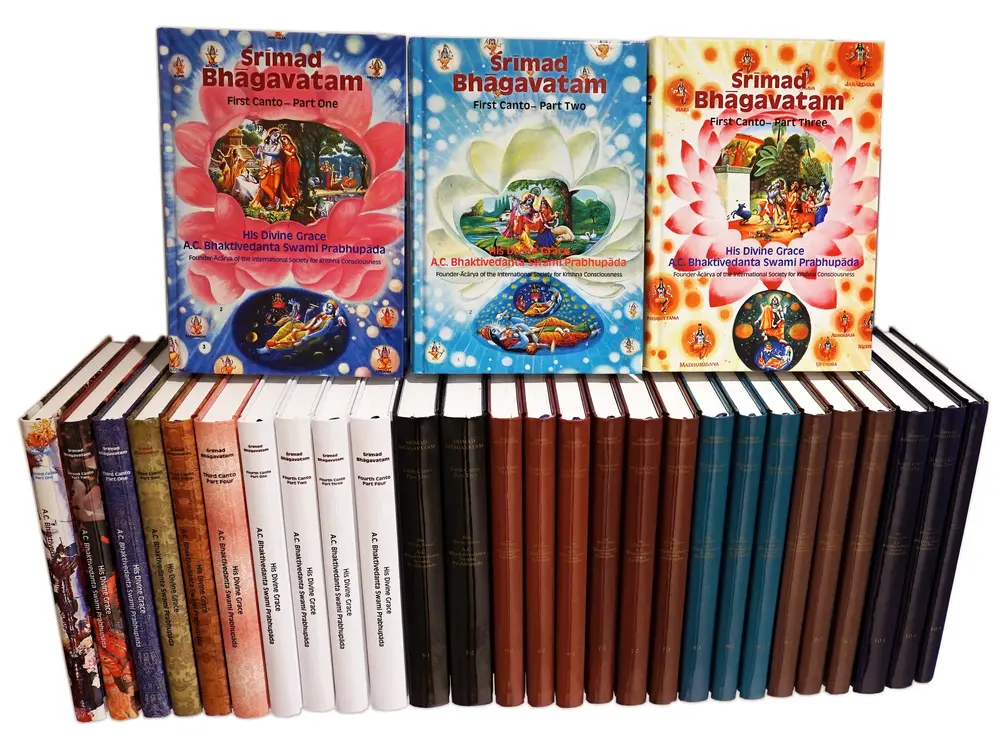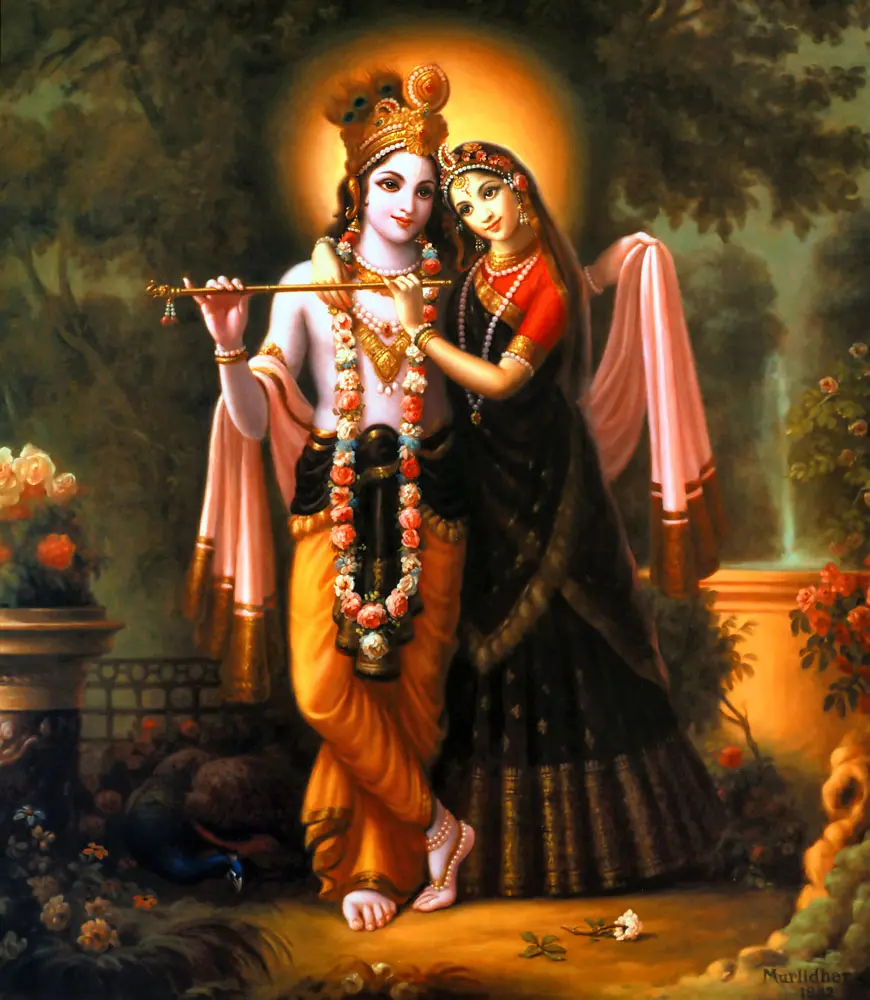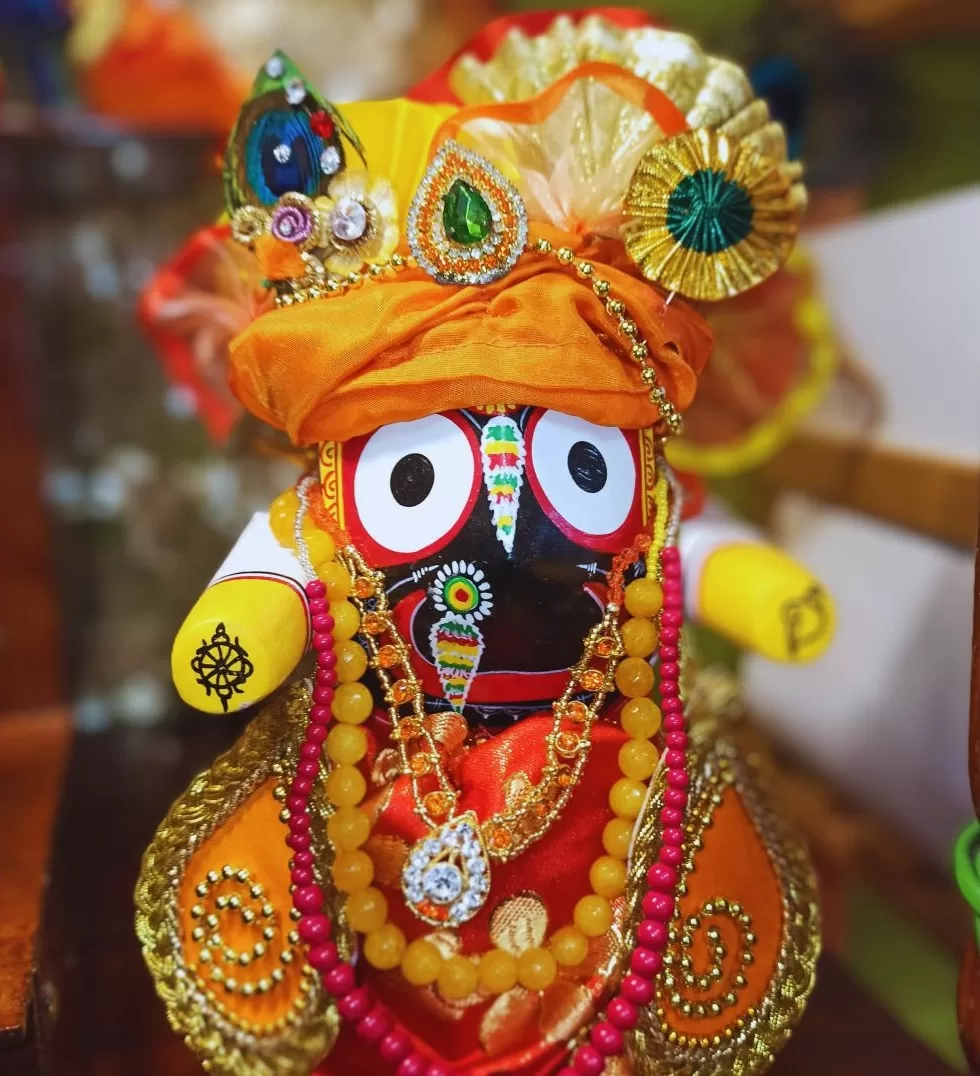
Hare Krishna, tomorrow is Appearance day of Srimati Radharani, today article: Worship of Krishna Without Radha is Futile is from Bhakti Ballabh Tirtha Gosvami
Prayers
Śrī Guru-Praṇāma:
oṁ ajñāna-timirāndhasya
jñānāñjana-śalākayā
caksur unmīlitaṁ yena
tasmai śrī-guruve namaḥ
“I offer my respectful obeisances unto my spiritual master, who with the torchlight of knowledge has opened my eyes, which were blinded by the darkness of ignorance.”
Two important verses:
suna suna nityananda, suna haridasa
sarvatra amara ajna karaha prakasa
prati ghare ghare giya kara ei bhiksa
‘bala krsna, bhaja krsna, kara krsna-siksa’
“Listen, listen, Nityananda! Listen, Haridasa! Make My command known everywhere! Go from house to house and beg from all the residents, ‘Please chant Krishna’s name, worship Krishna, and practise what Krishna teaches.’” (Sri Chaitanya-bhagavat, 2.13.8-9)
harer nāma harer nāma
harer nāmaiva kevalam
kalau nāsty eva nāsty eva
nāsty eva gatir anyathā
“In this age of quarrel and hypocrisy, the only means of deliverence is the chanting of the holy names of the Lord. There is no other way. There is no other way. There is no other way.”
Mahā-mantra Hare Kṛṣṇa:
Hare Kṛṣṇa Hare Kṛṣṇa
Kṛṣṇa Kṛṣṇa Hare Hare
Hare Rāma Hare Rāma
Rāma Rāma Hare Hare
Worship of Krishna Without Radha is Futile
Harikathā, Śrīla Bhakti Ballabh Tīrtha Goswami Mahārāj
Śrī Gurudeva first narrates on why Śukadeva Gosvāmī did not take the name of Rādhā directly in Śrīmad-Bhāgavatam. He then explains the meaning of a hymn written by Śrīla Bhaktivinoda Ṭhākura, ‘rādhā-bhajane yadi mati nāhi bhelā’. He also emphasizes on the fact that without understanding Kṛṣṇa-tattva nobody can understand Rādhā-tattva. He narrates Brahma-vimohana-līlā to indicate how even Brahmā failed to understand Kṛṣṇa when He appeared as a cowherd boy.
Please forgive me for my offences which I might have committed knowingly or unknowingly for which reason I am unable to feel any spiritual ecstatic feelings on the holy advent day of Śrīmatī Rādhārāṇī, the absolute counterpart and complete internal potency, of Supreme Lord Śrī Kṛṣṇa. I pay my innumerable prostrated obeisances again and again. There is no certainty of life. Any moment we may leave this world. If I do not get the grace of Śrīmatī Rādhārāṇī and Her dearest persons, then my spiritual life has no value.
The absolute internal potency of Supreme Lord Śrī Kṛṣṇa has made Her appearance here in this world on this holy day. Generally I stay in India, mostly in Kolkata Maṭha, but continuously for two years, now I am coming to Moscow. Last year also, I had the opportunity to observe Śrī Rādhāṣṭamī here as per your desire.
I have heard from our Guru Mahārāja that our Parama Gurudeva Nitya-līlā-praviṣṭa Oṁ Śrīla Bhaktisiddhānta Sarasvatī Ṭhākura, is not an ordinary human being; he is actually the dearmost associate of Śrīmatī Rādhārāṇī. All of Śrīla Bhaktisiddhānta Sarasvatī Ṭhākura’s associates know him as Nayanmaṇi Mañjarī.
In his sermons, he said, “Śrīmatī Rādhārāṇī is, in all the pastimes of Śrī Kṛṣṇa, the highest amongst all devotees.” Yet, Her name is not mentioned in Śrīmad-Bhāgavatam directly. Why? Our Gurumahārāja used to say one English word, ‘major-domo’, meaning chief servant who makes arrangements in service. He heard from his Gurudeva Śrīla Bhaktisiddhānta Sarasvatī Ṭhākura. Śrīmatī Rādhārāṇī is the major-domo of the Supreme Lord Śrī Kṛṣṇa. All are subservient to Her. Without Her, Kṛṣṇa cannot have His highest pastimes in a consort hood of love. But why is Her name not mentioned in Śrīmad-Bhāgavatam?
Bhaktisiddhānta Sarasvatī Gosvāmī Ṭhākura expressed his heart to our Gurudeva and other Guruvarga, because nobody thinks we can speak about Śrīmad-Bhāgavatam more than Śukadeva Gosvāmī. It would be vanity and the cause of a spiritual fall if you say, “I can speak more than Śukadeva Gosvāmī.” If that kind of vanity is there, we cannot have devotional spiritual amelioration. Why did Śukadeva Gosvāmī not clearly speak about Śrīmatī Rādhārāṇī while he was speaking about the whole Śrīmad-Bhāgavatam to Parīkṣit Mahārāja?
Śrīmatī Rādhārāṇī can make Kṛṣṇa’s heart perturbed and make Him feel ecstatic. Kṛṣṇa, the Supreme Lord, is Her object of love. The Supreme Lord Kṛṣṇa is crying to get the company of Śrīmatī Rādhārāṇī. Śukadeva Gosvāmī could have uttered the name of Rādhārāṇī directly, but if he would have done the same his voice could have been choked and tears would have rolled down from his eyes, and he would not be able to complete reciting about Śrīmad-Bhāgavatam to Parīkṣit Mahārāja.
For that reason, he could not utter directly, but indirectly he has said. He thought ‘If I utter, I won’t be able to complete my reciting of Śrīmad-Bhāgavatam to Parīkṣit Mahārāja and he will not be rescued from the curse.’ Our Bhaktisiddhānta Sarasvatī Gosvāmī Ṭhākura said that. But, we are uttering, “Rādhā! Rādhā!” And no tears are coming. Kṛṣṇa is weeping, but we are feeling nothing.
Now, Śukadeva Gosvāmī said indirectly, which also our Parama Gurudeva pointed out:
anayārādhito nūnaṁ
bhagavān harir īśvaraḥ
yan no vihāya govindaḥ
prīto yām anayad rahaḥ(Śrīmad-Bhāgavatam 10.30.28)
When there was rāsa-līlā with all the gopīs, one of the gopīs (without referring to the name), when She left that rāsa-līlā place then millions of gopīs could not keep Kṛṣṇa there. When Kṛṣṇa left, all the gopīs were crying. After getting the vision and contact of Rādhārāṇī, He could console Himself (Kṛṣṇa was consoled only after getting contact of Rādhārāṇī). Indirectly it is said, not directly. Also, Śukadeva Gosvāmī thought, ‘If I say something more, the enslaved jīvas will not be able to understand it.’
Generally, I go through the teachings of Śrīla Bhaktisiddhānta Sarasvatī Gosvāmī Ṭhākura on Rādhāṣṭamī Tithi, what he delivered, what he spoke for the eternal benefit of his disciples at that time. He said something, by hearing which, we conditioned souls may get afraid of. He said, “If a jewelled necklace, a very valuable necklace of diamond or gold is given to a monkey, what will that monkey do?
He will tear it”. He is giving us this warning. We are reading Śrīmad-Bhāgavatam spoken by Śukadeva Gosvāmī. When Śukadeva Gosvāmī could not utter, how could an enslaved jīva like me utter? He is Brahmagyānī Ṛṣi, just from the womb, mahā-jñānī, mahā-yogī, mahā-bhāgavata — he could not utter. We should think about this very deeply.
Our Mahāmantra has got the reference of Rādhārāṇī. Actually we are worshipping Lakṣmī-Nārāyaṇa. Rādhā-Kṛṣṇa is the object of pure, sweet love only. We have a portrait of Rādhā-Kṛṣṇa in the front, but actually we are worshipping Lakṣmī-Nārāyaṇa.
We are not worshipping Rādhā-Kṛṣṇa. Gradually when our mind will become sanctified then our object of worship will become Rādhā-Kṛṣṇa. Our Guruvargas have said, “Your object of worship is Rādhā-Kṛṣṇa but (before you get fully sanctified) you should worship as per rules and regulations, as per scriptural injunctions, as per the direction of the Vaiṣṇavas.” Śrīla Bhaktivinoda Ṭhākura writes in one of his songs,
vidhi-mārga-rata jane
svādhīnatā ratna dāne
rāga-mārge karān praveśa“Krishna eventually bestows the jewel of independence unto those persons who are attached to the path of rules and regulations, thereby allowing them entrance into the path of spontaneous loving service.”
When your mind is sanctified you will get rāga-bhakti, the spontaneous devotion. But it will not happen all of a sudden. Only then you will understand that the Supreme Lord cannot be many, the Supreme Lord is one. Even if a flower is outside the Supreme Lord, then that Complete Reality will lose His position. Nothing can be outside the pūrṇa, the Complete Reality, the Infinite.
If there is then He will become finite. Infinite is one, but He has got numerous manifestations. Some of His pastimes we know from the scriptures and from the śuddha-bhakta, but he has got infinite forms, infinite pastimes. He is infinite. This world, the brahmāṇḍa is finite but the transcendental realm is infinite.
Nobody can say, “I have realized the Supreme Lord completely.” If someone says that then he does not know the Supreme Lord. As per the degree of submission to the Supreme Lord, by His grace, one can know Him but that is not the last. It is very difficult. Our Bhaktivinoda Ṭhākura has said, although it is very difficult to understand Śrīmatī Rādhārāṇī, our Guruvargas have installed deities in Vṛndāvana: Rādhā-Govinda, Rādhā-Mādhana-Mohana, Rādhā-Gopīnātha, Rādhā-Mādhava, all these—our Guruvarga were knowing fully well that ordinary conditioned souls cannot understand it.
Caitanya Mahāprabhu has appeared to give us the highest Divine Love which we can get by worshipping Nandanandana Śrī Kṛṣṇa. In this special Kali-yuga, to give it to all, the most munificent form of Godhead has manifested as Caitanya Mahāprabhu and Nityānanda Prabhu. We belong to that blessed Kali-yuga, or you may say, Iron Age. We are, in a sense, very fortunate.
Not in all Kali-yugas does Caitanya Mahāprabhu appear. In one day of Brahmā, Nandanandana Śrī Kṛṣṇa, appears in the Dvāpara-yuga of twenty-eighth Catur-yuga of seventh Manu. One Manu’s span of life is seventy-one Catur-yuga. The Supreme Lord appears with His transcendental realm, Vṛndāvana-dhāma and His personal associates. He has not given that prema (Divine Love) to anybody except His own persons.
But in the Kali-yuga next to that Dvāpara-yuga, Nandanandana Śrī Kṛṣṇa takes the mood of Śrīmatī Rādhārāṇī, outside, Gaurāṅga having a golden complexion, inside, Kṛṣṇa. By appearing as Caitanya Mahāprabhu, He distributes the divine love to all. We are fortunate to hear about this. Śrī Bhaktivinoda Ṭhākura has said, which we remember in a hymn. Bhaktivinoda Ṭhākura is the Supreme Lord’s personal associate.
rādhā-bhajane yadi mati nāhi bhelā
kṛṣṇa-bhajana tava akāraṇa gelā
If you have no aptitude, no liking to worship Śrīmatī Rādhārāṇī, then your worship of Kṛṣṇa is futile, it has no value. Rādhā-bhajane yadi mati nāhi bhelā — you have no desire, no longing, no liking to worship Rādhārāṇī, then your worship of Kṛṣṇa is futile.
ātapa-rahita sūraja nāhi jāni
rādhā-virahita mādhava nāhi māni
His own person Śrī Bhaktivinoda Ṭhākura has said this. Without the quality of heat, we cannot think about the Sun. You may say, without the quality of light, we cannot think about the Sun. Just like that without Śrīmatī Rādhārāṇī, we cannot think about Kṛṣṇa. Can you have any conception of the Sun without light, without the quality of heat? Sun and sunlight are identical but the Sun is substance, light is a quality. Light is dependent on the Sun. Light comes from the Sun. Light and Sun, both are identical. Without a relation to the Sun, light cannot exist.
Light is emanating from the diamond. A particle of the light of the diamond is not a diamond, diamond is substance. A part of the diamond is a diamond, because there is a substance in it. But the particle of a ray of the diamond is not a diamond. With your own imagination if you unite all the particles of the light but that will not become the Sun. Sun is intrinsically different. The Sun is not coming from the light, the light is coming from the Sun. All the potencies are coming from Supreme Lord. The Supreme Lord is not coming from the potency.
Jīvas are the parts of the one kind of potency; that is called marginal potency—between the external and internal potency. They may become enveloped by the illusionary energy when they become averse to Śrī Kṛṣṇa, but when they come into contact with śuddha-bhakta, the internal potency in concrete form, by their grace, if they submit to them, then they can enter into the transcendental realm.
An imaginary line of demarcation is there between the internal and external potency of the Lord which is called ‘taṭa — an imaginary demarcation between water and land in a river’. We are coming out from that marginal energy (which is between the internal and external potency of the Lord). Those who want to enjoy this world; they are enveloped by illusion and they come to this prison house. There are so many brahmāṇḍas and so many planets.
Those who have turned their face towards Kṛṣṇa, they are eternally realized souls. Those who are averse, for lakhs and lakhs of births they are moving from here and there, when they come in contact with a śuddha-bhakta (pure devotee) then they can understand, “Oh! Who am I? From where have I come?” Śuddha-bhakta means Kṛṣṇa’s grace in the form of a śuddha-bhakta, grace incarnate. It is said:
kevala mādhava pūjaye so ajñānī
rādhā anādara karai abhimānī
Those who worship Kṛṣṇa only, ignoring His potency, His devotee — kevala mādhava — they are like those who want to see the Sun ignoring light, can they see the Sun? Through light you can see the Sun. It is self-effulgent. Without light you cannot see the Sun. Sun’s own light, you have to accept. Those who think, “I shall go to Kṛṣṇa ignoring the devotees”, they are ignorant, they do not know anything.
They have got some sort of pride, vanity. Why shall I submit to the devotees? Submit to Śrīmatī Rādhārāṇī? I shall go directly to Kṛṣṇa. Abhimānī — they have got pride. So, they do not want to submit to Śrīmatī Rādhārāṇī. How can we understand Mādhava without His potency? They have no conception.
kabhuṅ nāhi karabi tāṅkara saṅga
citte icchasi yadi vraja-rasa-raṅga
You should not associate with such people who ignore His internal potency, His grace incarnate potency, Śrīmatī Rādhārāṇī and Her extensions, all the sakhīs. Never associate with them. If you ever associate with them, you will not be able to get the sweet love of Kṛṣṇa, never.
kabhuṅ nāhi karabi tāṅkara saṅga
citte icchasi yadi vraja-rasa-raṅga
Now you see, time is short, what can I do? We have to know about Kṛṣṇa first and then we can have knowledge of Śrīmatī Rādhārāṇī. Who is Kṛṣṇa? So many pieces of evidence are there for this. Our Gurudeva and Guruvarga used to deliver sermons for two and a half hours daily throughout the year. They couldn’t finish Bhāgavatam. A person like me who has no such knowledge or devotion, how can I speak?
We will find evidence in various scriptures, yet we cannot understand this. When we come into contact with the personal associates of Śrīmatī Rādhārāṇī and submit to them, we shall get that aptitude. We should submit to a bona fide guru, not to a professional guru, and not to all other hypocrites like me. When you submit to śuddha-bhakta (pure devotee), the real self will be awakened and by his grace you will be able to understand the implications (significance) of whatever he will speak. Who is Kṛṣṇa?
kṛṣṇera svarūpa-vicāra śuna, sanātana
advaya-jñāna-tattva, vraje vrajendra-nandana(Caitanya-caritāmṛta, Madhya 20.152)
Caitanya Mahāprabhu is speaking to Sanātana Gosvāmī who was the Prime Minister in the assembly of Hussain Shah Badshah, the emperor. He renounced the Prime Minister-ship and everything, and came to Caitanya Mahāprabhu. Caitanya Mahāprabhu has given instructions through him (making him as the medium). He is a realized soul.
In Caitanya-līlā, he was the Prime Minister, but actually he is the personal associate of Kṛṣṇa. You have already heard who is Kṛṣṇa? Caitanya Mahāprabhu is acting as a guru now, taking the form of Śrīmatī Rādhārāṇī, the greatest, highest guru, and He is giving instruction to all living beings, human beings of this world through Sanātana Gosvāmī:
kṛṣṇera svarūpa-vicāra śuna, sanātana
advaya-jñāna-tattva, vraje vrajendra-nandana“O Sanātana, please hear about the eternal form of Lord Kṛṣṇa. He is advaya-jñāna-tattva — Absolute Knowledge. He is Absolute Infinite Knowledge, but He is also the son of Nanda Mahārāja.”
What is this? Absolute Knowledge, how can He be the son of Nanda Mahārāja? It’s not easy to understand. Then how we can understand Śrīmatī Rādhārāṇī? She is the foundation. Caitanya Mahāprabhu is saying Kṛṣṇa is Absolute Knowledge, Absolute Existence, Absolute Bliss — advaya-jñāna-tattva vraje vrajendra-nandana — but in Vrajadhāma, He is the son of Nanda Mahārāja.
It is very perplexing, how a son of a human being can be Supreme. We think of Nanda Mahārāja as an ordinary human being. So, it is beyond our comprehension. We can’t understand. Vrajendranandana is the son of Nanda Mahārāja. Even Brahmā could not understand Kṛṣṇa as the Supreme Lord. Brahmā has created us, these fourteen worlds, but he could not understand.
When Vraja-gopīs, Vraja-gopas, and Vrajavāsīs, the devotees, milk men and milk maids, they are saying to Brahmā, “Kṛṣṇa is the Supreme Lord.” He said, “How? He is a cowherd boy born in a milkman’s house. I have created him (Nanda Mahārāja), He is the son of Nanda Mahārāja. He cannot be Supreme Lord, I don’t believe it. He has no opulences. He is roaming in the forest with the other cowherd boys.
They have got small, dirty loincloths and with sticks they are grazing cows and calves in the forest. He is also a cowherd boy. He has got no ornaments, no opulences, no gold, no jewels nothing. On His head He is keeping a branch of a tree and a feather of a peacock; a bird. He has got one bamboo flute. And He has become the Supreme Lord? How? How can He be Bhagavān? I don’t believe this.”
Kṛṣṇa killed Aghāsura, a python, a twelve miles long demon, like a mountain. All the cowherd boys, while tending the calves, they saw the demon and said, “Hey! This seems to be like a python, a serpent, but it is like a mountain and there is one good road to enter into the cave.” They thought the tongue of the snake was a very good road to enter into it. “Let us go in,” they thought.
Kṛṣṇa was in the distance. He could see them entering into the great mouth of a python demon. That demon, Aghāsura is the brother of Pūtanā. Kṛṣṇa killed Pūtanā. For that reason her brother Aghāsura was angry and thought, “I shall devour all the children of Vrajavāsī and out of their separation grief, they will all die. I will also devour Kṛṣṇa then Nanda Mahārāja and all the other Vrajavāsīs will die.”
He opened his mouth and these little boys thought this to be a mountain with a good road into the cave. From a distance, Kṛṣṇa said, “Hey! Where are you going?” They could not hear Kṛṣṇa shouting and they entered. That python was waiting to devour Kṛṣṇa. Kṛṣṇa ran and entered into it. One part of the snake’s mouth, the jaw—was on the land and the other was on the sky.
When Kṛṣṇa entered, Aghāsura tried to devour Him, but Kṛṣṇa enhanced and extended His body. Kṛṣṇa expanded Himself so much that, Aghāsura got suffocated and he was unable to inhale air. Kṛṣṇa became so big that by suffocation Aghāsura died and his soul went out from his broken head. By seeing this, Brahmā was astonished.
How has this little boy killed this venomous demon? Then he came to examine Kṛṣṇa. Let me see who He is, he thought. He saw Kṛṣṇa with all the other cowherd boys. They came to the bank of a lake; we say sarovara, for taking food. All the cowherd boys brought food for feeding Kṛṣṇa. They kept it in the trees. In the evening, Brahmā came to see what they are doing.
The cowherd boys said, “Kanhaiyā, this is very good.” By tasting if it is sweet, not bitter or sour, they say, “Kanhaiyā, take this!” And Kṛṣṇa is taking all the remnants of the cowherd boys. Brahmā thought, He cannot be the Supreme Lord. We take remnants of the Supreme Lord, and He is taking their remnants. He rejected thinking that He cannot be the Supreme Lord. They are addressing Kṛṣṇa like this: “Oh Kanhaiyā, Oh Kanhaiyā… our calves have gone away to a distant place. You sit here and take food. We are going to bring them.
If it is very late to return home, our parents will be angry with us. You sit here.” They address Kṛṣṇa as, “Oh Kanhaiyā!” Brahmā thought, “What is this? We have to address the Supreme Lord with respect. The words they use are for inferior persons, not the Supreme Lord. He can never be the Supreme Lord. Alright, let me see what they do?”
Kṛṣṇa says, “No, no, no, no.. You all take your food. I alone can bring all the calves”. And He went to bring them. What did Brahmā do? He lifted all calves and put them in the Cave of Sumeru Mountain at a great millions of miles distance. Kṛṣṇa was searching, very worried and asking so many persons, “Have you seen My calves? You have not seen? How can I go back home without the calves?” “We have not seen.” “How can I return to the house?” “We have not seen, we do not know.”
Then Brahmā smiled and thought, “The Supreme Lord is omnipotent, omniscient. He is not omniscient because He doesn’t know who lifted the calves. If He is my master, the Supreme Lord, He could bring His own calves forcibly but He is asking so many persons, He has got no power to snatch His calves from me and He looks worried, He cannot be the Supreme Lord. I reject Him as the Supreme Lord.”
When Kṛṣṇa returns, He couldn’t see any cowherd boys there. Brahmā lifted them and kept them in the cave of Sumeru Mountain and Kṛṣṇa was searching, and asking so many people about His friends. Now Kṛṣṇa started weeping, “I have lost My calves, and have lost My dear friends. Where shall I go?” He was going to the mountains, the bank of the Yamunā, everywhere, asking so many people.
Then, Brahmā smiled and thought, “You remain here. I am going back to my abode.” When Brahmā left that place, Kṛṣṇa also smiled and He expanded Himself to many calves and cowherd boys. Exactly the same like them. Nothing is impossible for Him.
kartum akartum anyathā-kartuṁ samarthaḥ
“He can do, He can undo, and He can undo the doings again.”
All gopīs, they could not understand that they lost their sons. They had everything the same. Same form, same jumping, everything is exactly same. They could not understand the difference. Only thing they understood was that before they got love and attachment for Kṛṣṇa only and did not have much attachment for their own children. But now by touching their children, they feel like they have got the touch of Supreme Lord Śrī Kṛṣṇa. What is this? When they embrace their sons, tears are rolling down from their eyes.
They are astonished. As previously they were not having this same love and attachment for their children. They had desired to get Kṛṣṇa as their son. All the gopīs used to think, “If Kṛṣṇa could have been our son, we could have kissed Kṛṣṇa, suckled Him, we could have served Him.” To fulfill their desire, Kṛṣṇa came in person as their children but they could not understand. Baladeva could understand, “Hey! What is this? All this is done by Kṛṣṇa!”
All the cows, generally they are fond of their newborn young calf, but as Kṛṣṇa has come as their one-year old calf, all the cows are running towards Him, through the jungle. By going there, those calves started suckling the breasts of the cows and tears are coming out from the eyes of the cows. Kṛṣṇa has fulfilled their desire. Kṛṣṇa came as a calf to fulfill the desire of the cows. They are not ordinary cows; they are munis and ṛṣis who are born as cows.
After one year, when Brahmā came and saw that Kṛṣṇa is doing the same pastimes with the same cowherd boys. “Oh, He is very cunning, He must have learned that I kept them there.” He goes to Sumeru Mountain and sees all the cowherd boys are there; they are sleeping, the same figure, everything the same. “What is this? Oh, I have seen wrong.”
He came to Vṛndāvana and saw them roaming there. He has four faces and he is seeing all the directions simultaneously, seeing here are calves, there are also more calves. Ultimately, he thought after seeing, “Oh! I have committed a great offence! I have lifted the calves and the cowherd boys. They are the personal associates of the Supreme Lord.”
Ultimately he took absolute shelter and prayed for forgiveness. Then by His grace, he saw all Gopas (cowherd boys) and calves as Catur-bhuja—with four arms, śaṅkha-cakra-gadā-padma-dhārī—carrying a conch shell, a disk, a club and a lotus in their arms, kirīṭa-kuṇḍala-dhārī—wearing crown and earrings and pīta-vasana-dhārī—wearing yellow garments. And when he saw this majestic aspect, he understood, “They are my object of worship”. He fell down and prayed. Kṛṣṇa graced him. There are no cowherd-boys, no calves, no four armed Nārāyaṇa.
He gave His darśana of His Kṛṣṇa form. In the left hand, yogurt and rice mixed, bamboo flute in His waist, and a cane under His left armpit. Previously, he criticized Kṛṣṇa for taking food in the left hand and he thought He doesn’t know Vedic instructions. How can He be Bhagavān? Now when he saw Him eating with His left hand, he thought, “Such beauty, such sweetness I have never seen in Vaikuṇṭha-dhāma, Ayodhyā-dhāma, Dvārakā-dhāma, nowhere have I seen something so sweet.”
And he was seeing all avatāras coming from Nandanandana Śrī Kṛṣṇa and then he started saying prayers.
naumīḍya te ’bhra-vapuṣe taḍid-ambarāya
guñjāvataṁsa-paripiccha-lasan-mukhāya
vanya-sraje kavala-vetra-viṣāṇa-veṇu-
lakṣma-śriye mṛdu-pade paśupāṅgajāyaBrahma said: My dear Lord, You are the only worshipable Lord and therefore I offer my humble obeisances and prayers to please you. O son of the king of the cowherds, Your transcendental body is dark blue like a new cloud, Your garment is brilliant like lightning, and the beauty of Your face is enhanced by Your guñja earrings and the peacock feather on Your head.
Wearing garlands of various forest flowers and leaves and equipped with a herding stick, a buffalo horn and a flute, You stand beautifully with a morsel of mixture of yogurt and rice in Your hand. (Śrīmad-Bhāgavatam 10.14.1)
This is a stava, very good. It requires more than one month to read it fully. But it is not possible here.
athāpi te deva padāmbuja-dvaya-
prasāda-leśānugṛhīta eva hi
jānāti tattvaṁ bhagavan-mahimno
na cānya eko ’pi ciraṁ vicinvanBrahmā says, “You are the cause of all causes, Lord of all Lords! Please excuse me. Without Your grace no one can know You in this world. If anyone endeavors to know You for thousands and thousands of years by his own effort, he cannot know. But if anybody submits himself completely to You and then by Your grace, he can know You.” (Śrīmad-Bhāgavatam 10.14.29)
Even Brahmā when he couldn’t know, how an ordinary person can know Him without His grace. Who is Śrīmatī Rādhārāṇī? Śrīmatī Rādhārāṇī is the complete internal potency. Kṛṣṇa is serving Himself in the form of Rādhārāṇī. Śrīmatī Rādhārāṇī, She is not different from Kṛṣṇa. In Gītā, Kṛṣṇa says:
kārya-kāraṇa-kartṛtve
hetuḥ prakṛtir ucyate
puruṣaḥ sukha-duḥkhānāṁ
bhoktṛtve hetur ucyatePrakṛti (nature) is the cause of all material actions, whereas the living entity is the recipient of the sufferings and enjoyments of all these actions. In this material world you can find cause and effect. The suffering is felt by the conscious principle not by this body. (Bhagavad-gītā 13.21)
When the puruṣa (conscious principle), by his own hand, is massaging his body, he gets happiness himself. This action is by his hand which is from prakṛti and who is feeling the happiness? The person, puruṣa is feeling it. Likewise, Kṛṣṇa is serving Himself with His complete potency which is called Rādhā, Rādhikā, Ārādhikā. Kṛṣṇa is worshipping Himself in the form of Rādhā. At the same time He is also enjoying happiness in puruṣa form.
So Śrīmatī Rādhārāṇī is not distinct from Kṛṣṇa. Kṛṣṇa Himself in the form of Śrīmatī Rādhārāṇī is serving Kṛṣṇa. By that service, Kṛṣṇa is getting happiness. The predominating aspect of the moiety is Kṛṣṇa and predominated aspect of moiety is Śrīmatī Rādhārāṇī. So, one half and another half. Our Gurudeva and Bhaktisiddhānta Sarasvatī Gosvāmī Ṭhākura used to say this. You will not find any appropriate English word.
Hlādinī-śakti, Sandinī-śakti, Samvit-śakti. Hlādinī-śakti — all the devotees are giving happiness to Kṛṣṇa. Sandinī-śakti is Baladeva, all the existence in the transcendental realm and in this realm are maintained by Him (Baladeva). And, samvit-śakti-vigraha is Supreme Lord Śrī Kṛṣṇa. Sambandha-jñāna — Kṛṣṇa is my eternal master, Kṛṣṇa is my friend, Kṛṣṇa is my son, Kṛṣṇa is my husband.
This vision will be given by Kṛṣṇa. With that relationship you will get love for Him. As per that relationship, the closeness, you will get that love. Gopīs’ love is highest and among all the gopīs, Śrīmatī Rādhārāṇī is the highest. I had to speak very fast as the time was short.