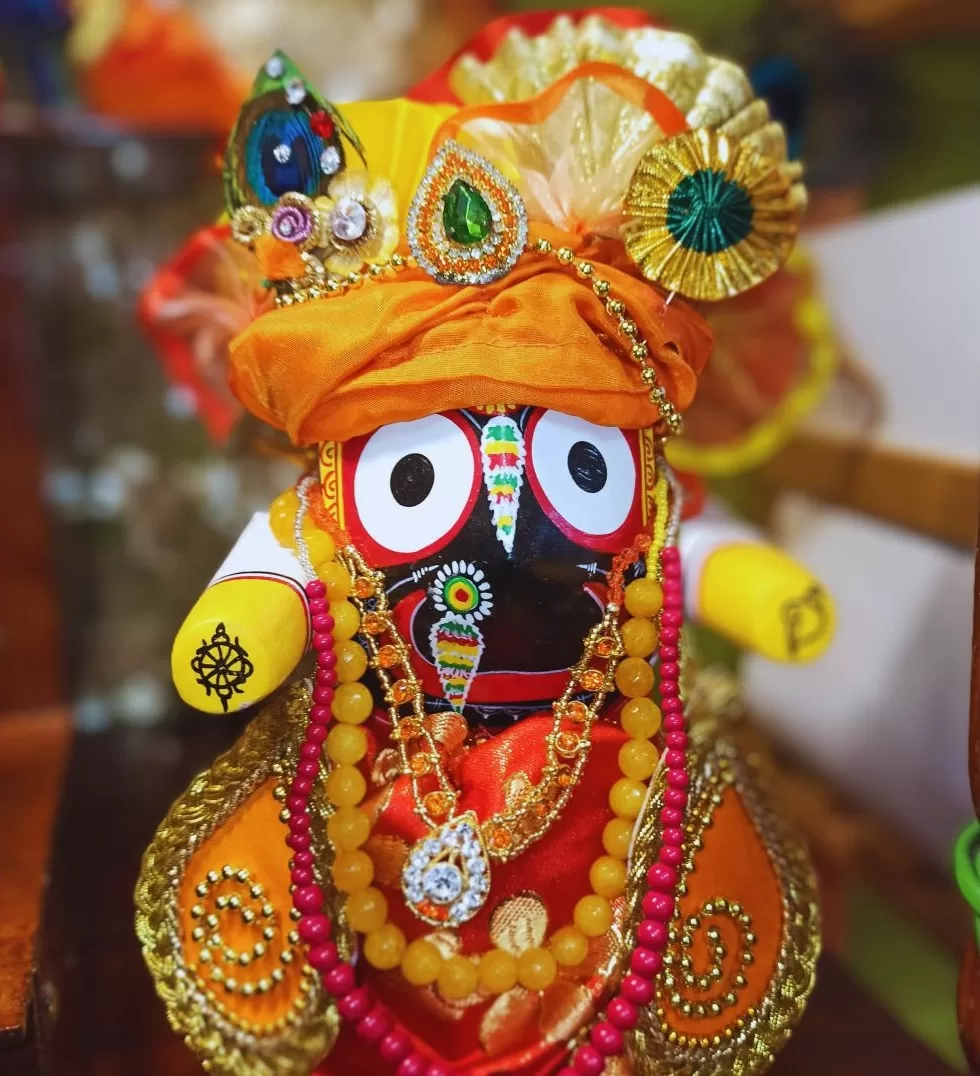
Hare Krishna, today article: What is the svarupa of the sadhaka? is from Bhaktivedanta Narayana Gosvami, disciple of Bhakti Prajnana Kesava Gosvami
Sloka Five
What is the svarupa of the sadhaka?
ayi nanda-tanuja kinkaram patitam mam visame krpaya tava pada-
sthita-dhuli-sadrsam vicintaya
ayi nandatanuja – O Nanda-nandana; visame-bhava ambudau – in the dreadful ocean of material existence; patitam kinkaram mam krpaya – being merciful upon me, your eternal servant fallen (in); tava pada-pankaja-sthita-dhuli-sadrsam – like a particle of dust affixed to Your lotus feet (in other words as your eternally purchased servant); vicintaya – please consider.
Translation
“O Nanda-nandana! Please be merciful upon me, your eternal servant, fallen in the dreadful ocean of material existence as a result of my fruitive actions. Like a particle of dust affixed to Your lotus feet, kindly accept me forever as your purchased servant.”
Sri Sanmodana Bhasyam by Bhaktivinoda Thakura
Is it proper for the sadhaka who has taken up the process of hari-nama-sankirtana to reflect upon the miseries of material existence? To solve this doubt, Sri Gaurasundara has set forth the verse mentioned above (ayi nanda tanuja).
“O Nanda-nandana! In reality, I am Your eternal servant (nitya-kinkara). But now I have fallen into this dreadful ocean of material existence as a result of my own misdeeds. Lust (kama), anger (krodha), envy (matsarata), and other contaminations are like crocodiles with ferocious mouths standing erect, ready to swallow me up. Drifting here and there in the waves of wicked hopes and misplaced anxieties, I am severely oppressed. The powerful blasts of wind in the form of bad association cause still greater anxiety. In such a condition, I have no shelter other than You.”
“Karma, jnana, yoga, austerity, and so on are like bunches of straw that are seen floating here and there. But has anyone succeeded in crossing the ocean of material existence by taking shelter of them? Sometimes persons drowning in the ocean of material existence grab hold of these bunches of straw and pull them down along with them.
“Now there is no refuge other than Your mercy. Your holy name alone is the only sturdy boat, taking shelter of which, the jiva can easily cross the ocean of material existence. Considering all this, I have taken shelter of the very firm boat of Your holy name by the causeless mercy of the lotus feet of sri guru. You are very affectionate to the surrendered souls. Please forgive all the faults of this person, who is without any other shelter, and consider me as a particle of dust at Your lotus feet, for then I shall never be separate from Your lotus feet.”
This is the purport of the above mentioned verse. It is to be understood from this that the bhakti- sadhaka must completely renounce the desire for material enjoyment and liberation.
Sri Caitanya-caritamrta (Antya-lila 20.33-35):
tomara nityadasa mui toma pasariya padiyachon bhavarnave mayabaddha hana
krpa kari’ kara more pada-dhuli sama
tomara sevaka karon tomara sevana punah ati utkantha dainya haila udgam
krsna thani mage prema-nama-sankirtana
“‘O Prabhu! I am Your eternal servant. Due to great misfortune, I have abandoned You. Being bound by maya, I am drowning in the bottomless ocean of material existence. Kindly accept me as a particle of dust at Your lotus feet. I shall become Your servant and eternally engage in Your service.’ Speaking in this way, great longing welled up within the heart of Sri Caitanya Mahaprabhu. In a very humble mood, He again began to pray to Sri Krsna to awaken love for nama-sankirtana.”
Siksastakam: Song 5 (Gitavali)
anadi karama phale padi’ bhavarnave jale tarivare na dekhi upaya
e visaya halahale divanisi hiya jvale mana kabhu sukha nahi paya
asa-pasa sata-sata klesa deya avirata pravrtti urmmira tahe khela kama krodha adi chaya batapade deya bhaya
avasana haila asi bela
jnana karma thaga dui more pratariya lai avasese phele sindhu jale
e hena samaye bandhu tumi krsna krpa sindhu krpa kari’ tola more bale
patita kinkare dhari pada padma dhuli kari deha bhaktivinoda asraya
ami tava nitya dasa bhuliya mayara pasa baddha ha’ye achi dayamaya
“O Parama Karunamaya Krsna! I am drowning in the bottomless ocean of material existence as a consequence of my beginningless fruitive activities. I can see no means of crossing this ocean. My heart is being scorched with the deadly poison of sense gratification. My mind is greatly perturbed. I am continuously troubled, being bound by the stringent ropes of unlimited lusty desires.
I am being tossed here and there, struck by the violent crashing of the waves of material nature. On the one hand, my life duration is dwindling and death is approaching. On the other hand, lust, anger, illusion, envy, greed, and madness are like six thieves which have pounced upon me. Karma and jnana are like two swindlers who have cheated me and thrown me into a bottomless ocean.”
“O Karuna-sindho! At such a time of formidable distress, You are the only friend. O Krsna! Kindly deliver me. I am Your eternal servant. I have forgotten You and thus become tightly bound by the illusory energy. Please accept this fallen servant, Bhaktivinoda, and fix me as a particle of dust at Your lotus feet.”
Vivrti by Bhaktisiddhanta Sarasvati Gosvami Prabhupada
Sri Nanda-nandana is the worshipable object for all jivas. Every jiva is by nature a servant of Krsna. Servitorship to Sri Krsna (krsna-dasya) is inherent within the suddha-svarupa of every jiva. The jiva, having become indifferent to the sense of servitorship toward Sri Krsna, is drowning again and again in the insurmountable and fearful ocean of material existence.
On this account, he is tormented by the three-fold miseries of material life. In this situation, the jiva’s only support is the mercy of the Lord. If Sri Krsna, out of His causeless mercy, accepts the jiva as a particle of dust at His lotus feet, then the jiva’s covered identity and eternal disposition of servitorship to Sri Krsna, can become manifest once again.
The attempt to attain the lotus feet of Sri Krsna by one’s own endeavour is called arohapantha. Krsna cannot be obtained by this method. Only upon surrendering unto Sri Krsna can the jiva obtain the service of the Lord by His will and mercy. Endowed with such firm faith, one should engage in the process of sadhana and bhajana. The words pada-dhuli (dust particle) indicate the jiva’s eternal identity as an infinitesimal part and parcel of Bhagavan (vibhinnamsa).
As long as the jiva is not situated in his svarupa, anarthas are inevitable. In such a condition, ascertainment of the ultimate goal remains ambiguous. Suddha-hari-nama-sankirtana begins upon the awakening of sambandha-jnana, and only by such suddha-nama-sankirtana is prema obtained. When, by continuous chanting of suddha-nama, rati (which is a combination of the samvit and hladini potencies of the Lord’s svarupa-sakti) toward the lotus feet of Bhagavan is awakened in the heart of the jiva, he is then known as a jata-rati-bhakta (a devotee in whom rati or bhava has manifested).
There is a difference between the nama-sankirtana of an ajata-rati-sadhaka (one in whom rati is not manifest) and a jata-rati-bhavuka-bhakta. To deceitfully present oneself as a jata-rati-bhakta before having attained to such a stage is completely inappropriate. After anartha-nivrtti, one becomes situated in naivantarya, or uninterrupted steadiness in the practice of sadhana (sravana, kirtana, etc.).
Next, one attains sveccha-purvika which means meditation on the pastimes of the Lord by one’s own will. This is an advanced stage of remembrance of the Lord which comes in the stage of asakti. This is followed by the condition known as svarasiki when the pastimes of the Lord automatically manifest in one’s heart as an uninterrupted flow (this comes in the stage of bhava after suddha-sattva manifests in the heart). At last one comes to the stage of krsna-prema.
Verses from Srila Bhaktivinoda Thakura’s Sri Bhajana Rahasya
When bhava manifests in the heart of the sadhaka, then dasya-rati is easily awakened. The dasya- rati mentioned here is general. It refers to the natural inborn inclination to serve Krsna. Without the manifestation of bhava, one’s service to Krsna is superficial. But when suddha-sattva manifests in the heart, then one naturally wants to serve Krsna with full expression of the heart. This is supported in Srimad-Bhagavatam (6.11.24):
aham hare tava padaika-mula- dasanudaso bhavitasmi bhuyah manah smaretasu-pater gunams te grnita vak karma karotu kayah
“O Lord Hari! Will I again be able to become a servant of Your servants who have taken exclusive shelter at Your lotus feet? I pray that my heart (antahkarana) may always remain engaged in remembering Your transcendental glories, my words in describing Your qualities, and my body in varieties of service to You, who are the Lord of my life.”
Srila Bhaktivinoda Thakura then says:
chinu tava nitya-dasa, gale bandhi maya-pasa, samsare painu nana-klesa
eve punah kari asa, hana tava daser dasa, bhaji’ pai tava bhakti-lesa
pranesvara! tava guna, smaruk mana punah
punah, tava nama jihva karuk gana karadvaya tava karma, kariya labhuk sarma, tava pade sampinu parana
“I am your eternal servant, but due to my own misfortune, I have forgotten You. Consequently, maya has captured me and, binding me in her chains, she has cast me down into this material atmosphere. I have been wandering here and there in this material existence and rotating through thousands and millions of different species of life.
I am being crushed by varieties of different miseries. Now in the association of the Vaisnavas, my intelligence has become aroused. Now the only aspiration in my heart is that I may become a servant of the servant of Your servants. I may then engage in Your bhajana and obtain a particle of bhakti.”
“O Pranesvara! Let my mind be constantly engaged in remembering Your transcendental glories and attributes; let my tongue be always engaged in chanting Your holy name, form, qualities, and pastimes; let my two hands be engaged in various types of service to You. I shall thus taste the bliss of service to You. My entire being is offered at Your lotus feet.”
By his constitutional nature, the jiva is meant to be enjoyed (bhogya), whereas Krsna is the Supreme enjoyer (bhokta). Therefore, by continuous practice of bhajana, an ardent desire will arise in the heart to become a maidservant of Srimati Radhika who is the embodiment of transcendental bliss (anandamayi). At that time, gopi-bhava, or the loving sentiment exhibited by the gopis, awakens in his heart. This is confirmed in Srimad-Bhagavatam (10.29.38):
tan nah prasida vrjinardana te ‘nghri mulam prapta visrjya vasatis-tvad-upasanasah tvat-sundara-smita niriksana tivra-kama-
taptatmanam purusa-bhusana dehi dasyam
The gopis say, “With a desire to serve You, we have abandoned our families and household and come to Your lotus feet. You are very merciful. Kindly bestow upon us qualification to serve Your lotus feet. O Purusa-bhusana (jewel among men)! Our hearts are burning with desire. Please grant us the vision of Your sweet, smiling lotus face and accept us as Your maidservants.”
The necessity of taking shelter of the lotus feet of Srimati Radhika is expressed in the following statement from Srila Rupa Gosvami:
anaradhya radhapadambhoja renu manasritya vrndatavim tat padankam asambhasya-tadbhava gambhira cittan kutah syama-sindho rasasyavagahah
“If you have never worshipped the dust of the lotus feet of Srimati Radhika or the land of Vraja which is marked with the impressions of Her lotus feet, or have not served the lotus feet of those devotees who taste the profound loving sentiments of Srimati Radhika, how can you become immersed in the blackish ocean of nectar known as syama-sindhu-rasa?”
Attainment of the service of the lotus feet of Srimati Radhika is the one and only goal of the bhavuka-bhaktas. This is exhibited in the eighth verse of Vilapa-kusumanjali:
devi duhkha kula-sagarodare duyamana mati durgatam janam tvat krpa pravala naukayadbhutam prapaya svapadapankajalayam
“O Srimati Radhike, who are adept in amorous sports! I am drowning in an unlimited ocean of horrible miseries. I am severely oppressed and shelterless. Kindly place me on the infallible boat of Your causeless mercy and guide me to the extraordinary shelter of Your lotus feet.”
Those devotees who have accepted the servitorship of Srimati Radhika constantly engage in sankirtana that is intently focused on Sri Krsna. This is stated in Sri Sri Radha-rasa-sudha-nidhi (259):
dhyayams tam sikhi piccha mauli manisam tannama sankirtayan nityam taccarany ambujam paricaran tam mantra varjyam japan sri radha pada dasyam eva paramabhistam hrda dharayan
karhi syam tad-anugrahena paramadbhutanuragotsvavah
“By constant meditation upon Sri Krsna whose head is bedecked with a peacock feather, by chanting His sweet holy names, by serving His lotus feet, and by performing japa of His mantras, we anxiously aspire to obtain the service of the lotus feet of Sri Radhaji. By constantly thinking in this way and by Her causeless mercy, a deep spontaneous attachment (anuraga) will awaken toward Her lotus feet.”
Additional Comment by Srila Narayana Maharaja
Those who taste rasa are called rasika, and those who taste bhava are called bhavuka. The gopis and Krsna are both rasika and bhavuka. When visuddha-sattva, or in other words bhava descends from the gopis upon those who are in the stage of sadhana (sadhanavastha), they attain svarupa- siddhi (perception of their sthayi-bhava), but they have not yet attained their siddha-deha. At that stage they are known as bhavuka-bhaktas. When by further advancement, the sthayi-bhava mixes with the elements of vibhava, anubhava, sattvika-bhava and vyabhicari-bhava and one is able to taste bhakti-rasa, instigated by hearing the pastimes of Sri Krsna, then one is called a rasika.
Just like in rasa-lila, Krsna is dancing and all the gopis are dancing. Krsna is continuously taking cups of rasa and giving them to the gopis – they are rasika, and those hearing all these things, who are drinking unlimited cups of that rasa within their hearts – they are also rasika and bhavuka. Those who meditate upon and remember the bhava exchanged between Radha and Krsna, or that which is found in the gopis, the sakhas, or in vatsalya, are called bhavuka. Bhava is the spiritual emotion of the atma; it is not of this bodily heart.
For example, Krsna is addressing Srimati Radhika: “Who are You? How have You come here (at Govardhana or Radha-kunda)? Why are You stealing all my flowers and breaking all my creepers which are very dear to me?” Then Srimati stopped, turned toward Krsna, and without saying a word, She glared at Him with an angry mood. What does this mean? Although She said nothing, Her look expressed everything. This is bhava. What bhava? “Are You are a thief, or am I a thief? You are a thief, so don’t accuse Me in this way.” She did not say this, but everything was expressed in Her gaze.
! For more Biography look here!
!For more Articles look here!
