Hare Krishna, today article:
The First Day of Kartika Vrata (7.10) is from Bhaktivedanta Narayana Gosvami
Prayers
Śrī Guru-Praṇāma:
oṁ ajñāna-timirāndhasya
jñānāñjana-śalākayā
caksur unmīlitaṁ yena
tasmai śrī-guruve namaḥ
“I offer my respectful obeisances unto my spiritual master, who with the torchlight of knowledge has opened my eyes, which were blinded by the darkness of ignorance.”
Two important verses:
suna suna nityananda, suna haridasa
sarvatra amara ajna karaha prakasa
prati ghare ghare giya kara ei bhiksa
‘bala krsna, bhaja krsna, kara krsna-siksa’
“Listen, listen, Nityananda! Listen, Haridasa! Make My command known everywhere! Go from house to house and beg from all the residents, ‘Please chant Krishna’s name, worship Krishna, and practise what Krishna teaches.’” (Sri Chaitanya-bhagavat, 2.13.8-9)
harer nāma harer nāma
harer nāmaiva kevalam
kalau nāsty eva nāsty eva
nāsty eva gatir anyathā
“In this age of quarrel and hypocrisy, the only means of deliverence is the chanting of the holy names of the Lord. There is no other way. There is no other way. There is no other way.”
Mahā-mantra Hare Kṛṣṇa:
Hare Kṛṣṇa Hare Kṛṣṇa
Kṛṣṇa Kṛṣṇa Hare Hare
Hare Rāma Hare Rāma
Rāma Rāma Hare Hare
The First Day of Kārtika Vrata
by Śrī Śrīmad Bhaktivedānta Nārāyaṇa Gosvāmī Mahārāja
[Dear Respected Readers,
Daṇḍavat praṇāma. All glories to Śrī Śrī Guru and Gaurāṅga. Below is a lecture Śrīla Gurudeva gave on the first day of Kārtika in Mathurā. I apologize we do not know the date. Thank you to Dvija-kṛṣṇa prabhu for recording and to Karuṇāmayī dāsī for digitizing the tape and translating the short parts that were not in English. And, thank you to Haripriyā dāsī for checking the translation.]
This very day, Śāradīya-rāsa-pūrṇimā (the full-moon day on which Kṛṣṇa’s Autumn rāsa-līlā began), is important in so many ways. On this day my Gurudeva entered nitya-līlā, Śrī Śrī Rādhā-Kṛṣṇa’s eternal pastimes. It is because he has entered nitya-līlā that we address him as “nitya-līlā-praviṣṭa oṁ viṣṇupāda aṣṭottara-śata Śrī Śrīmad Bhakti Prajñāna Keśava Gosvāmī Mahārāja.” He is one of the dearest associates of jagad-guru Śrīla Prabhupāda Bhaktisiddhānta Sarasvatī Gosvāmī Ṭhākura. He served Śrīla Prabhupāda throughout his life.
He left on this day, during Śāradīya-rāsa, when the moon was rising in Navadvīpa-dhāma. Navadvīpa-dhāma is non-different from Vṛndāvana-dhāma, and in some ways it is superior. Though both are the same, in some respects it is superior. Navadvīpa-dhāma (Gaura-dhāma), and Gaura-nāma (the holy name of Śrī Caitanya Mahāprabhu) do not take any offense. By Their mercy we can enter Vṛndāvana. By their mercy we can attain the mercy of Vṛndāvana and the mercy of the Divine Couple Śrī Śrī Rādhā-Kṛṣṇa. Without the mercy of Gaura-Nityānanda, we cannot enter the realm of bhakti.
We are told to observe the appearance and disappearance days of Vaiṣṇavas and Guru – both days – but we never observe the disappearance days of Kṛṣṇa and Mahāprabhu and Their manifestations. We can celebrate the appearance day of Kṛṣṇa, as well as that of His incarnations like Rāma, Nṛsiṁhadeva, Kalki, Vāmanadeva, and so on, but nowhere is the celebration of His disappearance day described in śāstra. There are many reasons for this.
We observe the appearance and disappearance days of Gurudeva and Vaiṣṇavas. On the appearance day of Gurudeva we perform Vyāsa-pūjā, because Gurudeva is a manifestation of Śrīla Vyāsadeva, the literary incarnation of Kṛṣṇa. We also observe the birthday of Vyāsadeva. We observe the appearance and disappearance days of Śrīla Rūpa Gosvāmī and the ācāryas in his disciplic succession, but never the disappearance days of Kṛṣṇa and His manifestations.
When a Vaiṣṇava takes birth, his glory is not manifested. No one knows the glory of that Vaiṣṇava, whereas from the first day of the birth of Kṛṣṇa and Mahāprabhu, or any manifestation of Kṛṣṇa, their glory is known. Regarding Vaiṣṇavas, for example, when Parama-pūjyapāda Śrīla Bhaktivedānta Svāmī Mahārāja was born, his glory was not seen. When he took sannyāsa, very little was seen.
After his taking sannyāsa, he preached throughout the world, and at that time his glory was somewhat seen. Then, after his disappearance it became known – Oh, how glorious he is – and we can remember his glory. In this way, a Vaiṣṇava’s and Guru’s disappearance day is more essential and glorious than his appearance day. This day is more important because we can consider so many aspects of his glory, and we can remember all his pastimes.
As today is the disappearance day of our Guru Mahārāja, today I am remembering the entirety of his pastimes, from the beginning – how he preached to the entire world, how he was most dear to his Gurudeva, and how he gave his everything, never keeping anything for himself.
Out of love, his Gurudeva used to call him dokla. Dokla means ‘very foolish,’ meaning that he was never thinking of himself but always thinking of his Gurudeva. Spiritually, it does not really mean ‘foolish;’ it really means ‘not thinking of oneself.’ He never kept even one paisā for himself.
In turn, Guru Mahārāja used to call his Gurudeva bokār-jāhāj. [Jāhāj means ‘ship,’ and bokār means ‘foolish.’ As a ship is full of varied cargo, bokār-jāhāj means ‘a brain full of foolishness.’] Why did he call Śrīla Prabhupāda bokār-jāhāj? It was because Prabhupāda had so much love and affection. He never did anything for himself; never. He gave his whole self to his own Gurudeva and to his disciples. With this quality of his being bokār-jāhāj, he showered his full mercy upon my Guru Mahārāja, who is now very easily worshipped throughout the world.
Whereas my Gurudeva never kept a paisā for himself, nowadays disciples are very ‘wise.’ It is rare that someone will have nothing in their pocket, for nowadays all are very intelligent – with one, two, three, or four pockets. Actually, this is real foolishness; it is most bokār. Those who keep things for themselves cannot understand guru-sevā.
[In 1965-8] One of my Gurudeva’s friends, Parama-pūjyapāda Śrī Śrīmad Bhaktivedānta Svāmī Mahārāja, came to America and made a very good platform for him. Śrīla Svāmī Mahārāja told him, “Now you can come, and throughout the world you will be worshipped by sincere devotees.” [In 1940], when Gurudeva established Gauḍīya Vedānta Samiti in Calcutta, his most intimate friend, Abhaya Caraṇāravinda prabhu [Śrīla Bhaktivedānta Svāmī Mahārāja’s name in his previous āśrama] was present as the other establisher. Thus, this Gauḍīya Vedānta Samiti is also of Śrīla Bhaktivedānta Svāmī Mahārāja. He helped establish it.
[In 1959], Śrīla Bhaktivedānta Svāmī Mahārāja took sannyāsa here – sitting right here – in Mathurā. I was the priest. Kṛṣṇadāsa Bābājī was the kīrtanīya, and Śeṣaśāyī prabhu and others were also singing kīrtana. They were witnesses of this ceremony, along with Raṅganātha Bābā, Kuñjabihārī prabhu, Padmanābha Mahārāja, Muni Mahārāja, and many other sannyāsīs.
[In 1968], on the evening of the full moon, we were performing kīrtana – all varieties of kīrtana. Especially, I was singing, “O he Vaiṣṇava Ṭhākura,” “Gaurāṅga Bolite Habe,” “Hari Haraye Namaḥ Kṛṣṇa Yādavāya Namaḥ,” “Jaya Rādhe Jaya Kṛṣṇa, Jaya Vṛndāvana,” and all kinds of prayers. We performed guru-vandanā and Vaiṣṇava-vandanā, and Gurudeva was hearing.
When we saw that he was about to leave this world, we began to chant, “Hare Kṛṣṇa Hare Kṛṣṇa Kṛṣṇa Kṛṣṇa Hare Hare, Hare Rāma Hare Rāma Rāma Rāma Hare Hare.” While we were singing kīrtana, we kept his photo of his Gurudeva and Rādhā-Kṛṣṇa and Mahāprabhu in front of him, and he was uttering, “Hare Kṛṣṇa Hare Kṛṣṇa Kṛṣṇa Kṛṣṇa Hare…”
All began to weep.
In the meantime, as the pūjārī was performing sandhyā-ārati, the garland of Rādhikā or Kṛṣṇa fell down, and, weeping, he ran to us and we gave the garland to Gurudeva. Pūjyapāda Śrī Rūpa Siddhāntī Mahārāja and others were called, and together we gave samādhi to Gurudeva throughout the night. Then, throughout the morning, we remembered and glorified his pastimes – how he served Rādhā-Kṛṣṇa, Mahāprabhu, Nityānanda Prabhu, and his Gurudeva.
What is the meaning of the word viraha (generally understood as ‘separation’)? Our Gurudeva used to explain its significance. ‘Vi’ means ‘in a special way,’ and ‘raha’ means ‘meeting.’ Thus, viraha means ‘meeting internally, in a special way, by prema. For example, Śrīmatī Rādhikā and the gopīs used to meet with Kṛṣṇa in Vṛndāvana when He was in Mathurā.
They were always thinking, and thinking, and thinking of Him; totally absorbed. Kṛṣṇa used to directly manifest in Vṛndāvana and meet with them. They would think that they were seeing Him in a dream or a sphūrti (vision), but actually He had come to them.
In the Gambhīrā, Mahāprabhu was full with the intrinsic mood of Rādhā and, in viraha, was always totally absorbed in the pastimes of Kṛṣṇa.
Whatever ideas I am now expressing have all come from my Gurudeva. He used to explain so much about viraha. I want to publish a Vaiṣṇava literature describing the glory of the Vaiṣṇava viraha (the real mood of separation from exalted Vaiṣṇavas).
The glory of viraha, separation, is that meeting is present within it. Such separation is not a bad thing. There is no unhappiness in such separation, as revealed in the separation pastimes of Sītā devī and Śrī Rāmacandra. Their pastimes are full of hardships, wherein Rāma was always immersed in feelings of separation from Sītā.
Rāma sent Sītā out from His kingdom, and Lakṣmaṇa took Her to Vālmīki’s āśrama. Just before Rāma’s pastimes were to come to an end in this world, He called for her. Vālmīki then brought her and her two sons to Rāma’s assembly. Hundreds of thousands of Ayodhyā residents were assembled there, including Rāma’s mothers Kauśalyā, Sumitrā, and Kaikeyī.
Vālmīki was walking in front. Sītā’s head was lowered, as she held the hands of her sons Lava and Kuśa in her own hands and walked into the silent, awe-filled assembly. Rāma gave a signal to give Sītā a place to sit, after which she and Lava and Kuśa sat down along with Vālmīki.
Lord Rāma announced, “I know that Sītājī is pure. I know that there is not a black spot on her. I have no doubt. I am a King and I must maintain My dharma, so I had to send the Queen out of the kingdom – but I always kept Sītā in my heart. My desire is that, in front of everybody, let her purity be established.”
When Sītā heard this, she stood up, folded her palms, and declared, “Is proof still needed? All right, I will give You proof.” Then, she said three times, “O Pṛthvī devī (Mother Earth), If I am pure, please open yourself and take me in your lap. If I have never touched any other man but Rāma – even in my mind or heart, then open yourself and take me into your lap.
If in my helpless condition someone touched my body, I cannot say anything about that; but if in my mind I have not given any place to anyone but Rāma, O, Pṛthvī devī, please open up.” In this way, Sītā devī prayed three times to Mother Earth. At that moment Mother Earth, Pṛthvī devī, rose from the now opened earth on a golden chariot and took Sītā in her lap – and then they both disappeared into the earth.
Lava and Kuśa began to weep for their mother, all the queens wept, all the people wept, and Rāma also wept. Rāma took his bow and arrow and exclaimed, “O Pṛthvī devī, O Mother, remember that I punished the ocean. Return my Sītā, otherwise I will punish you as well, by breaking you in pieces.” Vālmīki then approached Rāma and said, “[The time has come. I have not written beyond this point] Please be peaceful. It is Your time to go. Sītā went first [Rāma’s potency, Sītā devī, set the platform for Him to leave His Earthly pastimes], and now You must also go.”
When people come to a theatre and watch a drama of these pastimes, they bitterly weep. On the next day the same drama takes place again, and still more people come than on the first day. If crying is so painful, why do more people come on the following day? And why do the same people come back to cry? It is because in this crying, there is a special kind of pleasure.
If a person does not have in his heart this kind of separation mood for his guru, that person’s heart is like a thunderbolt. He does not even have a trace of bhakti in his heart. Guru-niṣṭhā is the backbone of all bhakti, and without guru-niṣṭhā, a person is devoid of any kind of bhakti. His heart is zero.
Guru Mahārāja always served his Gurudeva with his life and soul. For the pleasure of his Gurudeva, he was willing to jump in the ocean or the fire.
Śrīla Prabhupāda Bhaktisiddhānta Sarasvatī Ṭhākura was once doing Navadvīpa parikramā along with thousands of pilgrims. On the third day he came to Navadvīpa town, in front of the Prauḍha Māyā temple, which was surrounded by a big population. All the so-called brāhmaṇas and caste Gosvāmīs there were in opposition to Śrīla Prabhupāda, because they felt he thought himself superior to brāhmaṇas.
They made a conspiracy saying, “We will punish and kill him.” About a thousand of these brāhmaṇas took sticks, bricks, stones, soda water and hot water; and they threw these from all the houses. This was reported to the police, but the police were silent; they were favoring the caste brāhmaṇas.
There was no way to escape. Śrīla Prabhupāda was alone; all his senior disciples had fled. One brahmacārī was with him – in white cloth, not saffron. He at once signalled to Śrīla Prabhupāda and they both approached a house. He begged the householders, “O, please open the door. We want to stay for a moment.” He immediately gave Śrīla Prabhupāda his own white clothes, and took his sannyāsī clothes and daṇḍa. In this way he actually took sannyāsa there, and then he somehow sent Śrīla Prabhupāda, in white cloth, to Māyāpura.
My Gurudeva, Śrīla Bhakti Prajñāna Keśava Gosvāmī Mahārāja, was beautiful like Prabhupāda, and therefore he was able to take Prabhupāda’s sannyāsa daṇḍa, sannyāsa cloths, and cādar. He gave his life to save his own Gurudeva. Prabhupāda loved him so much, and made him most dear.
Gurudeva’s disappearance day in Kārtika month took place on Śāradīya-rāsa. What can I say of the glories of this month; you should know its glories.
Śrīmatī Rādhikā is called Ūrjeśvarī (the Mistress of all power), and this entire month is called Ūrjā month. Ūrjā means power, or śakti. Kṛṣṇa can only wish, but He cannot do anything to fulfil His wish. He depends on Śrīmatī Rādhikā for everything. He can wish, and She can fulfil.
Do not think Kṛṣṇa lifted Govardhana Hill. Śrīmatī Rādhikā lifted it. Kṛṣṇa can only desire to do whatever He wants to do; that is why Śrīmatī Rādhikā is Ūrjeśvarī. As stated in the brahma-gāyatrī mantra, “savitur vareṇyam.” Ūrjā-śakti is the source of the light of the sun; the sun’s light comes from Rādhājī. Rādhikā is vareṇyam. She is worshipful by the Sun, who gives heat and light.
The brahma-gāyatrī mantra concludes with the words “Dhiyo yo naḥ pracodayāt.” We meditate on Śrīmatī Rādhikā and pray that She will come in our heart. We pray that She will manifest Her beauty, so that we can see how beautiful She is.
Another meaning of ūrjā is bhakti, or prema. Prema, the purest love for Śrī Kṛṣṇa, comes from the heart of Rādhikā, not from Kṛṣṇa. He is the taster. He is the relisher of love and affection, but that love and affection comes from Rādhikā’s heart. She gives ūrjā, the power of prema, love and affection, to all, even to Kṛṣṇa. Kṛṣṇa cannot exist, or remain alive, without Her. Without Her He would be nirviśeṣa-brahma (the formless and qualitiless spirit whole). This is why Rādhājī is Ūrjeśvarī. Without worshipping Her, we cannot achieve Kṛṣṇa.
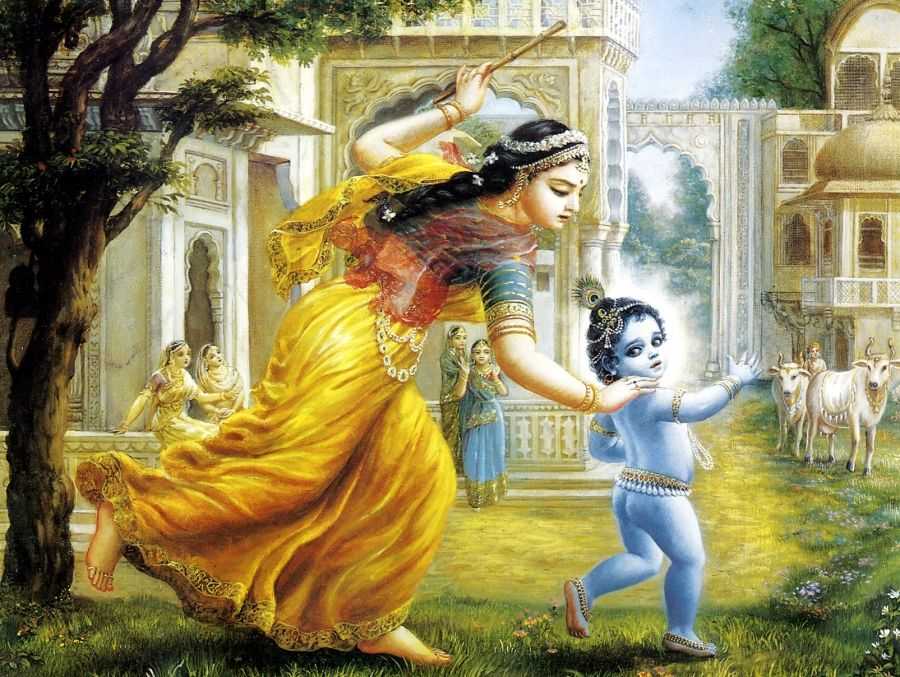
Because Rādhikā is the predominating Deity of Kārtika month, She is also called Dāmodarī. Kṛṣṇa is Dāmodara, and Rādhikā is Dāmodarī. Without Rādhikā, no one can bind Kṛṣṇa permanently. Mother Yaśodā can bind Him for a day, but Rādhikā can bind Him forever.
During this Kārtika month, Kṛṣṇa lifted Govardhana on the very day of Govardhana pūjā, just before the full moon day of this month, and Dīpāvalī, the day on which Mother Yaśodā bound Her son Kṛṣṇa, also took place in this month.
Dīpa means ‘light,’ and real light manifests in the form of bhakti-tattva (the established truths of pure devotional service), kṛṣṇa-tattva (the established truths about the Supreme Lord Śrī Kṛṣṇa), māyā-tattva (the truth of this deluding material world), jīva-tattva (the truth of the eternal spirit soul) – all this knowledge is ‘light.’ Knowledge of all these tattvas comes from Śrīmatī Rādhikā.
Śrī Kṛṣṇa left the rāsa dance on this day, in this month. Thus feeling great separation from Him, the gopīs sang their Gopī-gīta. In this month they also sang their Veṇu-gīta, and some of their verses (Śrīmad-Bhāgavatam 10.21.1,5,9) are as follows:
śrī-śuka uvāca
itthaṁ śarat-svaccha-jalaṁ
padmākara-sugandhinā
nyaviśad vāyunā vātaṁ
sa-go-gopālako ‘cyutaḥ
[“Śukadeva Gosvāmī said: Thus the Vṛndāvana forest was filled with transparent autumnal waters and cooled by breezes perfumed with the fragrance of lotus flowers growing in the clear lakes. The infallible Lord, accompanied by His cows and cowherd boyfriends, entered that Vṛndāvana forest.”]
barhāpīḍaṁ naṭa-vara-vapuḥ karṇayoḥ karṇikāraṁ
bibhrad vāsaḥ kanaka-kapiśaṁ vaijayantīṁ ca mālām
randhrān veṇor adhara-sudhayāpūrayan gopa-vṛndair
vṛndāraṇyaṁ sva-pada-ramaṇaṁ prāviśad gīta-kīrtiḥ[“Wearing a peacock-feather ornament upon His head, blue karṇikāra flowers on His ears, a yellow garment as brilliant as gold, and the Vaijayantī garland, Lord Kṛṣṇa exhibited His transcendental form as the greatest of dancers as He entered the forest of Vṛndāvana, beautifying it with the marks of His footprints. He filled the holes of His flute with the nectar of His lips, and the cowherd boys sang His glories.”]
gopyaḥ kim acarad ayaṁ kuśalaṁ sma veṇur
dāmodarādhara-sudhām api gopikānām
bhuṅkte svayaṁ yad avaśiṣṭa-rasaṁ hrādinyo
hṛṣyat-tvaco ‘śru mumucus taravo yathāryāḥ[“My dear gopīs, what auspicious activities must the flute have performed to enjoy the nectar of Kṛṣṇa’s lips independently and leave only a taste for us gopīs, for whom that nectar is actually meant! The forefathers of the flute, the bamboo trees, shed tears of pleasure. His mother, the river on whose bank the bamboo was born, feels jubilation, and therefore her blooming lotus flowers are standing like hair on her body.’]
In this month, although child Kṛṣṇa was tied to his mother’s grinding mortar, He gave mukti, meaning bhakti, to Nalakūvara and Maṇigrīva. As stated in Śrī Dāmodarāṣṭakam, He not only delivered them, but He gave them positions as singers – Madhu-kaṇṭha and Snigdha-kaṇṭha – in His own assemblies in Goloka Vṛndāvana.
kuverātmajau baddha-mūrtyaiva yadvat
tvayā mocitau bhakti-bhājau kṛtau ca
tathā prema-bhaktiṁ svakāṁ me prayaccha
na mokṣe graho me ‘sti dāmodareha[“O Lord Dāmodara, just as the two sons of Kuvera – Maṇigrīva and Nalakūvara – were delivered from the curse of Nārada and made into great devotees by You in Your form as a baby tied with rope to a wooden grinding mortar, in the same way, please give to me Your own prema-bhakti. I only long for this and have no desire for any kind of liberation.”]
In this month, along with His associates the Vrajavāsīs, Śrī Kṛṣṇa performed worship of the cows and calves (go-pūjā), brāhmaṇas, and Govardhana Hill. In this month they performed Govardhana parikramā.
Then, when Indra created torrential rains to destroy Vṛndāvana, Kṛṣṇa lifted Govardhana Hill, which was a trick to bring the gopīs in pūrva-rāga close to Him. Kṛṣṇa was thinking that all the gopīs should come nearer. Mother Yaśodā and Nanda Bābā were also present there, but on that day the young gopīs were not at all shy; they felt no shame. This was the first day the gopīs came so near to Kṛṣṇa.
Kṛṣṇa thus broke the pride of Indra. Indra then performed abhiṣeka of Kṛṣṇa and gave Him the name Govinda. Govindam ādi-puruṣaṁ tam ahaṁ bhajāmi. [All the devotees sang this song along with Śrīla Gurudeva, who, after a couple of moments said…] In this way. [Śrīla Gurudeva now led the devotees in singing the verse in the same tune as sung in the ISKCON temples, and then said…] We remembered Svāmījī.
In this month Śāradīya-rāsa took place, but it did not last for only one month. Even Kṛṣṇa Himself could not conceive how long it lasted, nor could the Gopīs. Only Yogamāyā knew. The moon stopped in one place, not moving at all, and the sun stayed on the opposite side of the rāsa. If the sun had made its presence there would not have been rāsa, so the sun also stopped in one place.
All these pastimes were performed in the month of Kārtika. In this way, this month is very high.
In the evening, at 4pm, we will all sit here and glorify My Guru Mahārāja’s contribution to the world. Now we will go to the Yamunā to make our vows (saṅkalpa) and offer our prayers that our parikramā will be successful and our desires will be fulfilled. Yamunā is Kṛṣṇa’s associate, Viśākhā-devī. You should all be ready and come. When we reach Vṛndāvana we will take vow again, at Keśī-ghāṭa.
[Endnote from the editors: For clarity, we have added some details regarding Śrīla Bhakti Prajñāna Keśava Gosvāmī Mahārāja’s changing cloths with Śrīla Prabhupāda (from Śrīla Gurudeva’s “Secret Truths of the Bhāgavatam” p. 145-146)]