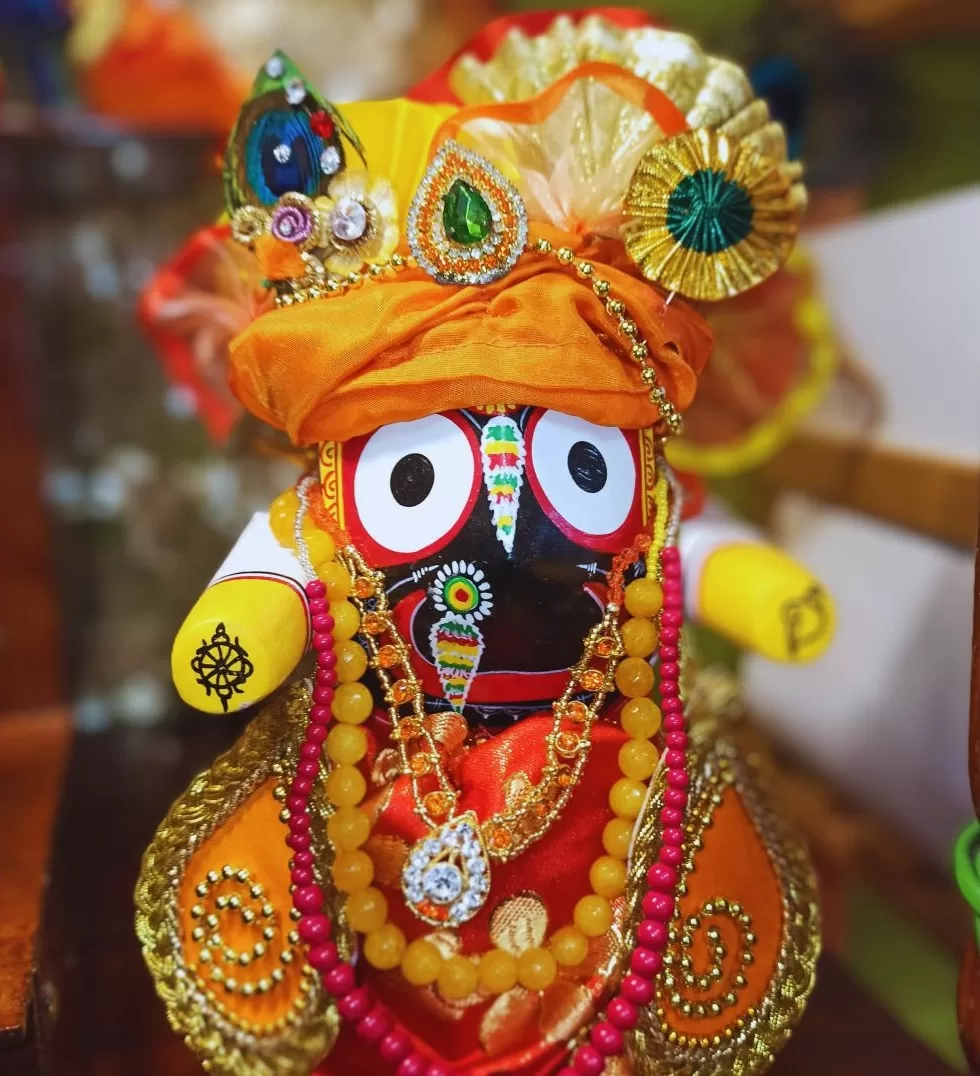
Hare Krishna, today article: The Attitude of a Servant: Being the Seen not the Seer is from Bhakti Prajnana Kesava Gosvami
Prayers
Śrī Guru-Praṇāma:
oṁ ajñāna-timirāndhasya
jñānāñjana-śalākayā
caksur unmīlitaṁ yena
tasmai śrī-guruve namaḥ
“I offer my respectful obeisances unto my spiritual master, who with the torchlight of knowledge has opened my eyes, which were blinded by the darkness of ignorance.”
Two important verses:
suna suna nityananda, suna haridasa
sarvatra amara ajna karaha prakasa
prati ghare ghare giya kara ei bhiksa
‘bala krsna, bhaja krsna, kara krsna-siksa’
“Listen, listen, Nityananda! Listen, Haridasa! Make My command known everywhere! Go from house to house and beg from all the residents, ‘Please chant Krishna’s name, worship Krishna, and practise what Krishna teaches.’” (Sri Chaitanya-bhagavat, 2.13.8-9)
harer nāma harer nāma
harer nāmaiva kevalam
kalau nāsty eva nāsty eva
nāsty eva gatir anyathā
“In this age of quarrel and hypocrisy, the only means of deliverence is the chanting of the holy names of the Lord. There is no other way. There is no other way. There is no other way.”
Mahā-mantra Hare Kṛṣṇa:
Hare Kṛṣṇa Hare Kṛṣṇa
Kṛṣṇa Kṛṣṇa Hare Hare
Hare Rāma Hare Rāma
Rāma Rāma Hare Hare
The Attitude of a Servant: Being the Seen, not the Seer
Śrī Śrīmad Bhakti Prajñāna Keśava Gosvāmī Mahārāja
It is mentioned in Śrī Hari-bhakti-sudhodaya (13.2):
akṣṇoḥ phalaṁ tvādṛśa-darśanaṁ hi
tanoḥ phalaṁ tvādṛśa-gātra-saṅgaḥ
jihvā-phalaṁ tvādṛśa-kīrtanaṁ hi
sudurlabhā bhāgavatā hi loke
Devotees of Bhagavān are extremely rare in this world. Therefore the perfection of the eyes is to see them, the perfection of the body is to touch them and the perfection of the tongue is to glorify them. Upon seeing the title of this essay and reading this verse, many people will object to this essay even before reading it.
Offering our brothers, the readers, prostrated obeisances (ṣaṣṭāṅga-praṇāmas) and keeping a straw between our teeth, we earnestly beseech them to hear us. By submissively approaching the lotus feet of an ācārya who is the personified conclusion and the manifested embodiment of śāstra, we can understand that our consideration of śāstra is based on external perception and is nothing but the whim of our minds.
In this verse, a fortunate person who has been blessed by darśana of a bhagavad-bhakta is overwhelmed with bliss. He says, “To have the darśana of a Vaiṣṇava is indeed the perfection of the eyes, to touch him is the perfection of the body and to glorify him is the perfection of the tongue, because in this world such bhagavad-bhaktas are rare.” Such a statement has been delivered by the servant of a Vaiṣṇava at his lotus feet, after the servant has received the Vaiṣṇava’s mercy and been overwhelmed by gratitude for him.
Unless a Vaiṣṇava bestows his mercy upon us and reveals his svarūpa, there is no possibility of us knowing and understanding him. When the Vaiṣṇava mercifully reveals his svarūpa, the jīva remembers his previous mundane, worldly perception of that Vaiṣṇava and he naturally feels a deep anguish in his heart.
It is stated in the above verse, akṣṇoḥ phalaṁ tvādṛśa-darśanam hi – the perfection of the eyes is to have darśana of a Vaiṣṇava. In such darśana the mood to render service under that Vaiṣṇava’s guidance is indeed expressed. This sevana-dharma, or service attitude, of the servant does not aim at attaining his own enjoyment through acts of seeing and touching that Vaiṣṇava. Bhagavān and Bhagavān’s devotees only accept our nature (svarūpa) that is devoted to service. They never accept our mundane nature, which is devoid of service.
Bhagavān is not a mundane entity (prākṛta-vastu). Similarly, the śuddha jīvātmā is also not a mundane entity. In his pure state, the jīvātmā is naturally devoted to service that pleases Bhagavān. The intense eagerness for the darśana of Bhagavān that is observed in him is solely to render service to Bhagavān. The perfection of the sevaka’s feet in visiting the dhāma of Bhagavān is to attain the service of Bhagavān. He cleans the temple of Viṣṇu with his hands, thus enhancing Bhagavān’s pleasure.
The sevaka’s two eyes become blessed by collecting all types of beautiful objects solely for the service of Bhagavān. With his tongue the sevaka performs the kīrtana of Bhagavān’s name, form, qualities and pastimes, thus enhancing His bliss. Besides this, he offers extremely tasteful foodstuffs to Bhagavān, having examined them with his tongue. The sevaka (the worshipper) has a spiritual body so that the sevya (worshipful) Bhagavān can experience the pleasure of touch from that sevaka.
We have entitled this essay: The Attitude of a Servant: Being the Seen, not the Seer. This means that one should not consider himself the subject (seer) of Bhagavān. A person should never hurry to have darśana of Bhagavān with the aim of self-enjoyment. When a person has kāma, or the desire to please his own senses, the door to the transcendental abode of Bhagavān closes to him.
When mundane endeavours for personal enjoyment and false renunciation have been completely eliminated from the heart that has been illuminated by exclusive surrender to Krishna (kṛṣṇaika-śaraṇatā), the servant’s sole disposition is to execute service exclusively for the pleasure of Bhagavān.
The transcendental gopīs of Vraja dress solely for the pleasure of Krishna. Phalgutva, to falsely renounce that which pleases Krishna, can never result in finding a place in their hearts. Their obsession for Krishna is solely to render service to Him. Their act of looking at Krishna’s lotus face without blinking their eyelids is also for enhancing His bliss. When Krishna sees that the gopīs are looking at Him, He becomes delighted. Knowing this, the gopīs are exclusively intent on attaining darśana of Him.
When they look at Krishna, it is not with the intention of personal enjoyment by being the subject (seer). In other words, they become visible to Krishna; they become the object seen by Him. Only to give Krishna bliss do they ‘show’ Him their nature (svarūpa), which is completely devoted to His service. Here the act of ‘showing’ does not express their ego, but indicates the excellence of their service.
Thousands and thousands of pilgrims visit holy places in order to have darśana of Bhagavān. Although most think that they received His darśana, they are actually unlimited miles away from receiving it. When one has actually attained darśana of Bhagavān, he is unable to utter statements like, “The deity is made of wood,” “The deity is made of stone,” “The deity is made of clay,” or “Jagannātha is devoid of hands and legs.” Their act of ‘seeing’ is endowed with the spirit of personal enjoyment, which is not the spirit of a servant of Bhagavān.
Many have lost the path by which they can have darśana of Bhagavān, being covered by the darkness of the new moon night (the spirit of personal enjoyment). Therefore, for their deliverance my śrī guru-pāda-padma has cautioned:
“Do not go to see Jagannātha with a spirit of personal enjoyment, which is born of aversion for Him and which is prevalent in this world. Enter the temple of Śrī Jagadīśa carrying the necessary ingredients, that is, a service attitude that delights Jagannātha. Always keep in mind that the act of ‘seeing’ Jagannātha with mundane eyes is not how a servant sees Him.
The servant’s disposition is to show Him the nature (svarūpa) of his service attitude – in other words, to become the object (the seen). It means to come within His sight in such a way that delights the worshipful Bhagavān. The servant’s attitude is not to derive pleasure himself by seeing Bhagavān. Rather, brilliantly situated within the servant’s heart is the attitude – ‘Bhagavān will be delighted by seeing me.’”
Translated from Sri Gaudiya Patrika, Year 7, Issue 9 by the Rays of The Harmonist team.
Published in English for the first time in Rays of The Harmonist No. 11 Kārttika 2002