Hare Krishna, today article: Thakur Haridas (part 4) is from Bhaktisiddhanta Prabhupada
Prayers
Śrī Guru-Praṇāma:
oṁ ajñāna-timirāndhasya
jñānāñjana-śalākayā
caksur unmīlitaṁ yena
tasmai śrī-guruve namaḥ
“I offer my respectful obeisances unto my spiritual master, who with the torchlight of knowledge has opened my eyes, which were blinded by the darkness of ignorance.”
Two important verses:
suna suna nityananda, suna haridasa
sarvatra amara ajna karaha prakasa
prati ghare ghare giya kara ei bhiksa
‘bala krsna, bhaja krsna, kara krsna-siksa’
“Listen, listen, Nityananda! Listen, Haridasa! Make My command known everywhere! Go from house to house and beg from all the residents, ‘Please chant Krishna’s name, worship Krishna, and practise what Krishna teaches.’” (Sri Chaitanya-bhagavat, 2.13.8-9)
harer nāma harer nāma
harer nāmaiva kevalam
kalau nāsty eva nāsty eva
nāsty eva gatir anyathā
“In this age of quarrel and hypocrisy, the only means of deliverence is the chanting of the holy names of the Lord. There is no other way. There is no other way. There is no other way.”
Mahā-mantra Hare Kṛṣṇa:
Hare Kṛṣṇa Hare Kṛṣṇa
Kṛṣṇa Kṛṣṇa Hare Hare
Hare Rāma Hare Rāma
Rāma Rāma Hare Hare
Thakur Haridas (part 4)
Journal ‘The Harmonist’ Edited by
Shrila Bhaktisiddhanta Saraswati Thakur (No. 5, Vol. XXV, October 1927)
THAKUR Haridas had infringed the social code by giving up yavanic manners and customs, and it was for such offensive conduct that he had been on that day hauled up before the administrator of the district at the instigation of the yavana community which was actuated by a desire to safe-guard the traditional customs of their society.
Thakur Haridas made the following reply, — “All this is merely the sport of the illusory power of God. The true religion is not the monopoly of either yavana or Hindu; and therefore, there can be no danger of the worship of Hari which is the common object of both communities, becoming impossible by one’s leaving the yavana society. God is beyond all material objects; He is the eternal, indivisible and absolute Reality. He is the perfect Truth. One worships Him in the manner that his own understanding approves, this also is His dispensation.
It is not necessary to create disorder by ignoring differences of the fitness of different persons. It is God Himself Who having caused me to be born in a yavana family has employed me on this quest of the highest good; and on the other hand, He may similarly, causing another to be born in the highest brahman family of the Hindus, make him turn a yavana because of his yavanic propensities.
Such is the will of God Who is ever full of beneficence. I will not follow the yavanic custom by reading kalma, giving up the highest good. Be pleased to award any punishment if you consider this an offence. I am prepared to accept it”.
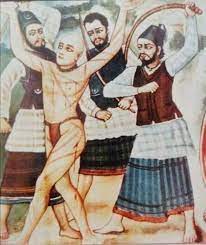
The muluk-pati Kazi now began to blaspheme against Vishnu in scolding Haridas, and when at last Haridas said, “Even if my body be cut to pieces, if body and life leave me, my mouth will never give up the Name of Hari”, being much enraged the Kazi sentenced him to be put to death after being severely whipped at twenty-two market-places of the Amua muluk!
While he was being whipped in the market-places, Haridas employing himself in the recollection of Shree Krishna and chanting aloud Krishna’s holy Name, remained unaffected by pain. The good people of those places noticing the utmost severity of the blows inflicted on the body of Haridas openly sympathized with him, but the wicked rejoiced. Some apprehended that very great harm would befall both the principal as well as his aiders and abettors of such brutal persecution of the great saint.
In the same way that Prahlad was tortured in olden times by command of Hiranya Kashipu, Thakur Haridas as was humiliated and oppressed by those yavanas. Bearing patiently his intolerable pain Ha rid as always said, “Have mercy on all these jivas. O Lord, may none of them offend Thee by their treatment of me!”
Till at last even the yavanas said, “The whole yavana community will suffer the terrible consequences of this inhuman oppression of you who is, indeed; a great saint. But your life has not been ended even by such prolonged and terrible beating. The muluk-pati will put us to death if we fail to kill you!” At this Haridas pitying those yavanas who were beating him exhibited the sight of quitting his mortal frame.
But those evil-minded yavanas, to prevent any good resulting to him if his body were interred in the earth which happened to be the method of disposal of a dead body recommended by the yavana scriptures, thought of casting the body of Haridas into the Ganges!
All this time the great Thakur Haridas, immersed in meditation, was occupied with recollection of Krishna. The yavanas who had been ordered by the Kazi to throw his body into the Ganges were unable with all their efforts to lift it and informed the Kazi of their own discomfiture. It was only then that those ruffians at last desisted from their wicked endeavors.
The muluk-pati Kazi, on the termination of the meditative trance of Thakur Haridas, begged his forgiveness with folded hands, saying, “I am now convinced that you are a great Pir and not merely a wordy sage or a juggling miraculist. Forgive me for my many faults. No one in heaven, earth or the subterranean, is able to know your real nature. You may go where you like, we will no more oppose you”. Thakur Haridas returned to Fulia without being daunted even by such terrible persecution.
At that time Fulia was a most populous village and an important-centre of the brahman community. The brahmans of Fulia received Haridas with great cordiality on his return. Having witnessed those deeds of his transcendental love they sympathized with his misfortunes and discussed among themselves regarding the cause of his sufferings. The holy Thakur said, “I have been a great offender. Having actually heard the yavanas blaspheme against Vishnu I sinned by not opposing and preventing them.
In consequence of that sin those sufferings were necessary for my own good. My offending ear, instead of having been deafened, listened to all those blasphemies with alacrity for which sin Bidhata has awarded the due punishment”. These utterances of the Thakur full of the spirit of humility did not save the muluk- pati and his followers and all their families from destruction.
All of them perished shortly with all their families. The holy saint continued un-opposed to take night and day the Name of Hari in the view of all the people. His cell at Fulia on the bank of the Ganges, by the chanting of the Name of Hari was transformed into Vaikuntha and ceased to be a place within the domain of maya.
A great hissing serpent had taken up its abode in the cell of the Thakur. This did not give rise to the least fear in the mind of Thakur Haridas. He took the Name of Hari all unconcerned, living in the same cell with the huge reptile. At last, however, he was persuaded by the representations of the brahman residents of the village and the pressing entreaties of his friends to make up his mind to give up the cell. At this the serpent of its own accord departed from the place. The brahmans were filled with great wonder by witnessing this extraordinary event.
One day at the house of a certain wealthy man a snake-charmer was exhibiting the scene of the suppression of the serpent Kalia by Krishna, with dancing and singing. Thakur Haridas accidentally arrived on the spot and taking his stand on one side watched the performance. The dancing and singing of the snake-charmer producing in Thakur Haridas the excitation of the lila of Krishna his breath was obstructed and he presently fainted away. Recovering from his fit Prabhu Haridas himself joined in the dancing and singing.
The eight svattic changes were manifested in his body. The snake-charmer stopping his performance stood silently on one side with his palms joined together. The exhibition was, however, resumed after an interval. The spectators joyously sprinkled themselves with the dust trod by the feet of Haridas. A hypocritical brahman in the crowd who was ambitious of religious fame thought within himself that he also would attract the regard of the spectators and the snake-charmer if he exhibited artificially similar svattic manifestations.
Thinking thus that brahman in imitation of Haridas begin to exhibit in his own body all the svattic perturbations in an artificial way. The snake-charmer, who had stood still with joined hands at the time of the spiritual manifestations of Thakur Haridas, noticing this hypocritical exhibition of the brahman, began at once to belabor him with all his might. The hypocrite, feeling the inconvenience of enduring such thrashing for any length of time, took to his heels.
When the spectators asked the snake-charmer the reason for that sort of behavior he said, “This brahman by his hypocritical exhibitions was bringing contempt upon Thakur Haridas. That is why, inspired by the mantra of the king of serpents, I have punished him according to his deserts”. It is, of course, a thing to be devoutly wished that all conceited people may always be punished in the aforesaid manner for their insincere Krishna-performances. The snake-charmer again joined in the dancing and singing of Thakur Haridas.
As an eternal companion of God-head Haridas always appears in the world whenever the Supreme Lord Himself becomes Incarnate and helps to enrich His lila by friendly support. For helping the lila of Chaitanya-chandra; to quote an old author, “Haridas was born in an inferior society by the command of the Lord Himself, in order to teach the world that caste and community are meaningless. If the devotee of Vishnu is born in the very lowest community he is none the less to be worshipped, as all the scriptures testify.
In order to prove the truth of these sayings of the Scriptures Haridas was born in a low community. The touch of Haridas is coveted by the gods; even the Ganges loners for the immersion of Haridas. The bondage of the world is snapped at the sight of one who takes the shelter of Haridas. He who utters the name of Haridas only once, verily, verily, goes to the eternal abode of Krishna”. The king of serpents in the form of the snake-charmer declared these glories of Haridas to the assembled people for the edification of all good men.
The author is unknown