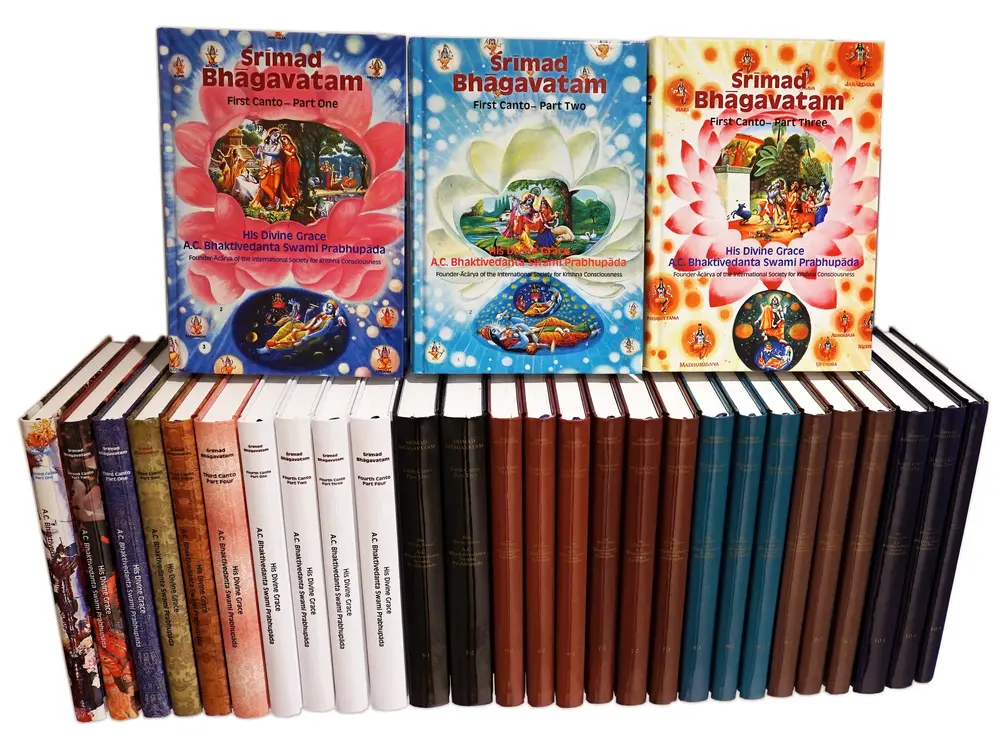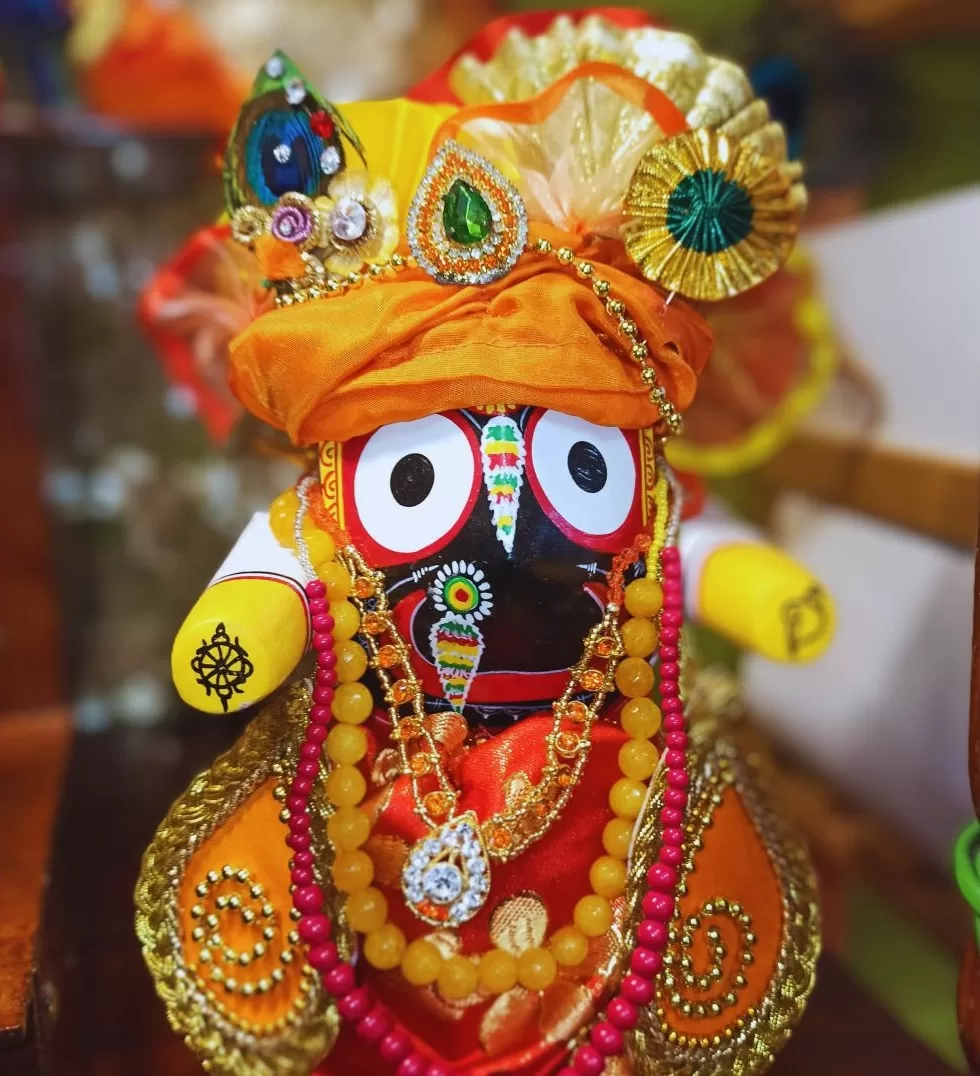
Hare Krishna, today article: Sri Guru Tattva (1/2) is from Bhakti Kumud Santa Maharaja, disciple of Bhaktisiddhanta Prabhupada.
Śrī Guru-Praṇāma:
oṁ ajñāna-timirāndhasya
jñānāñjana-śalākayā
caksur unmīlitaṁ yena
tasmai śrī-guruve namaḥ
“I offer my respectful obeisances unto my spiritual master, who with the torchlight of knowledge has opened my eyes, which were blinded by the darkness of ignorance.”
Two important verses:
suna suna nityananda, suna haridasa
sarvatra amara ajna karaha prakasa
prati ghare ghare giya kara ei bhiksa
‘bala krsna, bhaja krsna, kara krsna-siksa’
“Listen, listen, Nityananda! Listen, Haridasa! Make My command known everywhere! Go from house to house and beg from all the residents, ‘Please chant Krishna’s name, worship Krishna, and practise what Krishna teaches.’” (Sri Chaitanya-bhagavat, 2.13.8-9)
harer nāma harer nāma
harer nāmaiva kevalam
kalau nāsty eva nāsty eva
nāsty eva gatir anyathā
“In this age of quarrel and hypocrisy, the only means of deliverence is the chanting of the holy names of the Lord. There is no other way. There is no other way. There is no other way.”
Mahā-mantra Hare Kṛṣṇa:
Hare Kṛṣṇa Hare Kṛṣṇa
Kṛṣṇa Kṛṣṇa Hare Hare
Hare Rāma Hare Rāma
Rāma Rāma Hare Hare
Article: Sri Guru Tattva (1/2)
A Lecture by His Divine Grace Sri Srila Bhakti Kumud Santa Maharaja
(submitted to the internet by Indradyumna das)
My respected bhaktas (listeners), I was invited by my beloved Nandanandana to attend the celebration on the occasion of the Abirbhava (appearance) of Sripad Vamana Maharaja, the Acharya of Sri Gaudiya Vedanta Samiti.
In recent days some persons present themselves as the initiated ones of Gaudiya Math and speak of many matters full of apasidhanta (contrary to established decisions). As an instance, they say that the birthday of the Acharya will not be observed. The day of his initiation will be observed. It is a fully wrong decision. It can never be. According to the shastras:
ishwarer janmathithi je hano pabitra,
vaisnavaro janmatithi se hano pavitra
“The appearance of God is holy. The birthday of Vaishnava is also holy”
Those who think that the birth of their guru is birth only are unfortunates. Birth is of the jivas bounded by the results of their karma (works). If the God or Vaishnava appear in the world, then this is not an ordinary birth, but their Abirbhava (appearance).
Whenever they go away from this world it means it is their Tirobhava (disappearance). The tithis (days) of their appearance in the world are very holy for their sisyas and are to be observed. On their observation Hari Bhakti (devotion to Hari) will be resulted. If they are not observed violation will be inevitable as per the Mahajanas:
abirbhava tirobhava veda matrakai
“The Vedas speak of Abirbhava and Tirobhava only”.
The Sun rises. It does not mean that it takes birth. It is faulty. On the other hand the sun has set. It does not mean that it is no more. It is a faulty deduction. Whenever it comes to us it is its Abirbhava. With its disappearance Tirobhava is meant. They do not come by birth. They do not also breathe their last. Thus it is said in the Gita:
janma karma ca me divyam
evam yo vetti tavttvatah
tyaktva deham punar janma
naiti mameti so ‘rjuna
Srimad Bhagavad Gita, 4.9
“One who knows the transcendental nature of My appearance and activities does not, upon leaving the body, take his birth again in this material world, but attains My eternal abode, O Arjuna”.
Krishna said that “My birth and work are divya”. Divya means transcendental and it is not materialistic. One is customary material. The other is spiritual. It will be an aparadha (offence) if customary and materials matters are united with spiritualism.
Now the initiated persons of Sripad Vamana Maharaja are fortunate ones.
What is Guru-Tattva (knowledge about the guru)? First of all understand it and then proceed. Do not pay hate to what is being said by others. I am old now. I do not see, sometimes I can not remember thing known by me. So, with an urge for a discussion I came here after jotting down so many points one after another. I shall try to speak of that matter by its reading. Please, try to understand me.
According to shastra:
guru-padashrayas tasmat
krishna-dikshadi-shikshanam
vishrambhena guroh seva
sadhu vartanuvartamanam
Bhakti-rasamrita-sindhu, 1.2.74)
“[1] Accepting the shelter of the lotus feet of a bona fide spiritual master,
[2] becoming initiated by the spiritual master and learning how to discharge devotional service from him,
[3] obeying the orders of the spiritual master with faith and devotion, and
[4] following in the footsteps of great acaryas [teachers] under the direction of the spiritual master”.**
“First of all, the lotus feet of a guru are to be taken shelter of. Diksha guru and siksha guru are to be followed. The guru is to be served with faith in him. The path of a saints should be followed”. If one desires to be a pathfinder of the spiritual realm and is willing of going to the Lord, he hasto take shelter of the lotus feet of a guru: “guru-padashrayas”. What is the meaning of “ashraya”? “Ashraya” means “taking diksha”. Diksha is to betaken. One will have to take from him not only diksha but also siksha.
What is more? He is to be served the guru with faith in him. Yes, he willhave to bear in mind that if I serve him (guru) I shall have welfare. Not only that, he has to give up maintaining material dealings. He has toposses a spiritual faith. What is spoken of by “vishvasa”?
shraddha-shabde vishvasa kahe sudridha nishcaya,
krishne-bhakti kaile sarva karma krita haya
Sri Caitanya Caritamrita, Madhya-lila, 22.62)
ïShraddha is confident, firm faith that by rendering transcendental loving service to Krishna one automatically performs all subsidiary activities. Such faith is favorable to the discharge of devotional service].
“The word “sraddha” means “strong faith”. If Krishna is shown bhakti all works will be done”.
It is described as “vishvasa”. “Sraddha” means vishvasa point. How is this vishvasa. I shall give you one instance: Krishna is returning after tending the cows. Sridham, Sudhama, Vasudhama and other companions began to drink water of Kaliyadaha. He came running to them, slept each and asked, “What are you doing? This water is poisoned. If a bird flighs over the water it will die. And you are drinking it, you will surely die”. What did the companions answer?
“Kanai, Your companions do not love You with this sort of insignificant faith. We know that the water we are drinking is not poisoned it is nectar. We can not drink poison”, Krishna sees from behind that they are drinking the poisoned nectar. “Our death can not happen”. This is faith. Therefore, if the order of a guru is carried out after placing faith in his lotus feet and then he is worshipped and served, my welfare will come forth.
The sisya who will go forward with this faith will be rewarded with self welfare. What is this? The honest way we shall follow will be shown by him. He will show the way. This is guru-tattva. It has to be understood properly. Further:
tasmad gurum prapadyeta
jijnasuh sreya uttamam
sabde pare ca nisnatam
brahamany upasamasrayam
Srimad Bhagavatam, 11.3.21
“Therefore any person who seriously desires real happiness must seek a bona fide spiritual master and take shelter of him by initiation. The qualification of the bona fide guru is that he has realized the conclusions of the scriptures by deliberation and is able to convince others of these conclusions. Such great personality, who has taken shelter of the Supreme Godhead, leaving aside all material considerations, should be understood to be bona fide spiritual master”.
“A guru will have to be accepted for the best benefit”. Why should we accept a guru? Is the acceptance of a guru customary or materialistic? No, it is not customary. “Jijnasuh sreya uttamam”, (“being inquisitive about the highest good” note of proofreader) here two words ‘sreya” and “uttamam” have been used. What type of sreya is it? It is the best sreya. General sreya for obtaining materialistic welfare is not worthy of the name.
Uttama sreya is to be obtained. And so the lotus feet of a guru are to be taken shelter of. What sort of guru is he? “Sabde pare ca nisnatam” heis well acquainted with sabda brahman and para brahman. Sabda brahman and para brahman is one thing thus identical. The sound of this world is a material one. It is not sabda brahman. It is only sound. The sound of the Supreme World is the transcendental one. It is transcendental. That is sabda brahman.
So, he (guru) is equipped with sabda brahman and para brahman. We can not understand. But he is living very near to God. This feeling should be there. Taking shelter of the lotus feet of a guru is for this. It is for nothing else. What are the sings of such a guru? There are many signs of a guru.
I shall discuss it with you. How is he? He is kripa sindhu (an ocean of kindness) and doya sagar (sea of piety). He is full-fledged. A sisya shouldnot have a feeling about anything, one thing in his guru or any incompleteness of his guru. He (guru)is full-fledged and a benefactor of all beings.
He who will go to him will be benefited. This animate object will get welfare by coming in touch with him. Even inanimate objects will be in possession of such a benefit. Here is the paduka (shoe) of my guru. Is it material or animate? But we are offering it pranam. Because it has gone to the touch of the gurudeva and has been turned to be an object of our pranam. Gurudeva is disinterested in anything. He has no attachment, no hope of aspiration.
He is always siddha (perfect), well versed in all matters and expert in everything. He can cease all doubts he has the power to cut down all the doubts of his sisyas. One who cannot make answer to any question of his sisya is not a guru. Guru is not idle he has no idleness. He is called guru. He is described as a guru. So, he is an exact guru.
All can not be gurus. It is opined by many that diksha guru and siksha guru are equal. It is not my opinion. It is mentioned according to the scriptures. Yes, they (some people) take the two as equal. What is the inference? As par as Sri Chaitanya Caritamrita:
naivopayanty apacitim kavayas tavesha
brahmayusapi kritam riddha-mudah smarantah
yo ntar bahis tanu-bhritam ashubham vidhunvann
acarya-caittya-vapusha sva-gatim vyanakti
Sri Caitanya Caritamrita, Adi-lila, 1.48
“O my Lord! Transcendental poets and experts in spiritual science could not fully express their indebtedness to You, even if they were endowed with the prolonged lifetime of Brahma, for You appear in two features externally as the acarya and internally as the Supersoul to deliver the embodied living being by directing him how to come to You”).
He is within me as the caita guru. He Himself appears in the world as the Mahanta guru.
shiksha guruke ta; jani krishnera svarupa
antaryami, bhakta shreshtha ei dui rupa
Sri Caitanya Caritamrita, Adi-lila, 1.47
“One should know the instructing spiritual master to be the Personality of Krishna. Lord Krishna manifests Himself as the Supersoul and as the greatest devotee of the Lord”).
As the antaryami (dweller of the heart) He is caitya guru and as the bhakta shreshtha (best devotee) He is Mahanta guru or diksha guru. These are His two appearances. He who is there as the dweller in the heart is in the show as the best devotee. He is the diksha guru. So, some people say that a siksha guru more worshipable than a diksha guru. It is a wrong inference. Why? The matter should be understood properly. According to the scriptures:
mantra-guru ara yata shiksha-guru-gana
tahara-carana age kariye vandan
Sri Caitanya Caritamrita, Adi-lila, 1.35
“I first offer my respectful obeisances at the lotus feet of my initiating spiritual master and all my instructing spiritual masters”.
First of all diksha guru is mentioned. Thereafter siksha guru is indicated. Diksha guru is only one. Siksha gurus are many. They (siksha gurus) may be innumerable. Will everyone of them be accepted as a diksha guru? No, on no occasion it can be done.
I was initiated at Bagh Bazaar (Harinama was given to me at Sri Mayapur).Then all began to address me as “Prabhu”. My name in my Brahmachari life was Sri Radharaman. So, all called me “Radharaman Prabhu”. I was then in my boyhood. I went to my gurudeva, Srila Prabhupada. I said to Him, “Prabhu, previously all addressed me as Radharaman.
Why are they calling me as Radharaman Prabhu?” Prabhupada laughed and said “Just see, you are addressed as a prabhu, you consider yourself as “prabhu” This is an example and teaching. Vanity and pride may capture. In order to make that pride weaker the following teaching has been imparted.
gurur sewak moi mano aponar
“The servitor of a guru is to be your respected one”.
One of my brother disciples asked me thus, ïOne sisya of Bon Maharaja is seated. Your one sisya has also taken his seat. If a sisya of your brother’s sisya comes here, will he offer pranam to you or Bon Maharaja?” I said, “No, he will offer pranam to his guru. But the duty of his guru will be to direct him thus our guru-varga are seated here. Offer your pranam to them”. Whenever he (sisya) caries out the order he will have no aparadha.
But he will commit aparadha if he does not offer pranam to his guru at first. The duty of the guru will be to direct his sisya to make obeisances to my guru-varga at first. It is the rule and system. Learn it that diksha is the best.
diksha guru ara yata shiksha-guru-gana
It has a hidden side. Great sisyas of Sri Kesava Maharaja are seated here. One of the said sisyas is younger in age. Will he get the honor offer to the great sisyas? Will there be the fault for making an exception? He will not get the honor like the senior brothers.
Who is accepted as the siksha guru? He who is teaching the service to guru, Vaishnava and God is siksha guru. The person not making the above task will not be accepted as a siksha guru. He has vanity only. In fact, no welfare will be done by him. Other siksha gurus do not deserve honor from their sisyas.
Shastras assert thus diksha guru is the siksha guru. When he initiates he teaches also. In this matter diksha guru and siksha guru are identical. Diksha guru and siksha guru are both seated. Diksha guru is to be offered pranam at first. After that siksha gurus turn will come. Father and uncle are standing. Should one offer his pranam to his uncle at first? It can never be so. First of all father is to be offered pranam. After that uncle can be honored. This is the teaching. This inference is to be obeyed.
From the point of view of this material world, Srila Sanatana Goswami and Srila Rupa Goswami are brothers. Srila Jiva Goswami is their nephew. Vallabha Acharya went to Srila Rupa Goswami in Vrindavana. On reaching there he said, ïSri Rupa, Bhakti-rasamrita-sindhu, written by you, is very nice. But there is a thing of misery. I have felt unhappy. You wrote thus:
bhukti-mukti- spriha yavat
pishaci hridi vartate
tavad bhakti-sukhasyatra
katham abhyudayo bhavet
Bhakti-rasamrita-sindhu, 1.2.22
“The material desire to enjoy the material world and the desire to become liberated from material bondage are considered to be two witches, and they haunt one like ghosts. As long as these witches remain within the heart, how can one feel transcendental bliss? As long as these two witches remain in the heart, there is no possibility of enjoying the transcendental bliss of devotional service.
You met bhukti and mukti ïpisaci (an evil spirit). There are many persons who are in quest of moksa (salvation of the soul). Will not they take your words as abuse? A great personality like you are abusing”. Srila Rupa Goswami said then, “I accept what you say”. Vallabha Acharya was satisfied and went to the bank of the Yamuna. Vallabha Acharya was superior to him in respect of age. Just mark who Vaishnava is. Where is our attachment signifying a Vaishnava?
When Vallabha Acharya came to Rupa Goswami, Jiva Goswami was seated there. He followed Vallabha Acharya and went on the bank of the Yamuna.
He offered him pranam. Vallabha Acharya asked:
My dear son, who are you?
Jiva Goswami said: I am a sisya of demand to whom you had gone.
What is your name?
My name is Sri Jiva.
What do you want to say?
You refuted the inference of my guru. It is not a matter for refutation.
He has written the right thing.
How is it?
He wrote thus:
bhukti-mukti- spriha yavat
pishaci hridi vartate
tavad bhakti-sukhasyatra
katham abhyudayo bhavet
Bhakti-rasamrita-sindhu, 1.2.22
“The material desire to enjoy the material world and the desire to become liberated from material bondage are considered to be two witches, and they haunt one like ghosts. As long as these witches remain within the heart, how can one feel transcendental bliss? As long as these two witches remain in the heart, there is no possibility of enjoying the transcendental bliss of devotional service”.
He marked this spriha (aspiration) for bhukti and mukti as an evil spirit. How to understand this properly? I can give you one example. We don’t have to hate a female. If one says that female sex is a thing to be hated it will not be allowed. But a bad attraction to a female is to be hated. This has been given to understand. How do you say that it is not proper?
Vallabha Acharya wondered. He came back to Rupa Goswami and said:
Sri Rupa, what you have written is correct.
There is no need for excluding it.
Why do you say so, Prabhu?! You just told me thus that “this is wrong. I made the mistake and my fault is now corrected by a handsome boy.
Who is that boy?
His name is Sri Jiva.
You asked to say goodbye to “bhukti mukti spriha”.
– The aspirations for enjoyment and liberation are described as a bad thing.
Sri Rupa uttered previously thus “Yes”. Now he said thus, “Yes”. See how fine is the dealing.
Vallabha Acharya went away. Rupa Goswami then addressed to Jiva Goswami, “I shall not look at you. You are not fit for living in Vrindavana. Your vanity has not been ended. What a bad person you are: You have gone to refer the matter to him”. Jiva Goswami is his own sisya and nephew. He (Jiva Goswami) didn’t utter a single word like this ïPrabhu, this is unjust
He started his bhajan at Nandagrama by the side of the Yamuna. At first he lived on madhukari (one hand full of food). Afterwards he gave it up. He sat at a place and took Hari Nama only. He did not eat any food. Sanatana Goswami was then traveling dvadash vana (twelve forests). He came to Nandagrama. The residents of the Vraja said, ïPlease come and see. A handsome boy came here. He always utters the Name of Hari. But he does not eat any food. He will perhaps leave his life”.
Sanatana Goswami went to the place. When he saw Sri Jiva, he said him,
“What is this, Sri Jiva?! Why are you doing so?! Your life will be finished”. Sri Jiva answered, “Prabhu (he never utters the word father), my life is nothing without the kindness of my guru. What is the value of this life of the person who did not receive the krpa of his guru and whom the guru has left? His death is preferable. I think that death is the best for me”.
“What is the matter?” Sanatana Goswami asked him. Jiva Goswami told him the whole story. Finally he said, “I can not bear any condemnation of my guru. As my gurudeva is displeased with me I prefer this separation. I am now separated. I did not want to worry my gurudeva”.
Sanatana Goswami did not tell Sri Jiva anything. He came back to Sri Rupa and said, “Sri Rupa, Sri Jiva is going to leave his life. You, please, show piety and kindness to him”. Sri Rupa Goswami said, “Yes, I shall do it”. He went running to him (Sri Jiva) and said, “My dear son, come to me”. It is called the great devotion to a guru. Srila Prabhupada directly told us all this inferences. We have to obey them. That will bring to us welfare. So, it is said in the scriptures:
acaryam mam vigyaniyan
navamanyeta karhicit
na martya-buddhyasueta
sarva-devamayo guruh
Srimad Bhagavatam, 11.17.27
Sri Caitanya Caritamrita, Adi-lila, 1.46
“One should know the acarya to be Myself and never disrespect him in any way. One should not envy him, thinking him an ordinary man, for he is the representative of all the demigods”.
What is guru-tattva? “Know it that the Acharya is similar to Me”. “Mam vigyaniyan” “know it that he is like Me”. “Navamanyeta”, one should never disrespect. Why? Sarva-deva-mayo guruh “representative of all the demigods”. It is not in possession of those demigods. By the grace of the Lord he gets the power to show kindness. He learned to be all powerful.
Why? He can give the All Powerful Lord. This can not be given by any other person even the demigods fail. They have not such an ability. He should be considered from this point of view. So, diksha guru has been given the importance:
adou guru puja
“First of all a guru has to be worshiped”.
Who has to be worshiped first? Does the diksha guru or the siksha guru has to be worshipped first? First of all diksha guru should be worshiped. Siksha guru will not come first. Diksha guru is the one to be worshiped first. Tulsi Dasa said:
guru aur govinda do kore hai kisko laghu paya
yo guru go lake usko boli hari jaya
“Guru and Govinda are standing. Whom shall I offer my pranam? I shall praise him who will offer obeisances to his guru at first”.
Guru and Govinda are standing in front of me. Whom shall I offer my pranam at first? Guru is to be offered pranam first of all. Then Govinda is to be offered obeisances. If the inference is that will the siksha guru be offered pranam first? This judgment can not be a proper one. The characteristics of siksha guru can not be more then that of diksha guru. The only characteristic remaining is that diksha guru is the siksha guru. This judgment should be learned. Guru-tattva is such a thing, so it is said:
sad-guru pabe veda batave gyana kore upadesha
tou kailaki maila chote jou aga kore parevesha
“If you get a sad guru, he will show you the right path and will give you proper knowledge. It is just like a fire destroying all dirtiness”.