Hare Krishna, today article: About Sanatana, Rupa and Jiva Goswami is from Bhakti Sundar Govinda Gosvami
Prayers
Śrī Guru-Praṇāma:
oṁ ajñāna-timirāndhasya
jñānāñjana-śalākayā
caksur unmīlitaṁ yena
tasmai śrī-guruve namaḥ
“I offer my respectful obeisances unto my spiritual master, who with the torchlight of knowledge has opened my eyes, which were blinded by the darkness of ignorance.”
Two important verses:
suna suna nityananda, suna haridasa
sarvatra amara ajna karaha prakasa
prati ghare ghare giya kara ei bhiksa
‘bala krsna, bhaja krsna, kara krsna-siksa’
“Listen, listen, Nityananda! Listen, Haridasa! Make My command known everywhere! Go from house to house and beg from all the residents, ‘Please chant Krishna’s name, worship Krishna, and practise what Krishna teaches.’” (Sri Chaitanya-bhagavat, 2.13.8-9)
harer nāma harer nāma
harer nāmaiva kevalam
kalau nāsty eva nāsty eva
nāsty eva gatir anyathā
“In this age of quarrel and hypocrisy, the only means of deliverence is the chanting of the holy names of the Lord. There is no other way. There is no other way. There is no other way.”
Mahā-mantra Hare Kṛṣṇa:
Hare Kṛṣṇa Hare Kṛṣṇa
Kṛṣṇa Kṛṣṇa Hare Hare
Hare Rāma Hare Rāma
Rāma Rāma Hare Hare
About Sanātana, Rūpa and Jīva Gosvāmī
by Srila B. S. Govinda Maharaj
26-12-92
Jīva Gosvāmī was broken hearted by this order of his Guru, he left and went to the Yamunā, there he wanted to leave his body. He was living under the trees and fasting, and anyhow he fainted and a devotee of Mahāprabhu called Gopāla, who was also a friend of Jīva Gosvāmī came by Jīva in this lamentable situation. This Gopāla had some sakhya-bhāva and some parakīya-bhāva, that is paramour love and conjugal love. That is he had some attachment for conjugal life, that is vedic rules married life, like the relationship of a husband.
He liked that more than the paramour mood, anyhow he was a friend of Jīva Gosvāmī and Jīva had promised him that he would show that Rādhā and Kṛṣṇa are eternal conjugal lovers. Although Jīva was leaving his body, he remembered his promise to his friend Gopāla and in seven days he composed the great book “Gopāla-campū“.
Sanātana Gosvāmī was unhappy to hear about Jīva Gosvāmī’s heavy chastisement by Śrī Rūpa and he went to see Rūpa. Then Sanātana asked Rūpa could he tell him in a short way the gist of the teachings of Mahāprabhu. Śrī Rūpa replied “jīve dayā nāme ruci, vaiṣṇava-sevā” and “nirantara kara kṛṣṇa-nāma-saṅkīrtana” these are the teachings of Mahāprabhu.
“Jīve dayā means mercy to the conditioned souls, and nāme ruci and vaiṣṇava-sevā, means chant Hare Kṛṣṇa and do vaiṣṇava-sevā, this is the gist of Mahāprabhu’s teachings. The word “jīve dayā” means conditioned souls and also means Jīva Gosvāmī.
Then Sanātana Gosvāmī replied, “but I have seen that Jīva, he is dying on the bank of the Yamunā under a tree. This is not good, he is a young boy and he was only fighting for the honour of his Guru, and I think that is alright, why are you so strict with Jīva?” Then he left.
So Rūpa Gosvāmī was feeling that Śrī Sanātana was his guru and thinking that it was the desire of Sanātana that he bring back Jīva Gosvāmī. Rūpa Gosvāmī then went to the bank of the Yamunā to find Jīva, upon seeing his gurudeva Jīva began to cry and Rūpa Gosvāmī embraced him and took him back and they stayed happily together.
When anyone ever tried to teach Rūpa Gosvāmī something Jīva Gosvāmī could not tolerate it and many times he could not control himself in this regard. Śrī Jīva Prabhu saw Rūpa Gosvāmī as the topmost authority regarding the teachings of Mahāprabhu, so Jīva could not tolerate it if someone tried to teach something to his gurudeva.
One day Jīva Gosvāmī challenged Gopāla Bhaṭṭa Gosvāmī, this is what happened. Rūpa Gosvāmī used Gopāla Bhaṭṭa Gosvāmī’s name in the book Hari-bhakti-vilāsa, with the full consent of Gopāla Bhaṭṭa. And Jīva Gosvāmī composed the “Ṣaṭ-sandarbha” from the compositions of Gopāla Bhaṭṭa Gosvāmī. But one day while Rūpa Gosvāmī composed some ślokas, Gopāla Bhaṭṭa listened happily, and commented that there was a little Sanskrit fault in such a place and you may correct it like this.
Rūpa Gosvāmī was very humble and immediately he corrected that. Jīva Gosvāmī was also there but at some distance, and he left the bhajana-kuṭīra. Then Gopāla Bhaṭṭa Prabhu left and Jīva Gosvāmī showed the waterpot to Śrī Rūpa indicating that he was going to the Yamunā for some water, but he was not. Actually he ran after Gopāla Bhaṭṭa Gosvāmī, he wanted to ask Gopāla Bhaṭṭa what he said about the poetry of Rūpa, was it correct or not. Gopāla Bhaṭṭa asked Jīva his name and what was his interest in the poetry of Rūpa Gosvāmī.
Then Jīva Gosvāmī replied that he was the servant of Rūpa Gosvāmī. Jīva then said to Gopāla Bhaṭṭa “you see, what Rūpa has written is correct, if you look at it this way” and then understanding, Gopāla Bhaṭṭa Gosvāmī was very happy hearing the explanation of Śrī Jīva. Gopāla Bhaṭṭa Gosvāmī went back to Rūpa Gosvāmī and told him that what you have first written you can keep that word like that, it is alright, I was wrong. Your composition is perfect. Śrī Rūpa replied “alright, if it is your desire I shall keep it like that.”
When later Gopāla Bhaṭṭa Gosvāmī said to Rūpa Gosvāmī, “I have seen a young boy near to your bhajana, he met with me and we discussed this particular composition and I think that he is a great paṇḍita. Who is he, he is very intelligent and he has corrected me, tell me about that boy.” Then Rūpa explained that Jīva is his nephew and that he is trying to serve here, but this is not good that he has tried to correct your grammar.
But Gopāla Bhaṭṭa replied “what that boy told is correct, he is right, my conception was wrong. So as you have first written that is correct, please keep it that way.”
Then Gopāla Bhaṭṭa Gosvāmī left and Jīva Gosvāmī came in with the water and Rūpa said to him, “Oh, why are you doing this again and again, it is not good actually. You are living in Vṛndāvana-dhāma so you must always be humble.” Jīva Gosvāmī replied “Yes, Guru Mahārāja, it is true, but what will be right if anyone will say it is wrong, therefore it was necessary to show him that what you had composed was perfect, that is all I said to that vaiṣṇava.”
But Rūpa Gosvāmī said “It may be right or wrong, that doesn’t matter, it was the desire of the vaiṣṇava that I change that word then I shall change that word.” Śrī Rūpa gave some explanations showing that he was not happy with Jīva for doing this time and time again.
But in his heart Rūpa had much affection for Jīva and he knew that in the future he (Jīva) would do much service for the sampradāya, because he knew expert Sanskrit and his conception of the philosophy of Mahāprabhu was very clear. Now we can see all the wonderful books composed by Jīva Gosvāmī, and his “Ṣaṭ-sandarbha” is the highest philosophical book in our sampradāya.
In this way Rūpa Gosvāmī and Sanātana Gosvāmī and Jīva Gosvāmī were living in Vṛndāvana along with the many other devotees of Mahāprabhu. A friend of Mahāprabhu called Jagadānanda wanted to go to Vṛndāvana and Mahāprabhu told him that they were his guardians and that he need not go anywhere else, but “because you are my friend Jagadānanda Prabhu, they will consider you higher than themselves, but please, you don’t think like that.
They are actually living in a higher position than you, you please stay with them and follow their instructions, and don’t go to see the Gopāla on the hill of Govardhana, because that is Kṛṣṇa Himself, so don’t put your feet on the hill of Govardhana.” That was His advice to His dear friend Jagadānanda Paṇḍita.
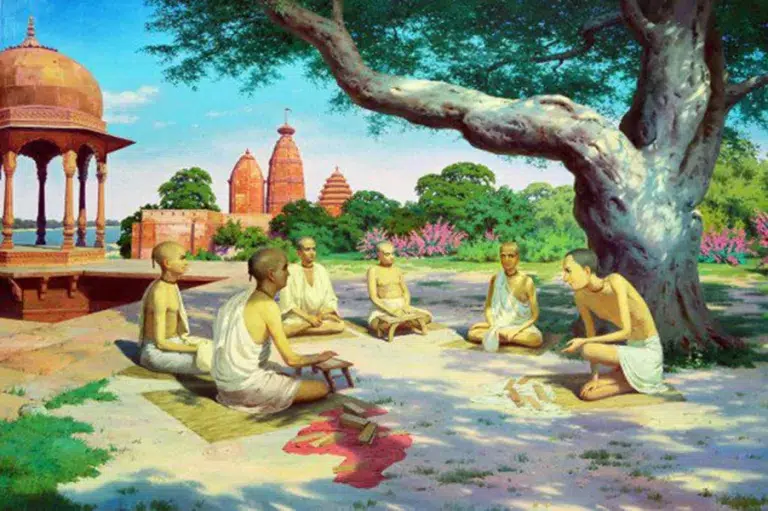
Later when they finished their sevā in Vṛndāvana they took samādhi. Rūpa Gosvāmī took samādhi in Rādhā-Dāmodara and Sanātana Gosvāmī’s samādhi is near to Madana-Mohana, and Jīva Gosvāmī and others joined in the mission of Mahāprabhu in Vṛndāvana and there were many devotees at that time. The Gosvāmīs of Vṛndāvana all had long lives even though they only rested a little every night and they also ate very little and they were all over eighty.
We are taking medicine and they did not, their bodies were also very strong, they did not have many garments and they did not have shoes, we cannot imitate them. Raghunātha dāsa Gosvāmī would only take one pot of Buttermilk a day and Rūpa and Sanātana would sometimes cook some capātīs and they would keep them up to seven days and with a little rice and spinach that was offered to them, they would offer that to Madana-Mohana and take that prasādam.
When I went to Vṛndāvana with Śrīla Guru Mahārāja in 1947, I stayed with Guru Mahārāja in the bhajana-kuṭīra of Sanātana Gosvāmī. There are two caves, and in one cave Kṛṣṇadāsa Bābājī was living and the other cave was vacant. Guru Mahārāja stayed in that cave and inside there were two or three rooms and other bābājīs also lived there, one whose name was Dīnatāriṇī Prabhu and the other was a bābājī disciple of Śrīla Sarasvatī Ṭhākura and there were one or two others.
Anyhow they have shown me how they did their “mādhukarī” and also how to preserve the roṭī. One day they will do “mādhukarī” that is they go from door to door and the people of Vṛndāvana will give them some roṭīs, and they will collect 15 or more roṭīs. Then they will eat two roṭīs in the morning and two in the evening and the other roṭīs they keep in the open ālmirā, cabinet.
Because the climate is so dry in Vṛndāvana the roṭīs also dry out and after fifteen days to one month they become like hard biscuits. Then they wash the roṭī with water and put into the buttermilk in the morning (2 roṭīs) then they will take that at noon time and the roṭī will be soft. Then again two roṭīs in the evening and in the morning they will take some boiled wheat with some buttermilk and that is their breakfast.
We also took like that but they arranged roṭī and dāl for Śrīla Guru Mahārāja, I would collect that roṭī and dāl from the “chatra” the free distribution center and I would collect that at noon time. Śrīla Guru Mahārāja and Kṛṣṇadāsa Bābājī Mahārāja arranged some festivals there at the bhajana-kuṭīra of Sanātana Gosvāmī.