Hare Krishna, today is disappearance day of Rupa Goswami
Prayers
Śrī Guru-Praṇāma:
oṁ ajñāna-timirāndhasya
jñānāñjana-śalākayā
caksur unmīlitaṁ yena
tasmai śrī-guruve namaḥ
“I offer my respectful obeisances unto my spiritual master, who with the torchlight of knowledge has opened my eyes, which were blinded by the darkness of ignorance.”
Two important verses:
suna suna nityananda, suna haridasa
sarvatra amara ajna karaha prakasa
prati ghare ghare giya kara ei bhiksa
‘bala krsna, bhaja krsna, kara krsna-siksa’
“Listen, listen, Nityananda! Listen, Haridasa! Make My command known everywhere! Go from house to house and beg from all the residents, ‘Please chant Krishna’s name, worship Krishna, and practise what Krishna teaches.’” (Sri Chaitanya-bhagavat, 2.13.8-9)
harer nāma harer nāma
harer nāmaiva kevalam
kalau nāsty eva nāsty eva
nāsty eva gatir anyathā
“In this age of quarrel and hypocrisy, the only means of deliverence is the chanting of the holy names of the Lord. There is no other way. There is no other way. There is no other way.”
Mahā-mantra Hare Kṛṣṇa:
Hare Kṛṣṇa Hare Kṛṣṇa
Kṛṣṇa Kṛṣṇa Hare Hare
Hare Rāma Hare Rāma
Rāma Rāma Hare Hare
Rupa Goswami
Sri Srimad Bhaktivedanta Narayana Maharaja
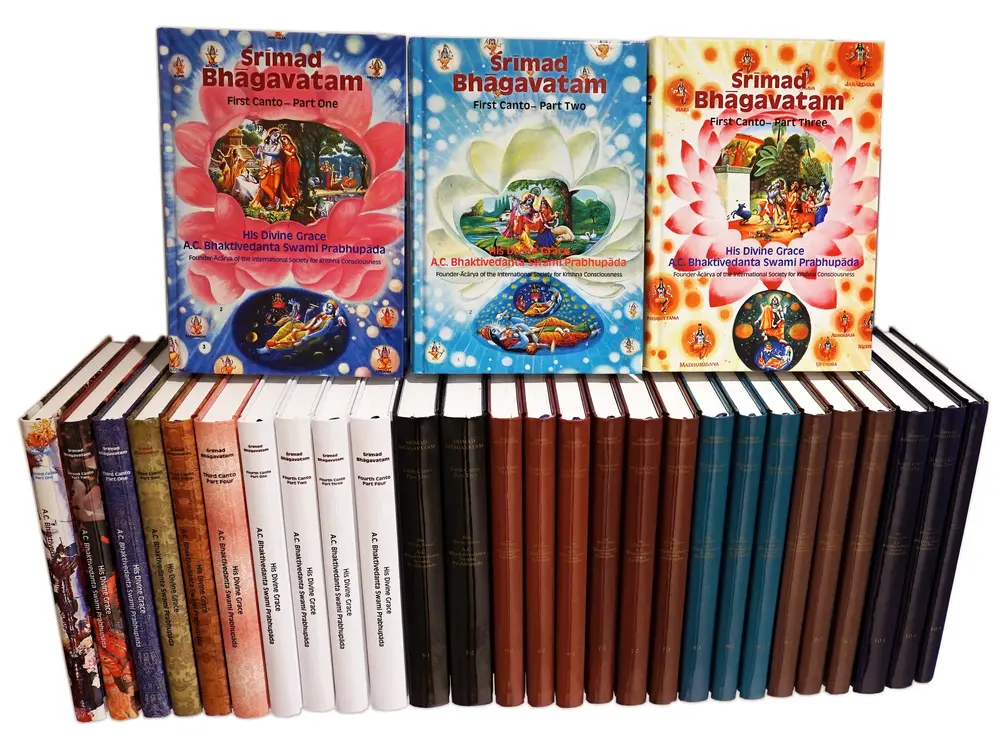
Rupa Goswami developed his style in writing Ujjvala-nīlamaṇi after reading these verses (SB 10th Canto), or we can say that these verses of the Bhāgavatam (especially those contained within the rāsa chapters) were written in the style of Rupa Goswami’s Ujjvala-nīlamaṇi. Śrīmad-Bhāgavatam is mūla-pramāṇa, the original root of all Vedic evidence.
Therefore Rupa Goswami composed his poetry in pursuance of the Śrīmad-Bhāgavatam’s version. However, because Rupa Goswami is Rūpa Mañjarī and is an eternal associate of Rādhā and Kṛṣṇa, he is the root of all understanding. Thus, it is equally true to say that the Śrīmad-Bhāgavatam follows the direction of Rupa Goswami.
In the conclusion of his Laghu-toṣaṇī Jīva Gosvāmī has given some biographical information in which he explains that Sarvajña is seventh in the ascending genealogical line from Rupa Goswami. He was highly respected amongst the brāhmaṇas of Karnataka, thus he was also referred to as “Jagadguru.” Being a brāhmaṇa from the Yajurveda clan, who are descendants of Bharadvāja, Sarvajña was an erudite scholar of all śāstras and theological treatises. Attracted by Sarvajña’s scholastic ability and admirable qualities, students flocked from different parts of the country to study under him. Sarvajña was also a king.
Sarvajña’s son, Aniruddha, was a great Yajurveda scholar and was admired by all. Aniruddha had two wives and two sons. His sons were Rūpeśvara and Harihara. Rūpeśvara became theologically astute, whereas Harihara became skilled in the use of weapons. When Aniruddha died the kingdom was divided between the two sons, but Harihara occupied the land of Rūpeśvara by force. In a helpless condition Rūpeśvara and his family migrated to Paurastyadeśa, where he became friends with the local King, Śikhareśvara.
Rūpeśvara’s son Padmanābha acquired great fame due to his handsome features, admirable qualities, erudition and wealth. Padmanābha moved his home to the village of Nabahaṭṭa (modern Naihati) on the bank of the Bhāgīrathī. Padmanābha had eighteen daughters and five sons. The youngest son was named Mukunda. Mukunda’s son, Kumāradeva, was an extremely religious man.
When religious upheaval occurred in Naihati, Kumāradeva moved to Baklā Candradvīpa (in Jessore). He is said to have settled for some time at Fateyavad–located between Naihati and Bakla. The three most renowned sons of Kumāradeva were Sanātana, Rūpa and Anupama. When their father died, these three sons went to their maternal uncle’s home in Sākurmā near the capital of Gauḍa where they continued their studies.
Gauḍīya Vaiṣṇava Abhidhāna P. 1350-1351: Rupa Gosvāmī was one of the six Gosvāmīs associated with Śrī Gaurāṅga-līlā. According to GGD 180 he was Śrī Rūpa mañjarī in Kṛṣṇa-līlā. He occupied a responsible post in the service of the Badshah Hussain Shah of Gauḍa. He later renounced everything and surrendered himself at the feet of Lord Gaurāṅga.
His fascinating biography is described in the CC., Bhaktamālā, etc. Narottama Ṭhākura has rightly praised him as “Śrī-Caitanya-manohabhīṣṭa-sthāpaka” (the implementor of Lord Caitanya’s desires). Rupa Goswami was specifically commanded by Lord Caitanya to carry out two tasks: (1) to re-locate and preserve the lost pilgrimage places of Vṛndāvana, and (2) to write and preach Vaiṣṇava theology.
From Prayāga Rupa Gosvāmī went to Vṛndāvana. He then visited his native home where he settled his property concerns. Thereafter he traveled on to Nīlācala to meet Lord Caitanya. While staying at Gauḍa, Rupa Gosvāmī developed the desire to write the Vidagdha-mādhava and Lalita-mādhava-nāṭaka. Initially he planned to present the Vraja-līlā and the Pura-līlā together in one drama with the view of calming the intensity of the Vraja-viraha by including the Dvārakā-līlā. However, while in Satyabhāmāpura he was commanded by Satyabhāmādevī to write two separate dramas.
In Nīlācala Lord Caitanya also gave him the same instruction. Only those who appreciate the true Vaiṣṇava spirit will understand the immense pleasure which Lord Caitanya and His associates derived from listening to this drama. After surcharging and empowering Rupa Gosvāmī with divine energy, Lord Caitanya sent him back to Vṛndāvana.
The following is a list of the most well-known books of Rupa Gosvāmī:
- Bhakti-rasāmṛta-sindhu
- Ujjvala-nīlamaṇi
- Laghu-bhāgavatāmṛta
- Vidagdha-mādhava
- Lalita-mādhava
- Nikuñja-rahasya-stava
- Stavamālā
- Śrī Rādhā-Kṛṣṇa-gaṇoddeśa-dīpikā
- Mathurā-māhātmya
- Uddhava-sandeśa
- Haṁsadūtam
- Dānakeli-kaumudī
- Śrī Kṛṣṇa-janmatithi-vidhi
- Prayuktākhyāta-mañjarī
- Nāṭaka-candrikā
The following are references from Caitanya Caritamrita which deal with Rupa Goswami:
- 2.1.165 Working as Dabir Khas in the employment of the King of Gauḍa.
- 2.1.196-197 He wrote a letter to Lord Caitanya prior to meeting Him and also received a reply.
- 2.1.165-170 He had a discussion relating to Lord Caitanya with Hussain Shah when the Lord visited Rāmakeli
- 2.1.171-173 On returning from Hussain Shah’s place Rupa had a talk with Sanātana and both went to meet Lord Caitanya.
- 2.19.30-35 On receiving information from the two messengers that Lord Caitanya had already left for Vṛndāvana, Rūpa took his younger brother, Anupama, along with him to meet the Lord. Rūpa sent a letter to Sanātana conveying this information, and encouraged him to escape from prison with the help of the money he had left in the custody of a grocer.
- 2.19.36-56 Rūpa meets Lord Caitanya at Prayāga, expresses his humility and aspirations, informs the Lord about Sanātana and fixes up his residence close to the Lord’s place.
- 2.19.61-67 Rūpa meets Vallabha Bhaṭṭa at Prayāga; Bhaṭṭa expresses awe at the humility and devotion of Rūpa.
- 2.19.81-82 Rūpa accompanies Lord Caitanya to the house of Bhaṭṭa at Aḍaila village.
- 2.19.104-107 Lord Caitanya instructed Rūpa for ten days at Prayāga on the theology of Kṛṣṇa, Bhakti, rasa, etc. The Lord empowered Rūpa with His own divine energy.
- 2.1.173-202 Rūpa and Sanātana first meet Lord Nityānanda and Haridāsa Ṭhākura, and later meet Lord Caitanya. They expressed their humility and spiritual aspirations and obtained the mercy of Lord Caitanya.
- 2.1.203-206 Lord Caitanya introducing the two brothers to the devotees and requests them to show their mercy to them.
- 2.1.207-212 The two brothers requested the Lord to leave that place and not to go to Vṛndāvana with a large crowd of people. They then returned home.
- 2.19.2-4 Upon arriving at home the two brothers began to devise plans by which they could abandon their wealth.
- 2.19.5-8 By boat they visited their ancestral home and distributed their wealth.
- 2.19.10-11 Śrī Rūpa Gosvāmī heard that Lord Caitanya had returned to Jagannātha Purī and was preparing to go to Vṛndāvana through the forest, thus he sent two people to Purī to find out when Śrī Caitanya Mahāprabhu would depart for Vṛndāvana.
- 2.19.240 Rūpa Gosvāmī is instructed by Lord Caitanya to go to Vṛndāvana.
- 2.19.241 The Lord tells Rūpa that later he can go to Jagannātha Purī through Bengal and there he will meet the Lord again.
- 2.25.186 Rūpa reaches Mathurā and meets Subuddhi Rāya at Dhruva-ghāṭa.
- 2.25.207 Rūpa wins the friendship of Subuddhi Rāya and together they visit the twelve forests of Vṛndāvana.
- 2.25.209-210 After one month in Vṛndāvana Rūpa leaves for Prayāga, following the route along the bank of the Ganges.
- 2.25.216-219 From Prayāga Rūpa and his brother go to Kāśī and meet the devotees.
- 2.25.221 Rūpa leaves for Gauḍa after staying in Kāśī for ten days.
- 3.1.34-36 While in Vṛndāvana Rūpa Gosvāmī desired to write dramas concerning the pastimes of Lord Kṛṣṇa, thus he composed the introductory verses of a drama. On his way to Gauḍa-deśa he had been thinking of how to write the action of the drama. Thus he had made some notes and begun to write.
- 3.1.37-38 On reaching Gauḍa, Anupama breathed his last. Rūpa leaves for Nīlācala.
- 3.1.40-44 Rūpa halted for a night during his journey at Satyabhāmāpura in Orissa, at night he had a vision of the deity Satyabhāmā who commanded Rūpa to write a separate drama. Rūpa first planned to write a single drama comprising both Vraja-līlā and Pura-līlā. Now on receiving the divine command, Rūpa decides to write two separate ones.
- 3.1.45-58 Rūpa arrives at Nīlācala and stays at the residence of Haridāsa Ṭhākura, where he meets Lord Caitanya. He also met all the other devotees and Lord Caitanya urged them to shower their grace upon Rūpa. Rūpa was loved by them all.
- 3.1.59-64 Rūpa joins Lord Caitanya daily in Iṣṭagoṣṭhī and participates in the cleaning of Guṇḍicā.
- 3.1.65-68 Lord Caitanya gives instructions that Kṛṣṇa never leaves Vṛndāvana.
- 3.1.71 At the command of Satyabhāmā and Lord Caitanya, Rūpa arranges to write two separate dramas.
- 3.1.72-88 Rūpa writes a verse interpreting the śloka “yaḥ kaumāra-haraḥ” chanted by Lord Caitanya during Ratha-yātrā. He wrote this on a palm leaf and placed it in his thatched roof and went to take bath. Lord Caitanya found that verse and was overwhelmed with ecstasy. Thus He showered His mercy upon Rūpa. Lord Caitanya showed that verse to Svarūpa Dāmodara.
- 3.1.89 Lord Caitanya instructs Svarūpa to teach Rūpa Vaiṣṇava theology.
- 3.1.97-99 Lord Caitanya feels ecstacy upon reading the Sanskrit verse composed by Rūpa beginning with “tuṇḍe tāṇḍavinī.”
- 3.1.100-105 Lord Caitanya goes to meet Rūpa at the house of Haridāsa Ṭhākura, along with Sārvabhauma, Rāmānanda, Svarūpa, etc. There the Lord glorifies Rūpa’s qualities.
- 3.1.109-121 Rūpa meets the devotees and they all share the beauty of the verses “priyaḥ so’yaṁ kṛṣṇaḥ” and “tuṇḍe tāṇḍavinī.”
- 3.1.199 Lord Caitanya personally guides Rūpa to invoke the grace of all the devotees.
- 3.1.202 Considering Rūpa to be competent to understand the science of rasa, Lord Caitanya transmitted His divine energy to Rūpa and commanded him to write books about Bhakti.
- 3.1.206 Lord Caitanya expresses His desire to the devotees to endow Rūpa with the ability to describe Vraja-līlā-prema-rasa.
- 3.1.210 Haridāsa Ṭhākura praises the fortune of Rūpa.
- 3.1.215-216 Rūpa participates with Lord Caitanya in the Holī festival.
- 3.1.217-220 Lord Caitanya bids farewell to Rūpa after empowering him to go to Vṛndāvana and write transcendental literature, to excavate the lost holy places and to establish the service of Lord Kṛṣṇa and preach the mellows of Lord Kṛṣṇa’s devotional service.
- 3.1.221 Taking leave of the devotees Rūpa goes to Vṛndāvana via Gauḍa.
- 2.1.31-36 Name of some of the books compiled by Rūpa Gosvāmī.
- 1.10.84-90 Rūpa and Sanātana Gosvāmī both preached extensively and built temples and installed Deities in Vṛndāvana.
- 1.10.93-104 When Raghunātha Gosvāmī visited Vṛndāvana, Rūpa and Sanātana treated him just like a brother.
- 2.19.124-133 His extraordinary renunciation and devotion
- 2.18.47-54 Rūpa has darśana of the Gopāla Deity.
- 2.19.124-133 Rūpa and Sanātana’s conduct in Vṛndāvana.
- 2.1.208 Lord Caitanya reveals the names of Rūpa and Sanātana.
- 2.1.215 Lord Caitanya describes the glories of Rūpa and Sanātana to His associates.
(From GPC): In his Laghu-vaiṣṇava-toṣaṇī, Sri Jīva Gosvāmī describes the descendants of Rūpa and Sanātana: “Their forefather was Śrī Sarvajña Jagadguru who was a Yajurvedī brāhmaṇa of the Bhāradvāja caste and the King of Karnataka. His son was Aniruddha Deva, who had two queens and two sons, Śrī Rūpeśvara and Śrī Harihara deva. Śrī Rūpeśvara deva was an expert in śāstras, and Śrī Harihara deva was expert in the use of weapons. By force, Śrī Harihara snatched the power and estate of Śrī Rūpeśvara deva.
Thus Śrī Rūpeśvara deva, along with his wife and eight horses, went to Paulasthyadeśa. There he became a friend of the King, Śrī Śekhareśvara. Śrī Rūpeśvara deva had a son named Śrī Padmanābha deva, who was a genius in Vedic scriptures. Śrī Padmanābhadeva lived at Naihaṭi on the bank of the Ganges. He had eight daughters and five sons. All of his sons, namely Puruṣottama, Jagannātha, Nārāyaṇa, Murāri and Mukunda deva, were brilliant scholars of the Vedic scriptures.
Śrī Mukunda deva built his house and settled at Baklā Candradvīpa. He also built a house in Jessore and Fateyavad because he frequently visited the houses of his yajamānas. Śrī Kumāra Deva was the son of Śrī Mukunda deva. He had many sons amongst whom Śrī Sanātana, Śrī Rūpa and Śrī Anupama (Vallabha) were great Bhāgavatas.”
Śrī Sanātana Gosvāmī was born in 1488 A.D. (1410 Śaka). Śrī Rūpa Gosvāmī was born in 1493 A.D. (1415 Śaka). In order to complete their education they lived at their uncle’s house in a small village named Sākurmā near the capital of Gauḍa. Having heard the glories of Śrī Rūpa and Sanātana from many intelligent persons, Badshah Hussain Shah of Gauḍa appointed the two brothers as ministers in the court. Though reluctant to accept the Bādshāh’s offer, out of fear of the Yavana King, they agreed to take the post.
Hussain Shah happily offered them enormous amounts of wealth and riches. Śrī Rūpa and Sanātana thus lived in the village of Rāmakeli, the capital of Gauḍa. Many great brāhmaṇa scholars from different parts of the country visited their house regularly, and the two brothers took great pleasure in serving and arranging accommodations for them.
The brother of Sārvabhauma, the famous Vidyāvācaspati, was the philosophy teacher of Śrī Rūpa and Sanātana. As mentioned in the Daśama-ṭippanī of the Bhāgavata, their other teachers were Śrī Paramānanda Bhaṭṭācārya and Śrī Rāmapāda Vadrāpāda. From their early childhood Rūpa, Sanātana and Anupama, were very devotionally inclined. Thinking of the wonderful land of Vṛndāvana, they use to plant trees like Tamāla, Kadamba, Yūthikā and Tulasī groves in the nearby garden of their house.
They also dug two lakes in their garden, naming them Rādhā-kuṇḍa and Śyāma-kuṇḍa. Everyday they were absorbed in the service of Madana Mohana. When they heard the glories of Śrī Caitanya Mahāprabhu, they became extremely anxious to meet Him. A transcendental voice spoke to them saying, “Be patient, the deliverer of mankind will soon come to visit your village.”
When they heard that Śrī Gaurahari had taken sannyāsa and gone to Purī, Sanātana and Rūpa fainted on the ground in grief. Thinking that they would never have the opportunity to see the Lord they began to lament profusely. Suddenly a voice spoke to them saying, “Do not lament, the ocean of mercy–Śrī Gaurahari will soon come here.”
Thus they heaved a sigh of relief. After living happily in Purī for five years, Śrī Caitanya Mahāprabhu went to Gauḍa to see his mother and the River Ganges. The devotees were mad with joy and mother Śacī, overwhelmed with ecstacy, happily cooked various preparations for her dear son. Śrī Caitanya Mahāprabhu stayed in the house of Śrī Advaita Ācārya in Śāntipura for some days and then traveled on to Rāmakeli.
In this way Śrī Caitanya Mahāprabhu arrived at the beautiful village of Rāmakeli. There He danced in ecstacy and millions swarmed around Him to take the dust of His lotus feet. When news of Mahāprabhu’s powerful presence reached Badshah Hussain Shah he said, “Without giving in charity this fellow has so many people following behind Him. He must be a great prophet.” Thus he told the Kājī and the Yavanas not to obstruct Him in any way and to allow Him do anything and go anywhere.
Due to the presence of Śrī Caitanya Mahāprabhu the entire village of Rāmakeli overflowed with joy. People from all corners came to see the Lord. When the Badshah asked his special representative, Keśava Chatri, about Mahāprabhu’s presence, Keśava Chatri said, “Yes, I have heard that a beggar sannyāsī has come here along with a few followers.” The Badshah said, “What are you talking about? Millions of people are walking with Him.”
Hearing this Keśava Chatri smiled slightly. The Bādshāh then privately spoke to Dabira Khāsa (Rūpa Gosvāmī) who replied, “Why are you asking me? Ask your own mind. It is this Gosvāmī who has given you this kingdom. It is your good fortune that He has taken birth in your country. Go and see Him yourself. Can any human being possess such magnetic power of attraction?” The Badshah was pleased by Sanātana’s sweet words and ordered that Mahāprabhu be allowed to do whatever He likes.
After returning to his residence, Dabira Khāsa and his brother decided after much consideration to go see the Lord incognito. Thus in the dead of night the two brothers, Dabira Khāsa and Sākara Mallika, went to see Śrī Caitanya Mahāprabhu incognito. First they met Nityānanda Prabhu and Haridāsa Ṭhākura, who told Lord Caitanya about two personalities–Rūpa and Sanātana–who had come to see Him.
In great humility, both brothers took bunches of straw between their teeth, and each binding a cloth around his neck, they fell down like rods before the Lord. Upon seeing Lord Caitanya Mahāprabhu, the two brothers were overwhelmed with joy, and out of humility they began to cry. The Lord asked them to get up and assured them of all good fortune. The two brothers got up and humbly offered prayers with folded hands.
After hearing the prayers of Dabira Khāsa and Sākara Mallika, Śrī Caitanya Mahāprabhu said: “My dear Dabira Khāsa, you two brothers are My old servants. From this day your names will be changed to Śrīla Rūpa and Śrīla Sanātana. Now please abandon your humility, for My heart is breaking to see you so humble. You have written several letters showing your humility, and from these I have understood your heart.
I really had no business in coming to Bengal, but I have come just to see you two.” In accordance with the instructions of Śrī Caitanya Mahāprabhu, the two brothers immediately touched the lotus feet of all the Vaiṣṇava associates of the Lord present, including Nityānanda, Haridāsa Ṭhākura, Śrīvāsa Ṭhākura, Gadādhara Paṇḍita, Mukunda, Jagadānanda, Murāri and Vakreśvara, who all became very happy and congratulated the brothers for having received the mercy of the Lord.
On the eve of the Lord’s departure from Rāmakeli, He blessed Śrī Sanātana and Rūpa by saying, “Very soon Kṛṣṇa will free you from the entanglement of material life.”
Later, the younger brother of Śrī Sanātana and Rūpa, Śrī Anupama, along with his son and other family members, worshiped the lotus feet of Śrī Caitanya Mahāprabhu and sang His glories. Mahāprabhu placed his hand on the head of Śrī Jīva, the only son of Anupama. After the Lord departed from Rāmakeli Rūpa and Sanātana began to devise means to get out of their government service.
Both brothers appointed some brāhmaṇas to perform puraścaraṇa ceremonies and chant the holy name of Kṛṣṇa. Śrīla Rūpa Gosvāmī deposited ten thousand gold coins with a grocer, and the balance he brought in two boats to a place called Baklā Candradvīpa. There he divided this money among the brāhmaṇas, Vaiṣṇavas and his relatives, and a portion he kept for emergency measures and personal needs.
When Rūpa Gosvāmī was informed that Śrī Caitanya Mahāprabhu was going to Vṛndāvana from Jagannātha Purī through the forest of Madhya Pradesh, he sent two people to Jagannātha Purī to find out when the Lord would leave for Vṛndāvana. When Mahāprabhu started for Vṛndāvana, Rūpa left home and sent news to Sanātana that he was leaving with his younger brother (Anupama Mallika) to meet Śrī Caitanya Mahāprabhu.
Meanwhile, Sanātana Gosvāmī told the Nawab that he was sick and could not attend to his work. Giving this excuse, he sat home and studied Śrīmad-Bhāgavatam with learned brāhmaṇa scholars. The Nawab Hussain Shah first sent his personal physician to see what the real facts were; then he personally came to see why Sanātana was not attending to official business. Knowing that he wanted to resign his post, the Nawab had him arrested and imprisoned. The Nawab then went off to attack Orissa.
Rūpa Gosvāmī finally reached Prayāga. While Śrī Caitanya Mahāprabhu was sitting in a solitary place in the home of a Deccan brāhmaṇa, Rūpa Gosvāmī and Śrī Vallabha (Anupama) came to meet Him. Both brothers were overwhelmed with ecstatic emotion and immediately fell down on the ground like rods. Śrī Caitanya Mahāprabhu was very pleased to see Śrīla Rūpa Gosvāmī and told him, “Stand up! Stand up! My dear Rūpa, come here. It is not possible to describe Kṛṣṇa’s mercy for He has delivered you both from the well of material enjoyment.”
After this the Lord sat them down by His side and asked, “What news do you have of Sanātana?” Rūpa replied, “Sanātana has now been arrested by the government of Hussain Shah. If You kindly save him, he can be liberated from that entanglement.” Śrī Caitanya Mahāprabhu immediately replied, “Sanātana has already been released from his confinement, and he will very soon meet with Me.”
At the time of Mahāprabhu’s visit to Prayāga, Śrī Vallabhācārya was living in the village of Aḍaila on the other bank of the Triveṇī. One day he invited the Lord to his house for lunch and Śrī Rūpa and Anupama accompanied Him. The Lord introduced the brothers Rūpa and Vallabha to him. From a distance, the brothers fell on the ground and offered obeisances to Vallabha Bhaṭṭa with great humility. When Vallabha Bhaṭṭācārya walked toward them, they ran away to a more distant place. Rūpa Gosvāmī said, “I am untouchable and most sinful. Please do not touch me.”
Vallabha Bhaṭṭācārya was very surprised at this. Śrī Caitanya Mahāprabhu, however, was very pleased, and He therefore spoke to him this description of Rūpa Gosvāmī: “Don’t touch him, for he belongs to a very low caste. You are a follower of Vedic principles and are a well-experienced performer of many sacrifices. You also belong to the aristocracy.”
Hearing the holy name constantly vibrated by the two brothers, Vallabha Bhaṭṭācārya could understand the hints of Śrī Caitanya Mahāprabhu, thus he said: “Since these two are constantly chanting the holy name of Kṛṣṇa, how can they be untouchable? On the contrary, they are most exalted.”
The two brothers lay prostrate on the ground at the feet of Vallabhācārya and praised him eloquently. Due to the great crowds in Prayāga, Śrī Caitanya Mahāprabhu went to a place called Daśāśvamedha-ghāṭa. It was there that the Lord instructed Śrī Rūpa Gosvāmī for ten successive days and empowered him to understand the philosophy of devotional service.
Śrī Caitanya Mahāprabhu said, “My dear Rūpa, please listen to Me. It is not possible to describe devotional service completely; therefore I am just trying to give you a synopsis of the symptoms of devotional service. The ocean of the transcendental mellow of devotional service is so big that no one can estimate its length and breadth. However, just to help you taste it, I am describing but one drop. Now listen to Me.
Out of many millions of wise men, one may actually become liberated, and out of many millions of such liberated persons, a pure devotee of Lord Kṛṣṇa is very difficult to find. Because a devotee of Lord Kṛṣṇa is desireless, he is peaceful. Fruitive workers desire material enjoyment, jñānīs desire liberation, and yogīs desire material opulence; therefore they are all lusty and cannot be peaceful. Out of many millions of wandering living entities, one who is very fortunate gets an opportunity to associate with a bona fide spiritual master by the grace of Kṛṣṇa.
By the mercy of both Kṛṣṇa and the spiritual master, such a person receives the seed of the creeper of devotional service. That seed must be watered by hearing and chanting. In this way the creeper sprouts and gradually, through continued watering, grows more and more and attains the shelter of the desire tree of the lotus feet of Kṛṣṇa, who is eternally situated in the planet known as Goloka Vṛndāvana in the topmost region of the spiritual sky.
There the devotee serves the lotus feet of the Lord, which are compared to a wish-fulfilling tree. With great bliss he tastes the juice of the fruit of love and becomes eternally happy.”
“Now I shall describe the symptoms of pure devotional service. Pure devotion to the Supreme Personality of Godhead is causeless and it cannot be obstructed in any way. Such a devotee does not accept sālokya, sārṣṭi, sārūpya, sāmīpya or oneness with Kṛṣṇa, even if offered these liberations. A pure devotee simply wants to serve Kṛṣṇa. By regularly rendering devotional service, one gradually becomes attached to the Lord. When that attachment is intensified, it becomes love of Godhead.
The basic aspects of prema, when gradually increasing to different states, are affection, abhorrence, love, attachment, further attachment, ecstasy and great ecstasy. All these stages combined are called sthāyibhāva, or continuous love of Godhead in devotional service. In addition to these stages, there are vibhāva and anubhāva. When the higher standard of ecstatic love is mixed with the symptoms of sāttvika and vyabhicārī, the devotee relishes the transcendental bliss of loving Kṛṣṇa in a variety of nectarean tastes.
According to the devotee, attachment falls within the five categories of śānta-rati, dāsya-rati, sakhya-rati, vātsalya-rati and mādhurya-rati. These five categories arise from the devotees’ different attachments to the Supreme Personality of Godhead. Examples of śānta-bhaktas are the nine Yogendras and the four Kumāras. Examples of devotees in dāsya-bhakti are innumerable, for such devotees exist everywhere (such as Raktaka, Citraka, Dāruka, Hanumān, etc.).
In Vṛndāvana, examples of devotees in fraternity are Śrīdāmā and Sudāmā; in Dvārakā the Lord’s friends are Bhīma and Arjuna; in Vṛndāvana the devotees in parental love are mother Yaśodā and father Nanda Mahārāja, and in Dvārakā the Lord’s parents are Vasudeva and Devakī. The chief devotees in conjugal love are the gopīs in Vṛndāvana, the queens in Dvārakā and the goddesses of fortune in Vaikuṇṭha.
In this way Śrī Caitanya Mahāprabhu taught Śrīla Rūpa Gosvāmī the ultimate limit of the truth about Lord Kṛṣṇa, the truth about devotional service and the truth about transcendental mellows, consummating in conjugal love between Rādhā and Kṛṣṇa. Finally He told Rūpa Gosvāmī about the ultimate conclusions of Śrīmad-Bhāgavatam. By entering the heart of Rūpa Gosvāmī, Śrī Caitanya Mahāprabhu empowered him to ascertain properly the conclusions of all truths.
He made him an experienced devotee whose decisions correctly agreed with the verdicts of the disciplic succession. Thus Śrī Rūpa Gosvāmī was personally empowered by Śrī Caitanya Mahāprabhu. After giving so much instruction, Śrī Caitanya Mahāprabhu advised Śrī Rūpa to go to Vṛndāvana. The Lord then departed for Vārāṇasī. With a grievous heart due to separation from the Lord, Śrī Rūpa and Anupama started for Vṛndāvana.
Śrī Rūpa in Nīlācala:
In Vṛndāvana, Rūpa Gosvāmī began to write a drama. In particular, he composed the introductory verses to invoke good fortune. On his way to Gauḍa-deśa, Rūpa Gosvāmī had been thinking of how to write the action of the drama. Thus he had made some notes and begun to write. In this way the two brothers Rūpa and Anupama reached Bengal, but when they arrived there Anupama died. After performing the funeral rites, Rūpa Gosvāmī traveled on.
In the province of Orissa, Śrīla Rūpa Gosvāmī rested for a night at Satyabhāmā-pura. That night he dreamed that a celestially beautiful woman had come before him and very mercifully gave him the following order. “Write a separate drama about me. By my mercy it will be extraordinarily beautiful.” After having this dream, Śrīla Rūpa Gosvāmī considered, “It is the order of Satyabhāmā that I write a separate drama for her.”
Thus absorbed in thought, he quickly reached Jagannātha Purī. When he arrived, he approached the hut of Haridāsa Ṭhākura. Out of affectionate love and mercy, Haridāsa Ṭhākura told Śrīla Rūpa Gosvāmī, “Śrī Caitanya Mahāprabhu has already informed me that you would come here.” Shortly thereafter the Lord arrived and warmly embraced Rūpa. They sat down together and inquired from one another about auspicious news.
The Lord asked Rūpa about Sanātana. Rūpa explained that he had not met Sanātana and informed the Lord of Anupama’s death. On the next day, Caitanya Mahāprabhu again met Rūpa Gosvāmī, and with great mercy the Lord introduced him to all the devotees. Every day the Lord would go to see Rūpa Gosvāmī, and whatever prasāda He received from the temple He would deliver to Rūpa Gosvāmī and Haridāsa Ṭhākura.
One day Śrī Caitanya Mahāprabhu went to see Śrīla Rūpa Gosvāmī, the omniscient Lord spoke as follows: “Do not try to take Kṛṣṇa out of Vṛndāvana, for He does not go anywhere else at any time.” After saying this, the Lord went to perform His noontime duties, leaving Rūpa Gosvāmī somewhat surprised. “Satyabhāmā ordered me to write two different dramas,” he thought, “now I understand that this order has been confirmed by Śrī Caitanya Mahāprabhu.”
During the Ratha-yātrā ceremony Rūpa Gosvāmī heard a verse uttered by Śrī Caitanya Mahāprabhu during the ceremony, and he immediately composed another verse dealing with the same subject. Only Svarūpa Dāmodara Gosvāmī knew the purpose for which the Lord recited that verse. According to the Lord’s attitude, he used to quote other verses to enable the Lord to relish mellows. Rūpa Gosvāmī, however, could understand the intention of the Lord, and thus he composed another verse.
After writing this verse on a palm leaf, he put it somewhere in his thatched roof and went to bathe in the sea. At that time, Śrī Caitanya Mahāprabhu went there to meet him, and when He saw the leaf pushed into the roof and saw the verse, He read it and was overwhelmed by ecstatic love. At that time Rūpa Gosvāmī returned and offered his obeisances.
The Lord slapped him mildly in love and said, “My heart is very confidential. How did you know My mind in this way?” Svarūpa Dāmodara said, “I can understand that You have already bestowed Your causeless mercy upon him. No one could otherwise understand this meaning.”
One day while Rūpa Gosvāmī was writing his book, Śrī Caitanya Mahāprabhu came to the cottage of Haridāsa Ṭhākura. The Lord inquired, “What kind of book are you writing?” He held up a palm leaf that was a page of the manuscript, and when He saw the fine handwriting, His mind was very pleased. “The handwriting of Rūpa Gosvāmī is just like rows of pearls,” He said. When Śrī Caitanya Mahāprabhu ordered Rūpa Gosvāmī to read from his book, Rūpa Gosvāmī, because of great shyness, did not read it but instead remained silent.
When the Lord persisted, Śrī Rūpa read, much to everyone’s pleasure. After hearing from him, both Rāmānanda Rāya and Sārvabhauma Bhaṭṭācārya said to the Lord, “Without Your special mercy, how could this Rūpa Gosvāmī have understood Your mind.” Rāmānanda remarked to Śrī Rūpa, “This drama of yours is a mine of conclusive statements.”
After four months had passed and the Dola-yātrā festival ended, Śrī Caitanya Mahāprabhu bade farewell to Rūpa Gosvāmī. The Lord empowered him and bestowed upon him all kinds of mercy. “Now go to Vṛndāvana and stay there,” the Lord said. “You may send here your elder brother, Sanātana.
When you go to Vṛndāvana, stay there, preach transcendental literature and excavate the lost holy places. Establish the service of Lord Kṛṣṇa and preach the mellows of Lord Kṛṣṇa’s devotional service. I shall also go to Vṛndāvana once more.” Having thus spoken, Śrī Caitanya Mahāprabhu embraced Rūpa Gosvāmī, who then placed the lotus feet of the Lord upon his head.
The appearance of Śrī Śrī Govinda deva:
One day while Śrī Rūpa Gosvāmī was sitting on the bank of the Yamunā he began thinking, “I have failed to carry out the order of Śrī Caitanya Mahāprabhu.” As he was thinking in this way an attractive Vrajavāsī appeared there and asked Rūpa, “Why do you look so depressed?” Śrī Rūpa explained, “My life is futile because I have failed to execute the will of the Lord.” “What is the order of Mahāprabhu,” the Vrajavāsī asked? Śrī Rūpa replied, “Śrī Caitanya Mahāprabhu requested me to establish the service of Lord Kṛṣṇa and excavate the lost holy places.”
The Vrajavāsī replied, “My lord, please come with me.” Śrī Rūpa Gosvāmī followed the Vrajavāsī who took him to a hillock and said, “This spot is known as Gaurā-ṭilā and Śrī Govinda deva is lying under this hillock. Every afternoon a cow comes here and bathes this hill with her milk.” Saying this the Vrajavāsī suddenly disappeared.
Śrī Rūpa puzzled over who the Vrajavāsī was and if what he said might be true. The next afternoon he went to the hill and saw a cow standing there, pouring her milk onto the hill. Śrī Rūpa Gosvāmī was overwhelmed with joy and anticipation. He rushed to the village and told the gopas about the incident, and they danced jubilantly. Under the order of Śrī Rūpa, they all took axes and spades and began to dig at Gaurā-ṭilā. After sometime they uncovered the Deity of Śrī Govinda deva, who was more beautiful than millions of Cupids.
Everyone cheered, ecstatically calling out the name of Hari. With tears in his eyes, Śrī Rūpa Gosvāmī fell prostrate on the ground before the Deity. News of the Deity’s appearance spread rapidly throughout the village and everyone rushed to see the Lord. The gopas of Vraja brought numerous baskets of curd, milk, rice and vegetables as offerings, and the brāhmaṇas immediately began to cook many varieties of preparations. After the wonderful abhiṣeka of Śrī Govinda deva, the brāhmaṇas offered the bhoga to the Lord. Śrī Rūpa Gosvāmī’s joy was boundless.
All the Gosvāmīs came for darśana of Śrī Govinda and everyone began to float in the ocean of transcendental bliss. Śrī Rūpa Gosvāmī immediately sent word of Śrī Govinda’s appearance to Śrī Caitanya Mahāprabhu in Nīlācala. Hearing this news, the Lord and His associates were filled with joy. At once, Mahāprabhu sent Śrī Kāśīśvara Paṇḍita to assist Rūpa Gosvāmī in Vṛndāvana.
The manifestation of Śrī Vṛndā devī:
After the installation of Śrī Govinda and Śrī Madana Gopāla, Śrī Rūpa Gosvāmī began to meditate upon Śrī Vṛndā devī. One night Vṛndā devī appeared to Śrī Rūpa and said, “I am living on the bank of Brahma-kuṇḍa, you can find me there.” In the morning Śrī Rūpa bathed in the Yamunā and finished his worship. He then went to the bank of Brahma-kuṇḍa and began searching.
Suddenly he came across a celestially beautiful woman of golden complexion. The glowing effulgence of her body lit the entire area and the air was filled with sweet perfume. Understanding that she was none other than Śrī Vṛndā devī, Rūpa Gosvāmī immediately began offering prayers: “Oh Vṛndā devī, you are the exalted nurse of Lord Govinda and the fulfiller of Govinda’s desires, I glorify you again and again.” In this way, Śrī Vṛndā devī appeared in this world.
The Dānakeli-kaumudī:
Śrī Rūpa Gosvāmī wrote a drama named Lalita-mādhava dealing with the Lord’s pastimes in Dvārakā and gave it to Śrī Raghunātha dāsa Gosvāmī to read. However, after reading it, Raghunātha dāsa became so morose and filled with sorrow that he decided to give up his life.
Understanding Śrī Raghunātha’s state of mind, Śrī Rūpa Gosvāmī wrote another book named Dānakeli-kaumudī, describing the Lord’s eternal pastimes in Vraja and gave the book to Śrī Raghunātha to read. This time, upon reading, Raghunātha dāsa became overwhelmed with happiness. (BRK)
The Affection of Śrī Rādhikā:
One day Śrī Rūpa Gosvāmī desired to prepare pāyasam for Śrī Sanātana but there were no ingredients for cooking in his cottage. Understanding the mind of Her devotee, Śrī Rādhā Ṭhākurāṇī-the fulfiller of her devotees’ desires, came to the hut of Śrī Rūpa in the guise of a milkmaid and brought milk, rice and sugar for him. “Oh my lord,” She said, “please accept this gift.” Hearing the girl’s voice, Śrī Rūpa Gosvāmī came out and saw a beautiful young girl standing before him and asked her, “My dear girl, why have you come here?”
She replied, “I have brought this gift for serving you.” Śrī Rūpa said, “My dear girl, why have you gone through so much difficulty for my sake?” Śrī Rādhā answered, “Oh my father, it has not been any trouble at all, I have brought this gift for serving you, who are such a saintly person.” Śrī Rūpa requested her to sit down, but she declined, “No I cannot stay any longer. I have many things to do at home.” Saying this the girl suddenly disappeared.
Śrī Rūpa was astonished by the girl’s sudden departure. He then prepared the pāyasam, offered it to Śrī Govinda deva and gave the prasāda to Sanātana. Upon eating the prasāda, Śrī Sanātana was filled with ecstacy and asked Śrī Rūpa, “Where did you get the rice and milk to cook this prasāda?” Śrī Rūpa said, “One young milkmaid brought it to me.” Sanātana questioned, “Did she suddenly appear before you?”
“Yes,” Rūpa replied, “this morning when I was thinking that I would like to prepare some pāyasam for you, a girl suddenly arrived with a gift of rice and milk.” Hearing this, Śrī Sanātana began to cry and told Śrī Rūpa, “Who could have supplied something with such a wonderful taste other than Śrīmatī Rādhārāṇī Herself?” (BRK)
The Affection of the Inhabitants of Vraja:
When Śrī Sanātana Gosvāmī and Śrī Rūpa Gosvāmī lived in Vraja, they won the heartfelt affection of all the residents there, who regularly brought the two brothers gifts of curd and milk. The Gosvāmīs also regarded the inhabitants of Vraja as the dear associates of Lord Kṛṣṇa. They respected them in that way and were always concerned about their well being.
In Bhakti-ratnākara Śrī Narahari Cakravartī explains: “Rūpa and Sanātana Gosvāmī used to know everything about the villagers of Vraja, such as how many sons and daughters they had and how old they were, who had given their son or daughter in marriage, how many cows and bullocks they possessed, how the crops were developing and what was the condition of their health.” In this way the Gosvāmīs carefully looked after the people of Vraja. From time to time they gave advice relating to health, etc.
They were very unhappy to hear of any misery or sorrow suffered by a Vrajavāsī, and were happy to hear any joyful news or jokes shared with them. When they visited different areas of Vraja, the inhabitants there did not want them to leave their village. If many days passed without a visit from the Gosvāmīs, the Vrajavāsīs would anxiously seek them out. Thus the Vrajavāsīs were the life of Sri Rupa and Sanātana, and Sri Rupa and Sanātana were the life of the Vrajavāsīs.
The Books of Sri Rupa Gosvami:
- Haṁsadūta
- Uddhava-sandeśa
- Śrī Kṛṣṇa-janmatithi-vidhi
- Śrī Rādhā-Kṛṣṇa-gaṇoddeśa-dīpikā (Vṛhad and Laghu)
- Śrī Stavamālā
- Śrī Vidagdha-mādhava (drama)
- Śrī Lalita-mādhava (drama)
- Dānakeli-kaumudī
- Śrī Bhakti-rasāmṛta-sindhu
- Ujjvala-nīlamaṇi
- Prayuktākhyāta-candrikā
- Śrī Mathurā-māhātmya
- Padyāvalī
- Nāṭaka-candrikā
- Saṁkṣepa-bhāgavatāmṛta
- Sāmānya-virudāvalī-lakṣaṇa
- Upadeśāmṛta
Śrī Rūpa Gosvāmī’s date of birth: Birth — 1411 Śaka era, 1546 calendar year, 1489 A.D. He lived twenty-two years at home, and fifty-one years in Vraja. According to Sri Radha Ramana Bera, he was born in 1415 Śaka era, 1568 A.D. His duration of life was seventy-five years; Death – 1486 Śaka era, 1621 calendar year, 1564 A.D., on the day of Śuklā Dvādaśī in the month of Śrāvaṇa (July-August). According to another view, he died in 1490 Śaka era, 1625 calendar year, 1568 A.D.