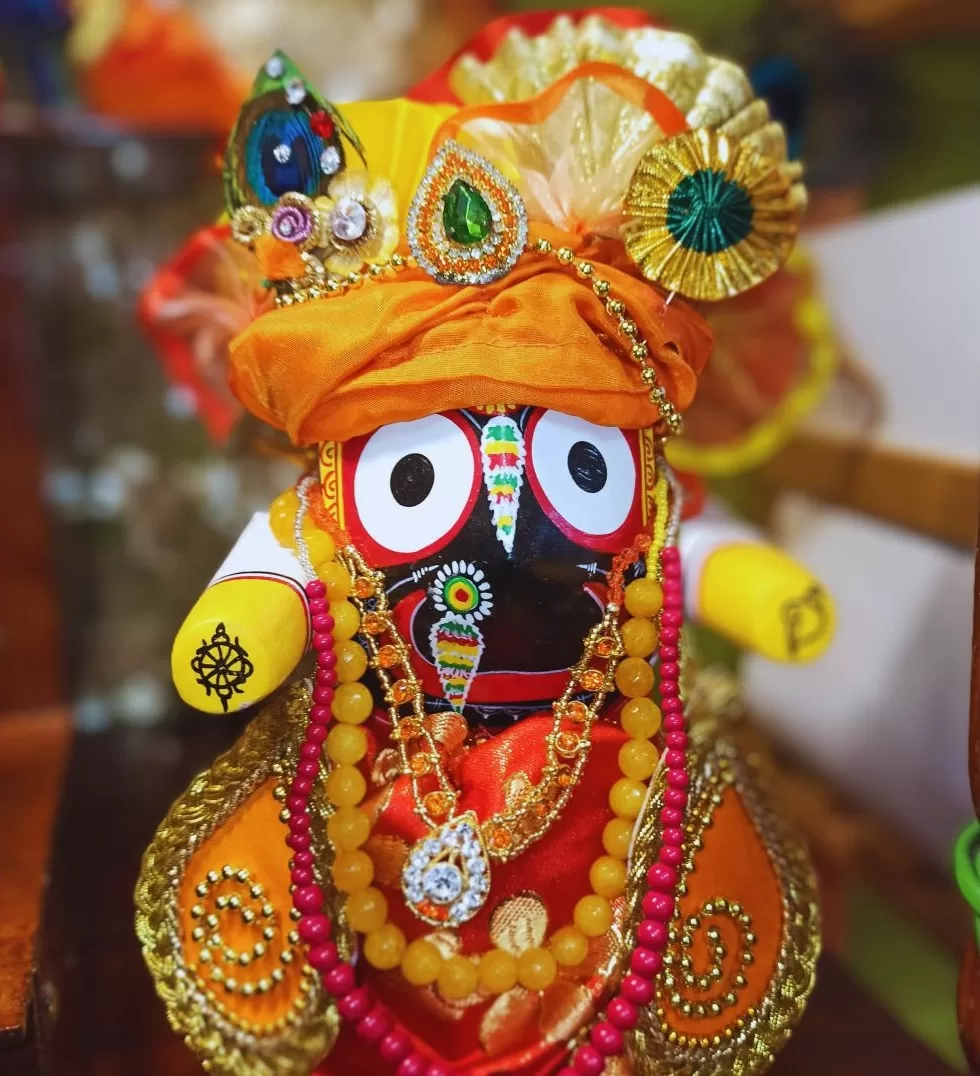
Hare Krishna, today article: Our Omniscient and Eternal Guardian is from Bhaktivedanta Vamana Gosvami, disciple of Bhakti Prajnana Kesava Gosvami
Śrī Guru-Praṇāma:
oṁ ajñāna-timirāndhasya
jñānāñjana-śalākayā
caksur unmīlitaṁ yena
tasmai śrī-guruve namaḥ
“I offer my respectful obeisances unto my spiritual master, who with the torchlight of knowledge has opened my eyes, which were blinded by the darkness of ignorance.”
Two important verses:
suna suna nityananda, suna haridasa
sarvatra amara ajna karaha prakasa
prati ghare ghare giya kara ei bhiksa
‘bala krsna, bhaja krsna, kara krsna-siksa’
“Listen, listen, Nityananda! Listen, Haridasa! Make My command known everywhere! Go from house to house and beg from all the residents, ‘Please chant Krishna’s name, worship Krishna, and practise what Krishna teaches.’” (Sri Chaitanya-bhagavat, 2.13.8-9)
harer nāma harer nāma
harer nāmaiva kevalam
kalau nāsty eva nāsty eva
nāsty eva gatir anyathā
“In this age of quarrel and hypocrisy, the only means of deliverence is the chanting of the holy names of the Lord. There is no other way. There is no other way. There is no other way.”
Mahā-mantra Hare Kṛṣṇa:
Hare Kṛṣṇa Hare Kṛṣṇa
Kṛṣṇa Kṛṣṇa Hare Hare
Hare Rāma Hare Rāma
Rāma Rāma Hare Hare
Article: Our Omniscient and Eternal Guardian
by Srila Bhaktivedanta Vamana Gosvami Maharaja
The Spiritual Biography
We have assembled here today for a special reason, that is, to honour the disappearance day or viraha-tithi, of my most beloved Gurudeva, jagad-guru nitya-lila pravishtha om vishnupada ashtottara-sata Sri Srimad Bhakti Prajnana Kesava Gosvami Maharaja. When people of this world write biographies, whether of common persons or eternally perfect and liberated saints, they always examine two.
The birth and death of the living entity entangled in fruitive action occur merely by the dictates of his past deeds and their consequences. But Bhagavan does not undergo material birth and death because He is saccid-ananda, the embodiment of spiritual existence, consciousness and bliss.
Similarly, the advent and disappearance of eternally perfect, liberated souls are not material. Such personalities are not bound in the cycle of birth and death by their activities and the results of those activities. This has been stated unambiguously in the scriptures.
On this same full moon day, my Gurudeva disappeared from this world at a glorious time, thus depriving us of his merciful association. Where did he go? To his eternal abode and destination, Goloka Vrindavana. Those who are eternally perfect and eternally liberated automatically achieve a destination that lies wholly beyond the reach of ordinary persons.
Our Eternal Well-wisher
If ever the question should arise whether or not Sri Guru and the Vaishnavas deceive us, the scriptures confirm that, in a way, they do. They accept the various hardships of this world just to assist those who are sincere in their efforts to practise hari-bhajana or sadhana-bhajana. And to those who avoid sadhana-bhajana and instead engage in whimsical activities, Guru and the Vaishnavas remain somewhat indifferent. This, especially, is to be understood.
If the residents of the matha, or spiritual institution, behave correctly and engage themselves in sadhana and bhajana by completely devoting their lives to the service of Sri Hari, Guru and the Vaishnavas, they can attain complete perfection. Qualified guardians assume the role of well wishers, even in this world; what then to speak of our spiritual guardians, in whom we witness a far more exalted conception of guardianship.
Who is Gurudeva? He is our best friend. He is our eternal well-wisher, who offers shelter to the shelterless. How is this? He is the exclusive point of refuge for those who can find no shelter in this world. None is as merciful and compassionate in the prison house of this world as he is.
Guru is concerned for our spiritual well-being. People often make a display of caring for others’ material well-being, but they do not understand the importance of spiritual welfare; nor can they help anyone else grasp this. Unless we receive Bhagavan’s causeless mercy, we will not identify the correct path to Him or ever find an appropriate guardian.
Guru of the Universe
Those who have become acquainted with the path of sadhana-bhajana by personally pursuing that path and successfully surmounting the various obstacles and hardships along the way, and who in turn point submissive souls in the same direction, fall within the category of jagad-guru-tattva, spiritual teachers of the entire universe. In relation to guru, people often think, “This person is my guru, that person is your guru, and that other person is his guru,” but the scriptures presents a different conception:
mannathah sri jagannatho madguruh sri jagadguruh
My Lord is the master of the universe, and my guru is the spiritual preceptor of the entire world.
Less intelligent people err in their attempts to understand this. That person who is my guru is the guru of all fourteen planetary systems, and therefore he is jagad-guru, guru of the entire universe. This is a scriptural truth, not mere fantasy. We may think that we honour our Gurudeva by praising him profusely, and that he will be pleased by our display of devotion, but this reveals a misunderstanding about guru-tattva. It is not like this.
When the guru has attained omniscience, he falls in the category of antaryami-tattva, which is to say he is all-knowing like the Supersoul. Nothing need be presented to him as newsworthy. He is inherently aware of our mistakes, imperfections, faults and shortcomings; and yet he still showers us with abundant encouragement to pursue spiritual life, inspiring us to perform sadhana-bhajana. This is his special mercy.
Sri Krishna, the Original Guru
In his hari-katha, Srila Bhaktisiddhanta Sarasvati Prabhupada has said that the people of the world plainly failed to understand the instructions of Bhagavad-gita and Srimad-Bhagavatam, though the Supreme Personality of Godhead, Sri Krishna, spoke them directly. They are unable to grasp these same teachings today, and will also be incapable of doing so in the future.
Having reflected on the living entity’s plight, Sri Radha and Sri Krishna personally appeared in this world in their combined form of Gaurahari, Sri Caitanya Mahaprabhu, and assumed the role of jagad-guru to instruct all humankind.
This indicates that Bhagavan is the original cause of the living entities’ engagement in hari-bhajana and is most concerned for them. Thus, by His personal example, He has arranged to teach the living entities how to chant the names of Sri Krishna and engage in bhajana of Sri Radha and Sri Krishna with deep and ardent yearning. His expression of bhajana is portrayed in such literary works as Sri Caitanya-caritamrita and Sri Caitanya-bhagavata, which depict His pastimes.
Can there possibly be any deficiency in Sri Krishna? He does not lack anything. Srimad-Bhagavatam (6.9.22) states, “svenaiva labhena samam prasantam – Bhagavan is always jubilant and fully satisfied by His own spiritual perfection.” While this is true, Bhagavan becomes distressed upon seeing the miserable condition of the living entities, and He weeps. This is the natural disposition of a guardian and is why Bhagavan personally descended to preach the process of sadhana-bhajana and nama-sankirtana, the congregational chanting of the holy names.
Many people raise the doubt, “Is Sri Caitanya Mahaprabhu still bestowing His mercy today? After all, are there not numerous examples to show that only His personal associates received His favour?” It is the conditioned soul’s doubting nature to always seek defects in others, be they Vaishnavas or Bhagavan Himself. His mentality is like that of an ant which tries to find a hole in a temple composed of gems. This is his great misfortune.
The Path of Humility and Surrender
The scriptures instruct us to care for our own wellbeing and the well-being of others, but we are unable to understand what this means. Our crippled nature blights everything and our useless fault-finding mentality takes us nowhere. Sri Caitanya Mahaprabhu has instructed: trinad api sunicena taror api sahishnuna amanina manadena kirtaniyah sada harih, Sri Sikshashtakam (3)
One should continuously chant the holy name of Sri Hari, thinking oneself to be even lower and more worthless than insignificant grass that has been trampled beneath everyone’s feet, being more tolerant than a tree, being prideless and offering respect to everyone according to his respective position.
The scriptures describes how one can become amani-manada, free from the desire to receive honour and able to offer all respect to others. Our guru-varga, or line of previous acaryas, has beautifully elaborated upon this point:
amani manada haile kirtane adhikara dibe tumi
My prayer is that when I have abandoned the desire for honour and am able to offer all respect to others, you will bestow upon me the ability to perform kirtana.
What does this mean? If I can become amanimanada, I may actually achieve something in spiritual life. But if, instead, I nurture desires unfavourable for bhakti, I will never attain any success. My devotional practices will merely deceive me and others. Our guru-varga is revealing this fact to us.
The scriptures offer abundant advice and regulations for our benefit, but we do not understand them. The instructions from the lotus lips of a sad-guru, whose heart melts with compassion, have such uncommon potency that he bestows his mercy upon the living beings through the power of these words alone.
What will allow us to understand this? By saranagati, dedicating ourselves completely to the lotus feet of Sri Guru, there is hope that we may make advancement. But if Guru and the Vaishnavas see that I am extremely proud, eager for name and fame, and behaving whimsically, they will become indifferent to me.
If I do not understand anything despite being told repeatedly, and if I do not follow the path indicated by Sri Guru, they may deprive me of their association. It is not their purpose to deceive us. This is not even the motive of Bhagavan, let alone of His associates, who are always eager to bestow mercy upon the conditioned souls. Sri Guru and the Vaishnavas only wish to see us advance spiritually, but we do not realise this.
Avoid Offences at All Costs
Today is my Gurudeva’s disappearance day, but my heart is not weeping. I have never missed him, from the core of my heart. I am not in the least bit concerned that I have lost such a precious stone, a touchstone. I have my dress of a sadhu and know that I will eat and live nicely. This attitude is a matter of serious concern.
Those who wish to follow the process of sadhana-bhajana and who try to engage themselves in thoughts of Bhagavan and in service to Him, should be extremely watchful. Srila Narottama Thakura has written “vando mui savadhana-mate – I bow to the lotus feet of my Sri Gurudeva with great care and attention.”
What does “care” refer to here? The scriptures instruct us to be attentive not to commit offences.
One should always keep this in mind. While chanting the holy name, one should carefully avoid nama-aparadha; while visiting the dhama one should avidly avoid dhama-aparadha; and while serving the deities one should take great care not to commit seva-aparadha. Moreover, while residing with Guru and the Vaishnavas and serving them, one should attentively guard against committing guruaparadha and vaishnava-aparadha.
With so many obstacles and restrictions, one may wonder where to go and what to do. But the more easily we shall attain our goal. A careful examination of the scriptures reveals that they contain Bhagavan’s words of discipline and regulation. Whatever instructions or advice Bhagavan has conferred upon us is repeated by Guru and the Vaishnavas. They do not fabricate anything. What they say to their community of followers they glean from the scriptures’ positive and negative injunctions.
The Guru’s Chastisement
“When I’m praised,” one may think, “I feel so much pleasure; but when criticised, I feel great discomfort.” That is not the correct attitude. It is inappropriate to hear Guru and the Vaishnavas glorify one. Rather, I should consider it my great fortune if, for my spiritual welfare, they mercifully punish and rebuke me out of love. But I am unable to tolerate this, and it leads me to present counter-arguments to defend myself. In niti-sastra, the scriptures delineating moral conduct, it is stated, “bhrityasca uttardayakah – he who immediately answers back on being directed should be rejected as a servant.”
One should listen to Guru and the Vaishnavas when they deem it necessary to rectify us. One and patience, in the faith that they are speaking for our benefit only. They have no selfish motive. We must always maintain this attitude, for what will Sri Guru’s attitude be towards us if we don’t? Extremely mild. He may treat us like an esteemed personality, a master, and behave like our servant. And then if he doesn’t listen to us, we may decide to reject him as our gurudeva.
Once, Srila Bhaktisiddhanta Sarasvati Thakura Prabhupada said with deep regret, “Those who think they must have a guru to live in this world, just as a person who wants to cross a river must procure a boatman, or a person who wants his clothes washed must locate a washerman, have been cheated. Such persons, who try to understand Gurudeva’s actions with their material intelligence, have never once seen or met me, nor with this attitude will they ever do so.”
The eternally liberated souls always speak the message of Vaikuntha. They never utter anything for their selfish interest, but nonetheless we see faults in them. In doing so, we create problems for ourselves and are simply being betrayed from all directions.
Translated from Sri Gaudiya Patrika, Year 55, Issue 10
by the Rays of The Harmonist team.
Published in English for the first time in Rays of The Harmonist No. 14 Karttika 2004