Hare Krishna, today is appearance day of Jīva Gosvāmī
Prayers
Śrī Guru-Praṇāma:
oṁ ajñāna-timirāndhasya
jñānāñjana-śalākayā
caksur unmīlitaṁ yena
tasmai śrī-guruve namaḥ
“I offer my respectful obeisances unto my spiritual master, who with the torchlight of knowledge has opened my eyes, which were blinded by the darkness of ignorance.”
Two important verses:
suna suna nityananda, suna haridasa
sarvatra amara ajna karaha prakasa
prati ghare ghare giya kara ei bhiksa
‘bala krsna, bhaja krsna, kara krsna-siksa’
“Listen, listen, Nityananda! Listen, Haridasa! Make My command known everywhere! Go from house to house and beg from all the residents, ‘Please chant Krishna’s name, worship Krishna, and practise what Krishna teaches.’” (Sri Chaitanya-bhagavat, 2.13.8-9)
harer nāma harer nāma
harer nāmaiva kevalam
kalau nāsty eva nāsty eva
nāsty eva gatir anyathā
“In this age of quarrel and hypocrisy, the only means of deliverence is the chanting of the holy names of the Lord. There is no other way. There is no other way. There is no other way.”
Mahā-mantra Hare Kṛṣṇa:
Hare Kṛṣṇa Hare Kṛṣṇa
Kṛṣṇa Kṛṣṇa Hare Hare
Hare Rāma Hare Rāma
Rāma Rāma Hare Hare
Jīva Gosvāmī
- Birth: 1533 (Christian calendar), 1455 (Śakābda), 12th day of the bright fortnight in the month of Bhādra.
- Disappearance: 1540 (Śakābda), 3rd day of bright fortnight, Pauṣa.
- Age: 85 years
Śrī Sanātana, Śrī Rūpa and Śrī Vallabha were three brothers, all employed in the service of the Badsa Hussain Shah. Amongst the three, there was only one descendent, Śrī Jīva. Having been rewarded richly by the Badsa for their services, their household life was very opulent. There was nothing lacking in whatever was necessary for the upbringing of the only son.
The house was illuminated by the effulgence of the child’s golden complexion; his eyes were like the expanded petals of the lotus; every part of his body was graced with a lusterous, radiant splendor. When Śrī Gaurasundara came to Rāmakeli, Śrī Jīva was blessed by having darśana of His worshippable Lord, though he was just a baby at the time. Placing the dust of His lotus feet on the child’s head, Mahāprabhu indicated him to be the future sovereign preceptor of the Gauḍīya sampradāya.
Though he was only a child, Śrī Jīva kept the form of the Lord, which fascinates all the world, within his heart. As he grew up, while eating, lying down, in his dreams, while he was awake, at all times, he would meditate on that form. Later on, when his father and uncles renounced their family life in order to be with Mahāprabhu, the only child, Śrī Jīva, was left with his mother in the family palace at Fateyabad. Lying in her lap, which was wet with tears of separation, he gradually began to grow as the waxing moon.
Seeing that the mother and the child’s face were always wet with tears, their friends also fell under the shadow of sadness and only with great difficulty managed to assuage their grief. Whenever Śrī Jīva would remember his father and uncles, or the lotus feet of Śrī Gaura Hari, he would lose consciousness and fall to the ground.
As he got a little older, Śrī Jīva took up the worship of the Deities of Śrī-Śrī Rāma-Kṛṣṇa. He would carefully decorate Them and offer bhoga and ārati, serving Them with his full attention. Even in his play, whatever games he played were connected with Śrī Kṛṣṇa’s pastimes. While studying under the local paṇḍitas he became proficient in grammar, poetry and rhetoric. Noting his great intellect, his teachers commented, “Such brilliance is not often found in a child so young as this. No doubt he will be a very high-souled, saintly person.”
Even while engaged in his studies Jīva always thought of Śrī Śrī Nitāi-Gaurāṅga. Once he saw in a dream that Śrī Rāma-Kṛṣṇa had taken the forms of Nitāi-Gaurāṅga and were dancing. (Bhakti-ratnākara 1.732) Giving him the dust of Their lotus feet, the Two Lords then disappeared. Having seen such a wonderful dream, Śrī Jīva was consoled somewhat. Then he began to think, “When will I be able to crawl out of this well of family life and devote my full time and energy, my very self, to serving these two most magnanimous Lords?”
But he was the only son of the family. Only in his company could his mother forget somewhat the pangs of separation in her heart. When Śrī Jīva learned that his father had given up his life on the banks of the Gaṅgā, he was completely unsettled. After that his eyes were never dry. The family members and friends tried to console him but to little avail.
Family life had become the source of his utter sadness. Someone suggested to Jīva to go to Navadvīpa and bathe himself in the coolness emanating from the lotus feet of Lord Nityānanda Prabhu so that his mind and body, burning with grief, could be refreshed. Thus Śrī Jīva set out for Navadvīpa with a group of pilgrims. (Bhakti-ratnākara 1.741) Nityānanda Prabhu, the omniscient Lord, could understand that Śrī Jīva was on his way to Navadvīpa. Therefore He also left for there from Khaḍadaha. After a few days, Jīva arrived at Navadvīpa.
Seeing the beauty of that place he was charmed. Falling down on the ground, he offered his daṇḍavats to Mother Gaṅgā. Inquiring from the villagers the directions to Māyāpura, he learned that Nityānanda Prabhu was residing at Śrīvāsa Paṇḍita’s house. At last arriving there, he fell down at the door to offer his daṇḍavats. Nityānanda Prabhu came out with Śrīvāsa Paṇḍita and picked him up and embraced him, asking, “Are you the nephew of Śrī Rūpa and Śrī Sanātana?” As an answer, Jīva again fell down on the ground at the lotus feet of Nityānanda Prabhu.
This time Nityānanda Prabhu brought him in the house and began to inquire after the welfare of his family at Fateyabad. Then Śrī Jīva was introduced to the devotees present in Navadvīpa; he offered his salutations at their lotus feet. Everyone was very happy to meet the nephew of Śrī Rūpa and Sanātana. That day Śrī Jīva received the remnants of Nityānanda Prabhu’s prasādam. The next day, the two of them came to Śacī Mātā’s house.
Seeing the birthplace of Śrī Gaurasundara, which was filled with such splendor, Śrī Jīva was greatly pacified and fell down on the ground to roll in the dust. In the large courtyard the devotees were singing songs praising the glories of Śrī Kṛṣṇa Caitanya Mahāprabhu. Seeing Nityānanda Prabhu, everyone stood up and then fell down, offering their daṇḍavats at His lotus feet. Then Jīva saw Śacī Mātā sitting on the veranda. Dressed in white with a silk cāddara around her shoulders she looked radiant, the white of her hair blending with her white sārī.
Though her body trembled with old age and was very thin, still the courtyard was illuminated by her divine effulgence. Forgetting herself in remembrance of Śrī Gaurasundara, she was sitting with her eyes closed. Becoming aware that Nityānanda Prabhu had arrived, she covered her head with her sārī and called her servant. “Īśāna! Śrīpāda has arrived. Please wash His feet.”
After this was done, Nityānanda offered namaskāra to the mother of the Supreme Lord and took His seat. He then introduced Śrī Jīva to her. Śacī Mātā placed her hand on his head to bless him, and Śrī Jīva floated in the ocean of happiness. Śacī Mātā then requested the two of them to honor the Lord’s prasāda. “Take prasāda here at your mother’s house today, my child. I offered these preparations in secret to Śrī Gauracandra.”
Śrī Jīva spent some days with Nityānanda Prabhu, touring the nine islands of Navadvīpa, in order to have darśana of the holy places of the Lord’s pastimes there. Then, as ordered by Nityānanda Prabhu, he set out for Kāśī (Varanasi). At Kāśī he studied Vedānta under Śrī Madhusūdana Vācaspati, a disciple of Sārvabhauma Bhaṭṭācārya.
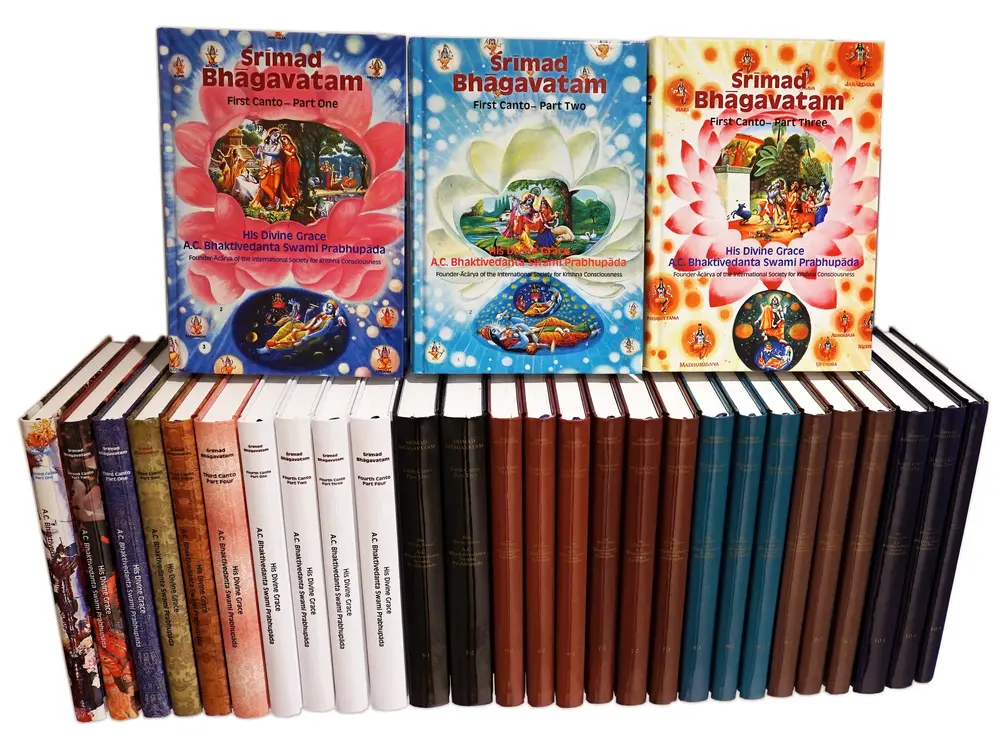
The conclusions of Vedānta contained in Śrīmad-Bhāgavatam that were expounded by Śrī Caitanya Mahāprabhu to Sārvabhauma Bhaṭṭācārya in Purī had been in turn taught by the Bhaṭṭācārya to Madhusūdana Vācaspati, who established a ṭola at Kāśī. From him, Śrī Jīva mastered the same conclusions.
From here Śrī Jīva set out for Śrī Vṛndāvana where he received shelter at the lotus feet of his two uncles, Śrī Rūpa and Sanātana. They were very pleased to see him and received from him all the news. Jīva stayed with Śrī Rūpa, who began to teach him Śrīmad-Bhāgavatam. After initiating him with the divine mantra, Rūpa engaged him in the service of Śrī Śrī Rādhā-Dāmodara. According to Sādhana-dīpikā, this Deity of Dāmodara was fashioned by Rūpa Gosvāmī’s own hand for his dear disciple Śrī Jīva. Śrī Śrī Rādhā-Dāmodara are presently being worshiped in Jaipur, Rajasthan.
Seeing that Jīva had quickly become conversant with the conclusion of the Śrīmad-Bhāgavatam, Śrī Rūpa engaged him in proof-reading his Bhakti-rasāmṛta-sindhu. At this time Śrī Jīva compiled a commentary on Bhakti-rasāmṛta-sindhu called Durgama-saṅgamanī. In the year 1476 (Śakābda) Śrī Sanātana Gosvāmī compiled Śrī Vaiṣṇava-toṣaṇī, a commentary on the tenth canto of Śrīmad-Bhāgavatam, which he gave to Śrī Jīva for proofreading. Under the order of Śrī Sanātana, Śrī Jīva compiled a commentary on that named Laghu Vaiṣṇava-toṣaṇī in the year 1500 (Śakābda).
His writings, along with those of Śrī Rūpa and Śrī Sanātana, Śrī Gopāla Bhaṭṭa, Śrī Raghunātha Bhaṭṭa, Śrī Raghunātha dāsa, Śrī Kṛṣṇadāsa, Śrī Kāśīśvara Paṇḍita, and Śrī Madhu Paṇḍita, completely captivated the learned men of that time. It was the beginning of a golden age at Śrī Vraja-dhāma. Śrī Jīva regularly brought water for Śrī Rūpa and Sanātana’s bath. He massaged their heads with oil, cleaned their āśrama, worshiped the Deity, cooked and corrected manuscripts.
After the disappearance of Sri Rupa and Sanatana, Sri Jiva continued the tradition that they had inaugerated. Once Śrī Jīva travelled to Agra to debate with the Rajputs concerning the glories of Yamunā and Gaṅgā rivers. He established that the Yamunā is more glorious than the Gaṅgā as the Gaṅgā emanates from Kṛṣṇa’s lotus feet whereas the Yamunā is His own consort. At this the Moghul emperor was very much satisfied and wanted to present him something. Śrī Jīva replied that he would accept some blank papers.
So the emperor presented Jīva some stained paper. (At that time paper was very rare and most manuscripts were usually composed on leaves.) There is also a legend that once, when a Moghul emperor (possibly Akbar) wanted to confer something on the Gosvāmīs of Vṛndāvana, they requested a farmān (emperor’s order) that no living beings would be killed within Vraja. As a result of this no king would come to hunt there anymore.
The disciple of Lokanātha Gosvāmī, Narottama dāsa Ṭhākura Mahāśaya, Śrī Gopāla Bhaṭṭa Gosvāmī’s disciple Śrīnivāsa Ācārya Prabhu, and the disciple of Hṛdaya Caitanya Prabhu, Śrī Śyāmānanda Prabhu, were greatly favored by Śrīla Jīva Gosvāmī. Under his tutelage they studied all the literatures of the Gosvāmīs. Later he sent them to preach this knowledge in Bengal.
Śrīla Jīva Gosvāmī composed many literatures, amongst them:
Bhāvārtha-sūcaka-campū.
Harināmāmṛta-vyākaraṇa
Sūtra-mālikā
Rasāmṛta-śeṣa
Gopāla-virudāvalī
Śrī Mādhava-mahotsava
Śrī Saṅkalpa-kalpavṛkṣa
Brahma-saṁhitā-ṭīkā
Bhakti-rasāmṛta-sindhu-ṭīkā (Durgama-saṅgamanī)
Ujjvala-nīlamaṇi-ṭīkā (Locana-rocanī)
Gopāla-campū
Ṣaṭ-sandarbha (Tattva-sandarbha, Bhāgavata-sandarbha, Paramātma-sandarbha, Kṛṣṇa-sandarbha, Bhakti-sandarbha, Prīti-sandarbha)
Śrīmad-Bhāgavata-ṭīkā (Krama-sandarbha)
Laghu-vaiṣṇava-toṣaṇī (Tenth Canto Bhāgavatam commentary)
Sarva-saṁvādinā (commentary on Ṣaṭ-sandarbha)
Gopāla-tāpanī-ṭīkā (Śrī Sukhā-bodhinī)
Padma-purāṇastha-yogasāra-stotra-ṭīkā
Gāyatrī-vyākhyā-vivṛti (A commentary on the Gāyatrī mantra as described in the Agni Purāṇa, chapters 216-217)
Rādhā-Kṛṣṇārcana-candrikā
Dhātu-saṅgraha