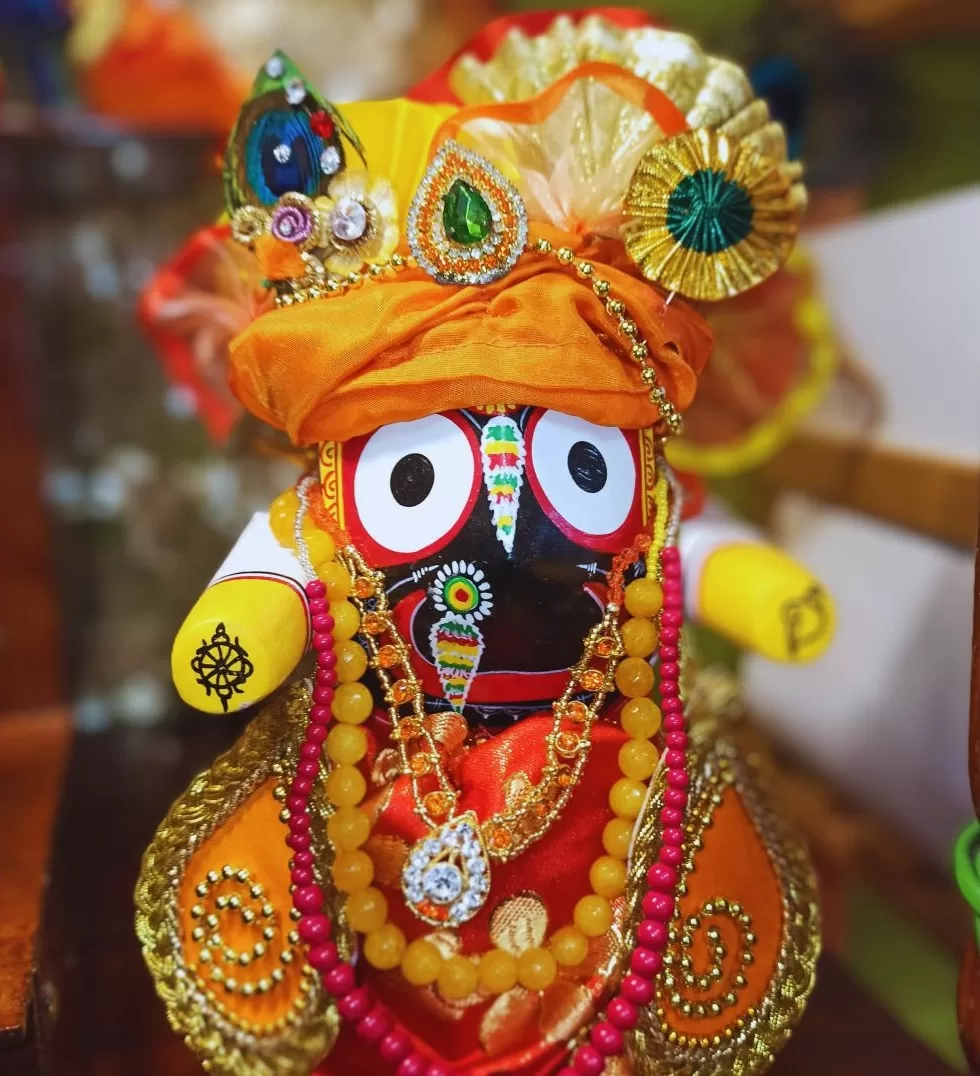
Hare Krishna, today article:
He Who Has Given Me Eyes to See (2/2) is from Bhakti Pramode Puri Gosvami, disciple of Bhaktisiddhanta Prabhupada
He Who Has Given Me Eyes to See
By Srila Bhakti Pramode Puri Gosvami Maharaja
Bodhayan Maharaja: Then, will we be liberated in this lifetime?
Guru Maharaja: Of course, you will. You will see the symptoms of attraction to the Holy Name, every one of the signs of pure devotion. All these characteristics of pure devotion are ready and waiting. They are ready and waiting, and those who have taken the path of pure devotion have no need for any other process.
Some people are like Sri Jiva Goswami’s father, who was a devotee of Rama. His own brothers were perfected Krishna bhaktas. They said to him, “Brother, we worship Radha and Krishna. Why don’t you join us?” Sri Jiva’s father stayed up the whole night, worrying. Then in the morning, he told his brothers, with tears in his eyes and said,
raghunathera paya muni veciyachon matha kadhite na pari matha, mane pai vyatha
“Murari Gupta said, ‘I have sold my head unto the lotus feet of Raghunatha. I cannot withdraw my head, for that would give me too much pain.” (CC 2.15.149)
Then his brothers understood that he was not able to change because he was totally committed to Rama. Though the results of worshiping Rama are not the same as those that come from worshiping Krishna, some people still prefer the form of Rama to that of Krishna. This is also the result of previous life’s activities. You will find in the Tattva-sandarbha-someone who is attached to Rama may change his taste, perhaps in another lifetime. Krishna and Rama are ultimately the same Supreme Truth, but in different forms.
The Supreme Lord takes different forms, like that of Vamana, Varaha, and so on. Jayadeva sings, kesava dhrta-rama-sarira, kesava dhrta-mina-sarira-“O Keshava, you have taken the form of Rama”, “O Keshava, you have taken the form of a fish,” etc. And then he concludes, dasdkrti-krte krsndya tubhyarii namah.
(Gita-govinda, 1.16)
So, my son, stop worrying your head about what is going to happen in another lifetime. Concern yourself with what you can do here and now. Try to chant the Holy Names and aim at getting a little taste for chanting. Then you will understand.
BM: Will we ever get a taste for chanting, Maharaj?
GM: Of course you will. You will get a taste. You have overcome so many dangers and obstacles and your mind has never wavered. You managed to escape them all. Krishna will surely bless you for everything you have done.
BM: Will everyone who has taken shelter of you get such a taste, Iviaharaj?
GM: I have told you that some people have truly taken shelter and others merely claim to have taken shelter. If you understand what it means to take shelter and you act accordingly, then it will certainly come about. What does it mean to take shelter?
A number of my disciples have left the matha. I don’t tell them to come back. What I say is that I have offered you to Srila Prabhupada’s lotus feet. The important thing is to try to chant without committing offences. Then the Holy Name will bestow its blessings. It will make you understand everything about what is devotional perfection and what is spiritual immaturity.
BM: It is very difficult to chant without committing offences.
GM: The problem is in our dealings with Vaishnavas. Perhaps someone is a really advanced Vaishnava and only seems to be an immature devotee from the outside, while inwardly he cries to the Lord with great intensity. And we focus on his faults and criticize them. That is why the scripture says para- svabhdvakarmani na ninden na prasariisayet. Mind your own business.
You can see directly from this that you should not keep the company of those who are opposed to Vaishnavism. This can be understood from those words from the Bhagavatam, “Neither criticize nor praise.” And in the Chaitanya Bhagavata it is said,
para-carcakera gati nahi hono kale
“Those who are obsessed with criticizing others will never attain the shelter of Krishna’s lotus feet.” (Cbh 2.13.34)
‘jati-kula, saba-nirarthaka’ bujhaite janmilena nica-kule prabhura ajnate
“In order to prove to the world that one’s caste or family background have no relevance to spiritual life, Hari Das took birth in a lowly family.”(Cbh 1.16.237)
I say this to everyone when I give the mantra. I thought that since he has come from so far away.. he was crying so much that the tears fell on my feet. But don’t I say that I am a freedom fighter? “Certainly I will engage in bhajan, but I am a freedom fighter.”
They haven’t so much eagerness for serving the guru. Who can you believe? I told them that their speech was good, but that’s all. I tell you to chant the Holy Name, to engage in sadhana and do bhajan.
bhajanera madhye srestha nava-vidha bhakti ‘krsna-prema’, ‘krsna’ dite dhare maha-sakti tara madhye sarva-srestha nama-sankirtana niraparadhe nama laile paya prema-dhana
“Of the many ways of executing devotional service, there are nine varieties that are considered to be the best, for they possess a great capacity to deliver love for Krishna and thus Krishna himself. Of these nine processes of devotional service, the most important is the chanting of the Lord’s holy name, for if one chants without committing offences he will obtain the treasure of love for the Lord.” (CC 3.4.70-1)
And we see in the Chaitanya Charitamrita that Mahaprabhu danced with Hari Das’ body in his arms, bathed it in the ocean and then helped to bury him. The Lord said, “Today, the ocean has become a great place of pilgrimage.” As though the ocean was not already a great place of pilgrimage. But still he says that because Hari Das’ body had been bathed in the ocean, it had been sanctified and made an even holier place.
[crying] Then Mahaprabhu said,
haridasa achila prthivira ‘siromani’ taha vina ratna-sunya ha-ila medini
“Haridasa Thakura was the crown jewel on the head of this world; without him, this world is now bereft of its valuable jewel.” (CC 3.11.97)
These great examples are found in the Chaitanya Charitamrita and Chaitanya Bhagavata. And Krishnadas Kaviraj praised Vrindavan Das Thakur extensively. He says that Lord Chaitanya Mahaprabhu wrote the Chaitanya Bhagavata through him. Read my introduction to the Chaitanya Charitamrita.
So the devotees should not say that I am not encouraging them, that “this or that” have not been given to them.
utsahan niscayad dhairyat tat-tat-karma-pravartanat sanga-tyagat sato vritteh shadbhir bhaktih prasidhyati
“Devotion reaches perfection through six virtues: enthusiasm, certainty of success, patience, consistently applying the practices, renunciation of bad association, and leading a moral life.” (Upadesamrita, 4).
You must be enthusiastic in your bhajan, certain that you will attain Krishna’s lotus feet. If you start grumbling, “What is the use of all this? What am I getting out of all this?” then you will run into difficulty. Then you will give everything up.
Remember Mukunda Datta, who was so pleased when he heard that he would see Mahaprabhu again, even though it would take a hundred lifetimes. He began dancing with joy and Mahaprabhu embraced him.
We must place special emphasis on the chanting of the Holy Name. Why else did Mahaprabhu say,
nama vinu kali-kale nahi ara dharma sarva-mantra-sara nama, ei sastra-marma
“In the age of Kali, there is no religious activity superior to the chanting of the Holy Names. The Holy Name is the essence of all mantras.” (CC 1.7.74)
And the further instruction,
bhajanera madhye srestha nava-vidha bhakti ‘krsna-prema’, ‘krsna’ dite dhare maha-sakti tara madhye sarva-srestha nama-sankirtana niraparadhe nama laile paya prema-dhana
“Of the many ways of executing devotional service, there are nine varieties that are considered to be the best, for they possess a great capacity to deliver love for Krishna and thus Krishna himself. Of these nine processes of devotional service, the most important is the chanting of the Lord’s holy name, for if one chants without committing offences he will obtain the treasure of love for the Lord.” (CC 3.4.70-1)
These are the teachings of the great authorities and we must follow them. Mahdjano yena gatah sa panthd. There are twelve great authorities. They are named in the story of Ajamila.
svayambhur naradah sambhuh kumarah kapilo manuh prahlado janako bhismo balir vaiyasakir vayam
dvadasaite vijanimo dharmam bhagavatam bhatah guhyam visuddham durbodham
yam jnatvamrtam asnute
“Lord Brahma, Bhagavan Narada, Lord Siva, the four Kumaras, Lord Kapila [the son of Devahuti], Svayambhuva Manu, Prahlada Maharaja, Janaka Maharaja, Grandfather Bhisma, Bali Maharaja, Sukadeva Gosvami and I myself know the real religious principle.
My dear servants, this transcendental religious principle, which is known as bhagavata-dharma, or surrender unto the Supreme Lord and love for Him, is uncontaminated by the material modes of nature. It is very confidential and difficult for ordinary human beings to understand, but if by chance one fortunately understands it, he is immediately liberated, and thus he returns home, back to Godhead.” (Srimad Bhagavatam, 6.3.20-21)
The word vayam (“myself’) means Yamaraj who is speaking this verse. These twelve Mahajanas devised the path of devotional life. They are the ones we must follow. Everyone else is going around starting this or that mission. Let them go on doing it. We have no criticism of them, but we don’t need to praise them for it either. Still, we have the scriptures to tell us who is on a level of true purity.
These are things that need to be discussed in the association of devotees:
siddhanta baliya citte na kara alasa iha ha-ite krsne lage sudrdha manasa
“A sincere student should not neglect the discussion of such conclusions, considering them controversial, for such discussions strengthen the mind. Thus one’s mind becomes attached to Sri Krsna.” (CC 1.2.117)
There is nothing to be afraid of. If you take shelter of Mahaprabhu’s lotus feet, you will achieve perfection. If in this lifetime we have taken shelter of Mahaprabhu, this means that we have been engaged in pious activities in previous lifetimes. This is no superficial statement. It is certain that we engaged in some kind of pious works that we could take up the practice of Vaishnavism in this lifetime.
I myself am the son of a practicing brahmin. In my youth, the influence of varnashram was very strong. People were going around saying, “I am a brahmin, I am a brahmin.” But after reading Bhaktivinode Thakur’s writings, I came to feel that one’s caste or family background have no relevance to spiritual life. I started to ask, “What does it mean to be a Brahmin?” Being a brahmin is no cause for pride.
We see the humility of the Vaishnavas like Krishnadas Kaviraj. Hari Das Thakur readily said that he was a mleccha. Rupa and Sanatan Goswami, though born in the highest brahmin family, presented themselves as the lowest of the low. Kaviraj Goswami writes:
jagai madhai haite muni se papistha purisera kita haite muni se laghistha mora nama sune yei tara punya ksaya mora nama laya yei tara papa haya emana nirghrna more keba krpa kare eka nityananda vinu jagat bhitare
“I am more sinful than Jagai and Madhai. I am lower than a worm in stool. Anyone who hears my name loses all piety, and one who speaks my name commits a sin. Who in this world other than Nityananda Prabhu would show compassion to one as despicable as me?” (CC 1.5.205-7)
Jaya Gaura Nitai! [laughs] Look at how Vrindavan Das described Nityananda Prabhu. When Nityananda Prabhu broke Mahaprabhu’s danda, Mahaprabhu asked him, “Who broke my danda?” Nityananda answers, “I broke a piece of bamboo.” Mahaprabhu asks, “You thought it was a piece of bamboo and that’s all?”
Vrindavan Das’ language is so amusing in this description. “Who broke my danda? I need a danda, so get me one right away Give me a danda.”
So all I want to say is that no one should lose their enthusiasm. I have mentioned the six qualities that are needed for success:
utsahan niscayad dhairyat tat-tat-karma-pravartanat sanga-tyagat sato vritteh shadbhir bhaktih prasidhyati
“Devotion reaches perfection through six virtues: enthusiasm, certainty of success, patience, consistently applying the practices, renunciation of bad association, and leading a moral life.” (Upadesamrita, 4).
We have no cause for fear. Srila Prabhupada said, “If you want to continue on this path and you need me, then I will not hesitate to take another birth to help you.” Srila Prabhupada will protect us in life after life. He said, “if I must, I will take birth again and again to you help you.” So he will. Then he will perhaps…
BM: But will you come again to deliver us?
GM: (laughs) What need do you have of me? Prabhupada said that he would come himself. He said he would come birth after birth.
BM: You were talking about Vaishnava aparadh, but Srila Prabhupada said that the disciple makes a contract with the Vaishnava guru to follow his orders…
GM: Yes, he said that…
BM: Sometimes we should be proud of who we are. In some other disciplic successions, the sadhus may accept Mahaprabhu, but they are not members of our MadhvaGaudiya sampradaya, but the Nimbarka sampradaya. But they criticize Srila Prabhupada. In such cases what do we do?
GM: We are neutral. We don’t have to put on a show.
BM: But if they are speaking against our spiritual masters?
GM: Even so, if they can be made to respect Mahaprabhu’s religion, then we can respect them also. If they do not respect Mahaprabhu’s religion, it is because they are proud.
BM: But what about what Prabhupada said, that we must have pride (dambhika)?
GM: Prabhupada said this out of his attachment to pure devotion. `This is the essence of all scriptures. Kaviraj Goswami Prabhu gives us the example of the Six Goswamis. In order to listen to their stories… that is not called pride.
BM: But if they are mayavadis?
GM: There are so many mayavadis around. Wherever you go you will run into them. So what of it? There was this one fellow named Karpatri who sometimes spoke in the assembly of Vaishnavas. What incredible lectures he gave. He had memorized the entire Chaitanya Charitamrita and so many other Vaishnava scriptures. But he was a complete mayavadi.
It is easier to have dealings with those who are openly impersonalists, whereas those who come disguised as Vaishnavas are a real disturbance. On the one hand, there are those who identify themselves as mayavadis and associate with their own kind. On the other, there are those who dress like Vaishnavas and know the Vaishnava scriptures, and use references to those scriptures to establish the impersonalist doctrine.
They are simply doing this to show off their knowledge and to earn the applause of the crowd. They can say, “So and so said such and such” and everyone will say, “Wow, what knowledge! What scholarship!” But such scholarship is of no value.
BM: But this very attitude is present in us, too. We study the doctrines of Mahaprabhu’s religion in order to garner a reputation, fame, and prestige for ourselves. What will happen to us if this is so?
GM: I can see that this is so. I see this is so. What else can I say? BM: What will happen to us in this case? We study the scriptures…
GM: We are, but we haven’t truly accepted Mahaprabhu. We quote so many verses in the name of “our Lord” but we have completely neglected his example. Can we call someone like this a devotee of the Lord?
Ramachandra Puri was looking all over for faults in other people, even those of Mahaprabhu himself, saying:
ratrav atra aiksavam asit, tena pipilikah sancaranti aho! viraktanam sannyasinam iyam indriya-lalaseti bruvann utthaya gatah
“Last night there was sugar candy here, because now there are ants all about. How distressing it is to see those in the renounced order of life showing such attachment to sense gratification.” (CC 3.8.49)
Ramachandra Puri saw ants crawling about just near the doorway of the Gambhira and immediately concluded that Mahaprabhu had been eating sweets and that the ants had been attracted by the sugar. As a result of his criticism, Mahaprabhu cut back on his food. The devotees knew that Ramachandra Puri would be leaving in a few days and so it was not necessary for Mahaprabhu to change his habits on his account, but they were afraid to tell him.
Mahaprabhu’s life is full of illustrative examples like this. If we study his life we will find answers to all our questions. Bhaktivinode Thakur and Srila Prabhupada wrote so many articles and books on the basis of their studies of Mahaprabhu.
BM: Maharaj, sometimes we think that our situation is conducive to engaging in bhajan, but in fact it is not. What should a conditioned soul like myself do?
GM: What should you do? I told you: follow Mahaprabhu’s example. Rupa Goswami, Kaviraj Goswami… all their writings are necessary for our spiritual life. That is why I started working on the Sandarbhas. The Sandarbhas are devotional texts that are commentaries on the Srimad Bhagavatam. Everyone reads the Bhagavatam differently, so the question remains: what is the true teaching of the Bhagavatam? That is what the Sandarbhas set out to explain. This is why you will not be able to understand the Bhagavatam properly unless you study the Sandarbhas. If I live, then…
BM: Bhagavat-sandarbha is being published.
GM: That’s what I want. It is being published, but if I continue to live, then I would like to lecture on the Sandarbhas. The trouble is that I am not in the best of health and I need better glasses…
There are seven Sandarbhas and, if you count Sarva-sariivadini, there are eight. BM: That’s enough for today. I have disturbed you sufficiently…
GM: No, no. You haven’t disturbed me. How many degrees did Babaji Maharaj get? It may not be absolutely necessary for our spiritual life, but if you want to preach then it might be useful. People want to know if someone is learned or not. Even so, Srila Bhaktivinode Thakur and Srila Prabhupada warned us about mundane scholarship:
jada-vidya jata, mayara vaibhava, tomara bhajane badha
moha janamiya, anitya samsare, jivake koraye gadha
“Material knowledge is one of the great splendors of the illusory energy, but it is an impediment to pure devotional service. It creates an illusory attachment to the material world and thus turns a human being into an ass.” (Saranagati, 3)
sei gadha haiye sarnsarera bojha bahinu aneka kala vardhakya ekhana saktira abhave kichu nahi lage bhala
“I too was an ass who carried the heavy load of household responsibility for such a long time. Now I am so old that I have lost all strength and nothing brings me pleasure any more.”
Bhaktivinode Thakur understood everything right away. He and the rest of our spiritual masters are all eternally perfect personalities who appeared on this earth in order to eradicate all misconceptions about spiritual life.
Vrindavan Das also said, pade kene loka… vidydya ki kare? “Why do people study? What do they get from their knowledge?” (CBh 1.12.251)
We were not able to understand this from the very beginning. Nevertheless, there is some use to all this material knowledge. It gives you credibility and added weight to whatever you say.
BM: So, Maharaj, will we ever attain the supreme goal of prema?
GM: Oh yes, oh yes. The reverend Tirtha Maharaj has published many books – Bhakti Ballabha Tirtha Maharaj, that is. Put those books to good use. Keep them with you and make use of them. We have so many holy days in the Vaishnava calendar. You should read these books on the holy days.
BM: Which books?
GM: Bhakti Ballabh Tirtha Maharaj has written two volumes about the lives of the Vaishnava saints. Take that book with you when you go preaching. For instance, today is the appearance day of Narottam Das Thakur. So this book will be very useful for talking about Narottam. I read the article about him and found it to be very good.
BM: So I am going, Maharaj.
GM: Come back. (to the Western devotees, in English) Learn Bengali!
Madhav Maharaj’s disciple Aravinda Brahmachari: You remain healthy in Puri, but not in Vrindavan.
GM: I didn’t really come to Puri for my health or because I prefer the climate here. I came because it is Jagannath’s home. Mahaprabhu came to live here and he performed his pastimes here in Puri. In his last twenty-four years, he spent six traveling around, visiting holy places, and the rest of the time, eighteen years, in Puri. Of those, six were spent with the devotees, singing and dancing in the Rathayatra in front of Jagannath’s cart. The other twelve years were spent in seclusion in the Gambhira, completely absorbed in the mood of Radha.
kahan mora prana-natha murali-vadana kahan karon kahan pan vrajendra-nandana kahare kahiba, keba jane mora duhkha vrajendra-nandana vinu phate mora buka
“Where is the Lord of my life, Krishna, the flute player? What can I do to find him? Where is the son of Maharaj Nanda? To whom can I talk of my distress? Who would understand me? Without the son of Nanda Maharaj, my heart splits in two.” (CC 2.2.15-16)
Baba, Mahaprabhu’s heart splits in the feelings of separation. I have been talking so much today, but Mahaprabhu’s heart would break and he would cry so intensely as to break others’ hearts also. The tears would pour over his chest and fall to the sand. This is not imaginary. Everything that Krishnadas Kaviraj Goswami wrote is based on eyewitness accounts. He wrote down what he heard from Raghunath Das Goswami, who told what he had seen or heard directly from Svarupa Damodar Goswami. And Murari Gupta’s karcha is also an eyewitness account.
So, as far as I am concerned, the three Mandalas-Gaura Mandala, Vraja Mandala and Kshetra Mandala- are all present here in Puri. I was not able to stay in Vraja Mandala, so I remember how Mahaprabhu displayed the Vraja lila here in Puri. I find solace in this thought. I also think of Narottam’s verse:
sri gauda mandala bhumi jeba jane cintamani tdra haya vraja-bhume vasa
“Someone who knows that the land of Bengal is completely spiritual lives in the land of Vraja.” (Narottam Das, Prarthana)
Only Mahaprabhu knows when I will have this vision. My life is almost over now, perhaps before I leave my body I will get a glimpse of this reality.
Notes
1. Srila Puri Maharaj has explained this example elsewhere. The male dog will sometimes try to eat the puppies, but the mother, even though not yet recovered from the pain of delivery, will defend them against the male.
! For more Biography look here!
!For more Articles look here!
