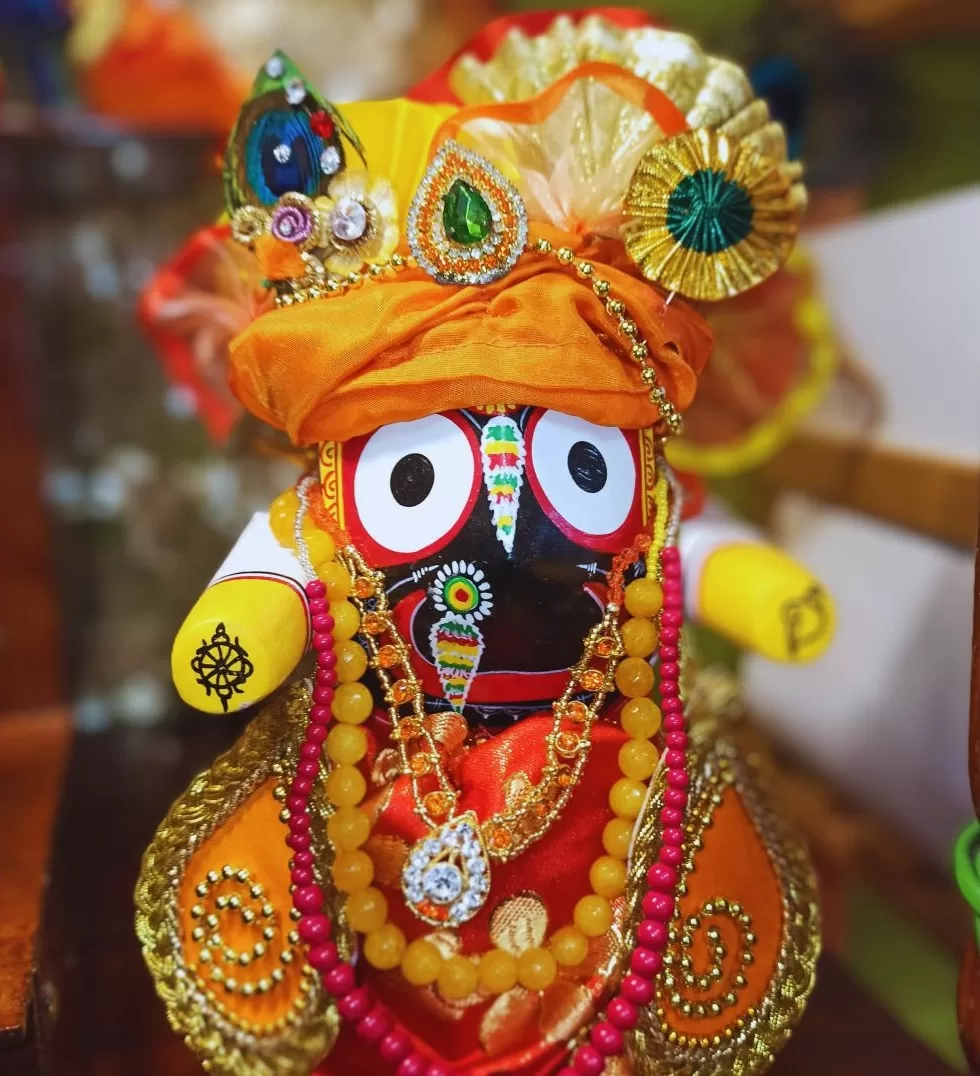
Hare Krishna, in saturday is Sri Krishna Janmastami
Prayers
Śrī Guru-Praṇāma:
oṁ ajñāna-timirāndhasya
jñānāñjana-śalākayā
caksur unmīlitaṁ yena
tasmai śrī-guruve namaḥ
“I offer my respectful obeisances unto my spiritual master, who with the torchlight of knowledge has opened my eyes, which were blinded by the darkness of ignorance.”
Two important verses:
suna suna nityananda, suna haridasa
sarvatra amara ajna karaha prakasa
prati ghare ghare giya kara ei bhiksa
‘bala krsna, bhaja krsna, kara krsna-siksa’
“Listen, listen, Nityananda! Listen, Haridasa! Make My command known everywhere! Go from house to house and beg from all the residents, ‘Please chant Krishna’s name, worship Krishna, and practise what Krishna teaches.’” (Sri Chaitanya-bhagavat, 2.13.8-9)
harer nāma harer nāma
harer nāmaiva kevalam
kalau nāsty eva nāsty eva
nāsty eva gatir anyathā
“In this age of quarrel and hypocrisy, the only means of deliverence is the chanting of the holy names of the Lord. There is no other way. There is no other way. There is no other way.”
Mahā-mantra Hare Kṛṣṇa:
Hare Kṛṣṇa Hare Kṛṣṇa
Kṛṣṇa Kṛṣṇa Hare Hare
Hare Rāma Hare Rāma
Rāma Rāma Hare Hare
Srila Param Gurudev on Sri Krishna Janmastami
Sreela Bhakti Dayita Madhava Goswami Maharaja
The following are excerpts from the speeches of Srila Gurudeva during Sri Krishna Janmāṣṭami at the Kolkata Maṭh between 1968 to 1974 noted and translated by Srila Gurudev. He spoke on different topics like, ‘The significance of the worship of Sri Krishna’, ‘The devotee and Bhagavan’ and ‘Getting the grace of Sri Bhagavan’.
The Significance of the Worship of Sri Krishna
To understand the significance of the worship of Sri Krishna, we first have to know who Sri Krishna is and what constitutes His real self. The significance of His worship rests upon His remarkable divine personality. The śāstras define the etymological meaning of the word Krishna as follows:
kṛṣir bhū-vācakaḥ śabdo
naś ca nirvṛti-vācakaḥ
tayor aikyaṁ paraṁ brahma
kṛṣṇa ity abhidhīyate
(Mahābhārata, Udyoga-parva 71.4)“The word Krishna is composed of the root kṛṣ meaning bhū, the shelter of all existence, and the word na, meaning nirvṛti or the form of supreme bliss. Combined, they form the word Krishna which signifies Param Brahman, the Supreme Absolute Truth.”
The word Krishna means “self-existing bliss.” The Vedānta has defined this as ānandaṁ brahma, and:
raso vai saḥ rasaṁ hy evāyam labdhvānandī bhavati
(Taittirīya Upaniṣad 2.7)“He is that rasa (ānanda or bliss). One who drinks that rasa becomes full of bliss.”
In another sense, the word Krishna means kṛṣ: “to attract” (karṣaṇe) and ṇa: “giving bliss.” The one who attracts all and gives them bliss, and who is blissful Himself, is known as Krishna. In other words, the word Krishna means ‘all-attractive’ and ‘all-bliss-giving.’ He cannot be all-attractive without being super-excellent in every respect.
When He exhibits His aspect of being smaller than the smallest, Krishna is known as Paramātmā. When He exhibits His aspect of being greater than the greatest, He is known as Brahman. Then again, reconciling both His aṇu (microcosmic) and vibhu (macrocosmic) natures and accepting a medium-sized Form, Sri Krishna performs wonderful pastimes of infinite variegatedness.
vadanti tat tattva-vidas
tattvaṁ yaj jñānam advayam
brahmeti paramātmeti
bhagavān iti śabdyate
(Śrīmad-Bhāgavatam 1.2.11)Knowers of the truth call that non-dual, absolute knowledge tattva—the Absolute Truth. This non-dual knowledge is referred to by the words Brahman, Paramātmā or Bhagavān.
The word Brahman signifies the largest (bṛhattva); Paramātmā, the smallest (aṇutva); and Bhagavān, the all-opulent (sarvaiśvaryamayatva: possessing all riches, all strength, all fame, all beauty, all knowledge and all renunciation). In other words, it encompasses the largest, the smallest, the middle, and everything else in existence.
The word Bhagavān reveals all the different aspects of the Absolute Truth. The jñānī experiences that non-dual tattva as Brahman, the yogī realises Him as Paramātmā, and the bhakta sees Him as Bhagavān. Bhagavān manifests infinite pastimes in infinite Forms, among which Sri Krishna is His original Form (svayam-rūpa).
ete cāṁśa-kalāḥ puṁsaḥ
kṛṣṇas tu bhagavān svayam
indrāri-vyākulaṁ lokaṁ
mṛḍayanti yuge yuge
(Śrīmad-Bhāgavatam 1.3.28)Sri Krishna is the origin (avatārī) of all other avatāras (divine descents). He is Bhagavān Himself.
yāṅra bhagavattā haite anyera bhagavattā
‘svayaṁ-bhagavān’-śabdera tāhātei sattā
(Caitanya-caritāmṛta, Ādi-līlā 2.88)Due to His (Krishna’s) divinity, others are divine.
In the Brahma-saṁhitā (5.1), Krishna is described as being the Cause of all causes—the Supreme Lord:
īśvaraḥ paramaḥ kṛṣṇaḥ
sac-cid-ānanda-vigrahaḥ
anādir ādir govindaḥ
sarva-kāraṇa-kāraṇam
Sri Krishna Chaitanya Mahāprabhu has also described Nandanandana Sri Krishna as being the highest object of worship. All possible needs of the living entity can be completely fulfilled only by the worship of Sri Nandanandana Krishna. How, then, will we be able to understand all these words? So long as we maintain an air of prejudice, this same prejudice will blur our vision.
One has to be worthy of understanding the science of the Absolute (bhagavat-tattva); unless one acquires that qualification, despite having considerable mundane worthiness, realisation of Bhagavān will not be possible. If we are not willing to work to reach that level, we should not expect to acquire that privilege. We cannot know Him through arrogance because He is Unchallengeable Truth. He has no cause, and there is no one equal to Him, what to speak of greater than Him.
Therefore, except for the grace of Bhagavān, there is no other method of knowing Him. To know Bhagavān, there are certain conditions that must be met. Surrender yourself with all humility. Be inquisitive, in a reverential manner, about all that is spiritual. Serve, with an attitude of surrender, the spiritual master who has knowledge of the spiritual. Śrīmad Bhagavad-gītā (4.34) has offered this instruction:
tad viddhi praṇipātena
paripraśnena sevayā
upadekṣyanti te jñānaṁ
jñāninas tattva-darśinaḥ
The Devotee and Bhagavān
If we accept the concept of Bhagavān, then we have to accept the concept of bhaga also. If we use the word dhanavān (“wealthy”) but exclude the word dhana (“wealth”), then the word dhanavān becomes meaningless. It is the same situation with bhaga and Bhagavān. He who possesses dhana (wealth) is dhanavān. Similarly, He who possesses bhaga is Bhagavān.
Bhaga means majesty (aiśvarya) or potency (śakti). Therefore, Bhagavān is He who possesses majesty and potency. The word Bhagavān does not specifically define the type of potency or energy involved. Therefore, Bhagavān is He who possesses all kinds of potencies or energies that could possibly exist. Thus, Bhagavān is the Omnipotent One:
aiśvaryasya samagrasya
vīryasya yaśasaḥ śriyaḥ
jñāna-vairāgyayoś caiva
ṣaṇṇāṁ bhaga itīṅganā
(Viṣṇu Purāṇa 6.5.47)One who possesses all majesty or wealth, all potency or strength, all fame, all beauty, all knowledge and all renunciation is known as Bhagavān.
The fact that Bhagavān possesses all beauty implies that He is beautiful; therefore, he must possess form. However, in saying that He must possess form, we should not attempt to confine Him by the perishable limits of length, breadth and height. The internal potency (cit-śakti) of Bhagavān has as its reflection the material energy, which is subject to change and destruction. We must not attribute those faults to that which is being reflected, i.e., Bhagavān, Who has a transcendental spiritual Form.
To do so would be foolish. Actually, Ultimate Existence is beyond the power of human intellect. The reflection has no real existence to speak of, but if the reflection gives the appearance of reality, then we must understand it to be a shadow reality—an unreal reality! Since a shadow is not real, we should not expect to derive true knowledge of reality from it. The śrutis say:
apāṇi-pādo javano grahītā
paśyaty acakṣuḥ sa śṛṇoty akarṇaḥ
sa vetti vedyaṁ na ca tasya vettā
tam āhur agryaṁ puruṣaṁ mahāntam
(Śvetāśvatara Upaniṣad 3.19)Bhagavān does not have limbs, yet He accepts and moves. He can see without eyes, He can hear without ears, etc.
The meaning of these apparently contradictory statements is that Bhagavān does not have a material form like ours, which is made up of material elements. On the contrary, He has a transcendental spiritual Form. In truth, because Govinda, the Cause of all causes, possesses form, we see so many forms in the universe. Without there being form in the cause, there can be no form in the effect; without there being form in the source, there can be no form in the reflection. Logically, something cannot come from nothing.
I have already said that if we admit to the existence of Bhagavān, we also have to admit to the existence of His energy or śakti. We cannot admit to the existence of Bhagavān without śakti. Even though Bhagavān is omnipotent, there are three predominating śaktis known respectively as the internal potency (cit-śakti), the external potency (māyā-śakti) and poised in between these two are His manifested living beings known as taṭastha- or jīva-śakti.
The śakti which takes us to the heart of Bhagavān is known as antaraṅga-śakti (internal potency). The śakti which overwhelms and enchants us with His external features, taking us away from Bhagavān, is known as bahiraṅga-śakti (external potency). The internal potency takes us towards, and the external potency takes us away from Bhagavān.
The internal potency performs the unalloyed service of Bhagavān; thus, it is referred to by the term bhakta (devotee). Bhakta and Bhagavān are one non-dual substance. That one substance is composed of two moods or aspects: the predominating and the predominated, the enjoyer and the enjoyed, the served and the servitor, the object of worship and the worshipper.
advaya-jñāna-tattva kṛṣṇa—svayaṁ bhagavān
‘svarūpa-śakti’ rūpe tāṅra haya avasthāna
(Caitanya-caritāmṛta, Madhya-līlā 22.7)“Krishna is the nondual Absolute Truth, the Supreme Personality of Godhead. Although He is one, He maintains different personal expansions and energies for His pastimes.”
The svarūpa-śakti (cit-śakti) has three divisions: (1) sandhinī, by which existence is preserved; (2) samvit, by which everything is known or perceived; and (3) hlādinī, by which activity and bliss is generated. Sri Baladeva is the principle of existence (sandhinī-śakti). Sri Krishna is the Consciousness Who enables awareness of our own existence (samvit-śakti). Sri Rādhikā is hlādinī-śakti or the pleasure-giving potency. The śakti that brings the greatest joy to Sri Krishna is the essence of all that is bliss, and is the very form of mahā-bhāva (the highest stage of Divine Love).
She is the daughter of Vṛṣabhānu—Śrīmatī Rādhikā. Sri Nanda Mahārāja and Śrīmatī Yaśodā-mātā, who serve in parental mellow (vātsalya-rasa), are the best among devotees because they too give supreme joy to Sri Krishna. Today is the Ānandotsava, the festival of joy of Sri Nanda Mahārāja. With his grace, we may also be blessed with the grace of Sri Krishna.
śrutim apare smṛtim itare
bhāratam anye bhajantu bhava-bhītāḥ
aham iha nandaṁ vande
yasyālinde paraṁ brahma
(Caitanya-caritāmṛta, Madhya-līlā 19.96, quoted in Padyāvalī 126)“Those who are afraid of material existence may worship the śruti, smṛti or Mahābhārata, but I pay my obeisances to Nanda Mahārāja because Sri Krishna, the Param Brahman, becomes trapped by the love of Sri Nanda and crawls around as a baby in his courtyard.”
śrī-rājovāca
nandaḥ kim akarod brahman
śreya evaṁ mahodayam
yaśodā ca mahā-bhāgā
papau yasyāḥ stanaṁ hariḥ
(Śrīmad-Bhāgavatam 10.8.46)“Mahārāja Parīkṣit asked, ‘What pious merits did Nanda Mahārāja accumulate by which Sri Krishna came to him as his son? What are Yaśodā’s past merits? She, too, is fortunate that the Supreme Lord Sri Krishna called her “Mother” and drank her breast milk.’”
Once, Lord Brahmā abducted the cows and cowherd boys of Vṛndāvana to test Krishna. However, as a result, he found himself deluded by Krishna’s mystic potency. Realising his folly, Brahmā then took absolute shelter of the Lotus Feet of Sri Krishna. Showering adorations, Brahmā praised the cowherd damsels (gopīs) of Vraja and their great fortune—their prema or unalloyed love for Sri Krishna.
aho bhāgyam aho bhāgyam
nanda-gopa-vrajaukasām
yan-mitraṁ paramānandaṁ
pūrṇaṁ brahma sanātanam
(Śrīmad-Bhāgavatam 10.14.32)“There are no limits to the good fortune of Nanda Mahārāja and the residents of Vraja. The personification of bliss, the eternal, Supreme Brahman, has manifested Himself as their dear friend.”
Getting the Grace of Sri Bhagavān
Since Bhagavān is beyond the confines of our limited intellect, we cannot know Him by virtue of our own merit alone. If that were so, then the very logic of Sri Bhagavān being the all-opulent Supreme Lord, Omnipotent and Infinite, becomes negated. The only way of knowing Bhagavān is by the desire of Bhagavān Himself.
To act according to the desire of Bhagavān is to have prīti (affection), or bhakti. If we act according to Bhagavān’s desire or, in other words, if we follow the course laid down by Bhagavān in the śrutis and smṛtis, then this will be the very means of achieving the grace of Bhagavān. That being said, how are we to know those rules laid down in the scriptures that are dear to Bhagavān? The answer to this is, we must seek the company of devotees and take shelter of a pure devotee.
There are two types of bhakti—vaidhi-bhakti and rāgānuga-bhakti. The first is the trodden path of scriptural rules and regulations, and the second is the blazing fire of transcendental love and passion. Sri Krishna can only be caught by rāgānuga-bhakti. Thus, sang one devotee:
śrutim apare smṛtim itare
bhāratam anye bhajantu bhava-bhītāḥ
aham iha nandaṁ vande
yasyālinde paraṁ brahma
(Caitanya-caritāmṛta, Madhya-līlā 19.96, quoted in Padyāvalī 126)“Those who are afraid of material existence may worship the śruti, smṛti or Mahābhārata, but I sing praises to Nanda Mahārāja, in whose courtyard plays the Param Brahman, Sri Krishna.”
Nanda Mahārāja and Mother Yaśodā have trapped the Infinite with their pure love. If I could even reach the doors of such a devotee, would there then be any doubt that I would definitely have darśana of Bhagavān? There are two aspects that I will carefully endeavour to enable you to understand. The devotee of Bhagavān always desires to please Bhagavān. If anyone else tries to please Bhagavān, then the devotee becomes that person’s slave.
Then again, Bhagavān wants the devotee to be happy. If one loves the devotee, then Bhagavān becomes captured by that person. That is why those who love and serve Bhagavān’s devotee can easily win the blessings of Bhagavān’s grace. Remember the saying, “If you love me, love my dog.” It is not difficult to love Bhagavān. Knowledge, wealth, beauty, power, etc., are not required in this love.
janmaiśvarya-śruta-śrībhir
edhamāna-madaḥ pumān
naivārhaty abhidhātuṁ vai
tvām akiñcana-gocaram
(Śrīmad-Bhāgavatam 1.8.26)“Those who are intoxicated with their birth (social status), wealth, learning and beauty are incapable of uttering the Name of Krishna, which can be taken by those who are bereft of all material assets.”
If all the pride in the world should occupy all the space in my heart, if I expend all my energies to chase after wealth, sex and power, then how can Sri Bhagavān find a place in such as my heart? Although a welcome sign hangs at the gate, the inside is cluttered up with so much rubbish that the invited guest has to turn away, being unable to find a place to sit. In like manner, it is no use to externally extend a welcome to Bhagavān if the inside is clogged up with unwanted desires. Bhagavān may very well come, but He will go away without finding a place to sit.