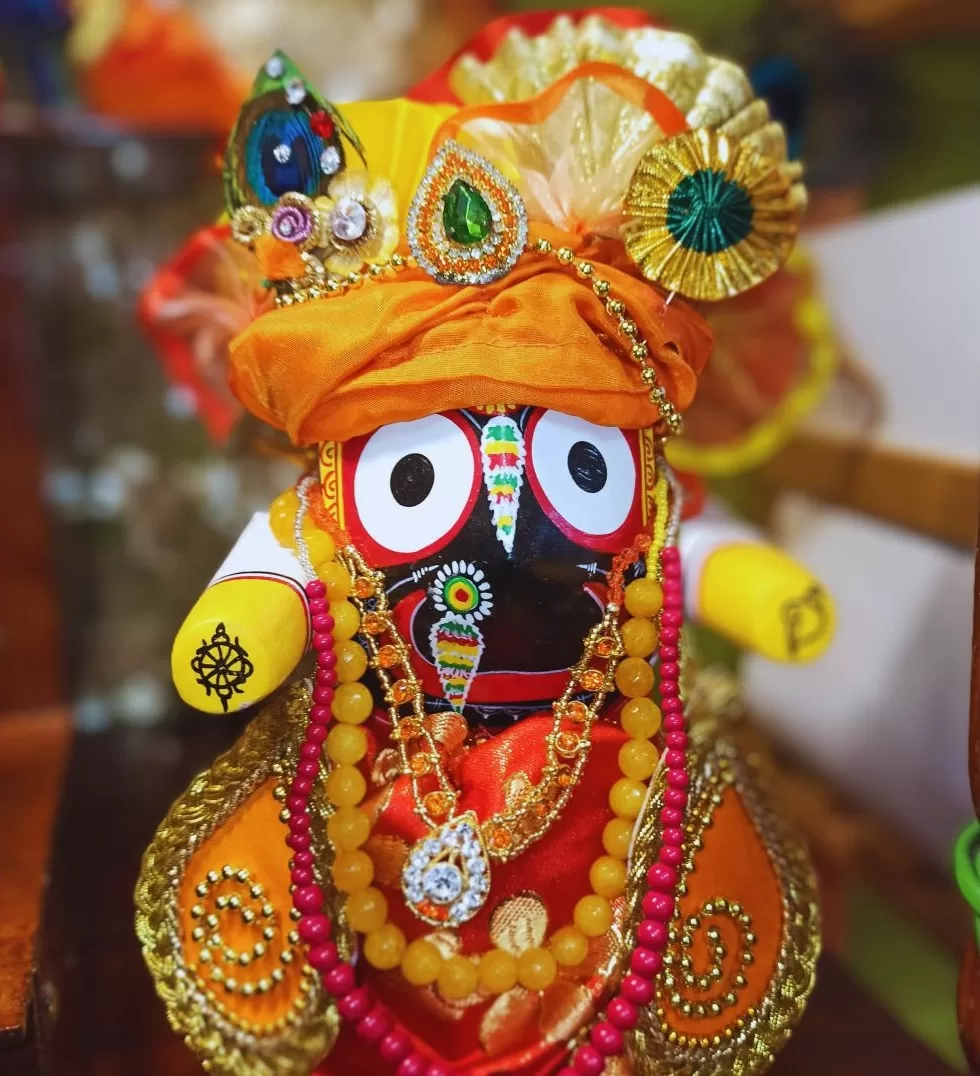
Hare Krishna, today article: Guru-tattva (3/3) is from Bhakti Pramode Puri Gosvami, disciple of Bhaktisiddhanta Prabhupada
Guru-tattva
By Srila Bhakti Pramode Puri Gosvami Maharaja
Another statement from scripture states that, the person is lowest among human beings who after deliberately accepting a guru at first, later reject him altogether. He will have to burn in hell for one million kalpas as atonement for this.
In actual fact, all these fearful statements in regard to rejection of a spiritual master refer only to the case when the Guru was genuine or bona fide. On the contrary worldly gurus who are deviant from the true paths, shows enmity to the true devotees, or are simply famous public personalities can be rejected in the consideration that these gurus will not help us to achieve our spiritual objective.
Srila Jiva Gosvami in Bhakti Sandarbha explains :- paramartha guruasrayo vyavarika
gururadi parityagenapi kartavyah
Meaning :- An incompetent spiritual master who is worldly-minded and accepted on convenience for name sake should be rejected and a self-realized soul who can impart spiritual knowledge is to be chosen. Further, in the Bhakti Sandarbha it is written:
vaisnavavidvesi cet parityajya eva guror apya baliptasyeti smaranat
The purport being, if a spiritual master is antagonistic to the devotees, or if he is an ordinary materialistic sense enjoyer, then he should be rejected. Such a guru, not having had any real symptoms of a devotee, will also incur fault for awarding the Mantra in an unauthorized manner and will have to glide towards the hellish region as a consequence.
The best course in this situation is to approach a great soul for guidance in humble submission. The famous verse in Mahabharata as quoted by Sri Jiva in his Bhakti Sandarbha commentary is stated:-
guruapya baliptasya karya akaryam ajanatah utpathapratipannasya parityago vidhiyate
One who is attached to sense gratification, who is indecisive of what is proper and not proper action and whose ways have deviated from the path of pure devotion, in other words a ‘guru’ by name only should be rejected. Srila Bhaktivinoda Thakura has mentioned when one has to reject a Guru in his Harinam Cintamani:-
tabe yadi ei rupa ghatana kabu haya asat-sange furura yogyata naya ksaya prathame chilena tini sadguru-pradhana pare nama-apvaradhe hoia hata jnana viasnava vidvesa kari chadi nama-rasa krame krame han artha-kaminira vasa sei gur chadi sisya sri krsna krpaya
sad guru labhiya punah suddha-nama gaya
In Jaiva Dharma, Srila Bhaktivinoda Thakura writes:
The initiating Guru (Diksa) is usually not to be given up but for two specific reasons can be renounced. Firstly when the disciple ignorantly accepts without any examination a Guru without consideration of his spiritual advancement and knowledge together with, whether or not he observes Vaishnava etiquette and conduct. Later when he understands his own dilemma and that no spiritual merit can be accomplished, that spiritual master needs naturally to be rejected. Narada Pancaratra’s verdict:-
yo vyakti nyayarahitam anyayena srnoti yah tavubhau narakam ghoram vrajatah kalam aksayam
One who speaks in a manner contrary to the revealed conclusions of scripture and the disciple who strictly upholds such distorted conclusions, will both go down to the darkest well of hellish existence.
The second reason by which a disciple can be allowed to reject the initiating Guru is the instance when at the time of initiation the Guru could have been very pure of conduct and learned in Vaisnava conclusions. Gradually by force of bad association, he may become converted to be an Impersonalist or a reviler of the Vaisnavas (blasphemous). Such a spiritual master should be rejected.
If one’s spiritual master is neither an offender of the Vaisnavas, an Impersonalist or attached to sinful activities then it is not warranted to reject such spiritual master simply on the grounds of his insufficient knowledge. Rather the proper etiquette is to keep adoring him as spiritual master but to take permission from him to approach another great self-realized soul for “Siksa” and to learn the higher spiritual truths from such an instructing spiritual master.
In the Hari Bhakti Vilas, the symptoms of a genuine Guru, one posing as a Guru including the characteristics of a disciple, have been elaborately explained at length. Srila Bhaktivinoda Thakura writes, one of model character and strong faith is eligible to become a disciple. Similarly the genuine Guru is of saintly character, understands the devotional conclusions, simple, not greedy in the least, free from any tinge of Impersonalism and naturally expert in all activities.
Generally a brahmin possessing all good qualities can accept disciples from other castes. In the absence of such brahmins however, devotees from other castes who are spiritually advanced can be selected as Guru. The basis of this injunction overrules the ordinary ‘varnasrama’ rules regarding superiority on the basis of seminal birth.
One who understands the science of the Supreme Lord is eligible to become a spiritual master. The usual caste brahmins at most may be able to get some extra material facilities by their superior birth, but the pure devotee can truly function as Guru.
The scriptures have specific rules according to as and when the disciple may be accepted in the light of trial. The fact of the matter is when the Guru sees the disciple as a fit candidate and when the disciple has strong faith in the purity of his Guru, then only will the flow of mercy take place between the Guru and the disciple.
The ‘Hari Bhakti Vilas’ mentions that a person who eats too much, procrastinates, is greedy for things not in connection with Sri Krishna, argumentative (in connection with this Jamini, Sugata, Nastika, Vagna, Kapila and Gautama with their followers are persons who practice agrumentation- hetuvada), wicked nature, strongly critical as well as relishing the misdemeanors of others, defamer, serve unworthy people, black teeth, black lips, who has foul odor emanating from his mouth, has bad qualities, is fond of amassing goods even though already having a sufficient amount, without hair or with excess of hair, are not the symptoms befitting an ‘Acarya’ (teacher).
All of one’s wealth and opulence will diminish in the acceptance of such an unqualified Guru.
In Mantra Muktabali, the appropriate qualities of a disciple are described. He should be born in a good family, be modest, opulent, possessed of loving disposition, truthful of pure character, very intelligent, free from arrogance, have given up lust and anger, surrendered to his Guru, with his mind, body and words, always devoted to the Supreme Lord, free from disease, freed from all kinds of sinful activities, sincere in honoring his elders and brahmins, of controlled senses, very youthful and compassionate. All these qualities make one eligible to be a disciple.
In the Srimad-Bhagavatam (11/10/6) it is stated:- amaniyamatsaro dakso nirmamo drdsauhrdhah asatvarohartha jijnasur anusuyara amoghavak
“The servant of the guru should be free from pride, not lazy or egoistic with the sense of ‘me’ and ‘mine’ in relation with wife and children, very devoted to Guru, not negligent, devoted to inquiry about the Supreme Truth, free from enviousness, not wasting time in loose conversations; all these qualities are befitting a disciple”.
On the other hand, in Agastya Samhita, the symptoms of an unworthy disciple are described as one who is lazy, dirty, who endeavors uselessly, naughty, miserly, poor, sickly, afflicted with diseases, attached to sense objects, eager for sense-delights, envious, gazes lustfully at other’s wives, shows enmity to learned people, foolish, rides himself to be highly scholarly, fallen in his vows, struggles to earn his livelihood, probes at others faults, bent on the downfall of others, glutton, always engaged in vile actions, sinful and not very willing to give up such despicable behavior and who cannot hear the beneficial instructions of Sri Guru; all these people are definitely not eligible to become disciples.
If being tempted by greed the spiritual master ventures to initiate all such unworthy people, he will incur the wrath of the demigods, consequently, being bereft of all wealth and opulence. Not only that, he will have to go to the hellish planets after which he will take birth in the animal species.
Therefore, one has to be careful not to accept disciples of this type.
The standing injunction is that the guru should examine a disciple for at least one year. taupr vat sarvasema kmatamupmua svabhavayoh
turuta sisyata ceti nanyathaiveti niscayah
The Guru should carefully examine his disciple while staying together with him and observing his qualities and character to judge whether he can be a fit candidate. Similarly, the disciple should examine the Guru accordingly. Other than this, there is no alternative way of knowing this fact. Without this recommended stipulation, one should not agreeable give initiation to anyone on mere request.
Further, there are spiritual statements to the effect that just as a King is responsible for his subjects having to suffer for their wrong actions, the man for the sins of his wedded wife, in the same manner the sins committed by the disciples will have to be borne by the spiritual master. Hence one has to be careful of awarding initiation to an unqualified person.
Notwithstanding, a powerful spiritually oriented person is not restricted by any scripture and does not have to consider who is worthy or unworthy. A fortunate person on receiving his benign glance can be nullified of many births of sinful activities and will be able to make rapid progress by the impetus of the Holy Names. The mercy of Srila Haridas Thakura in a lonely forest was such that even a prostitute was converted by his purity.
A Muslim tailor became perfect by helping to sow the cloth of Srivas Pandit. By the incredible mercy of Srila Sarana Murari, a dead body was infused with life and later became his own disciple. Srila Rasikananda Thakura’s compassion was such that even material objects were invigorated with consciousness and ordinary forest animals became blessed to chant the Holy Names.
Thus the potential self-effulgent ‘Acarya’ can surcharge others with energy, himself remaining unchanged in power and not affected in any way. Hari Bhakti Vilas too, a description about service to the spiritual master is mentioned.
The Kurma Purana explains, the disciple has constantly to carry the water pot of the Guru, pluck the sacrificial ingredients like khusa grass, kusum, etc. As a menial servant of his Guru. He should always clean the temple of his spiritual master, anoint the body of his guru with sandalwood and wash his cloth. The garlands, resting place, sandals, sitting cloth (asana), eating utensils and the shadow of Srila Gurudeva should never be stepped over or treated with disrespect.
One should not go out anywhere without the guru’s permission. One should always engage in activities dear to the spiritual master. One should never point or stretch his legs in the direction of Srila Gurudeva. In proximity to him, yawning, loud laughter and loud exclamations should be given up, also the practice of cracking one’s knuckles. Furthermore, the son of the spiritual master, his wife, relatives or other acquaintances should be treated with equal respect.
In Devi Tantra, Lord Siva says, the resting place of the spiritual master, his seating place, sandals, foot-rest, palanquin, bath -water and shadow should never be slighted or utilized. One should never worship any third person in front of Srila Gurudeva, nor should one try to equate oneself with him. In front of him, one should renounce erudite expositions of the scriptures nor maintain a superior attitude in relation to him. Also he should never give spiritual initiation to others while the spiritual master is present.
In Devya Agama, Narada Rsi states, whenever one obtains the vision of Srila Gurudeva, he should immediately, with folded hands, fall down in prostrated obeisances (like a falling tree) to the Guru. In no event should he be contemptible to the instructions of his Guru.
The Manu Smrti states, that one indirectly or out of hearing should not address the Guru by his first name or try to imitate his movement, speech and mannerisms. One should maintain his humble stance as the disciple of his Guru on the occasion of the Guru being in proximity with his Guru. One should not even go to the house of one’s parents if it doesn’t meet with the Guru’s approval.
In Narada Pancharatra, the way in which the name of the spiritual master is to be utilized is explained. One should never simply utter the syllables of the Guru’s name disrespectfully or carelessly at any time or place. With a bowed head and folded hands, one should firstly, with the pranam ‘om’, then with the title ‘108’ complete with the word ‘visnu pada’ has to be uttered, before mentioning his name respectfully.
It is also stated that one should never advise the spiritual master on any matter nor should he breach the instructions laid out by him. One should not eat anything that has not been offered to Sri Guru nor should he eat any food without his prior permission. On the arrival of the spiritual master, instantly one should bow in front of him reverently and should accompany respectfully when he is walking.
One should never remain seated on a pedestal or asana in front of him. Whatever is very dear to oneself should be first offered to the spiritual master and only after being granted by the guru, should he utilize it for himself.
In Visnu Smrti, it is said even when threatened or oppressed by the spiritual master, one should never cause him any pain in return. One should never criticize him in any way or work against his welfare. In the event of the disciple not engaging in the service of the guru even after taking the holy syllables and by the guru no having examined the disciple before, both are liable for punishment, being guilty. Narada Pancharatra states in this regard.
Yo vyakti nya yarahitam anyayena srnoti yah.
Srila Santana Gosvami writes in the Bhakti Hari Vilas:- pariksam bina gutrusevadinam bina ca mantrasya kathane grahne ca mahanartha iti likhati yo baktiti
In not going through the preliminary examination period, both the guru and the disciple face the prospect of going to a terrible hell for a long time. As stated in Agamas, the son of a born-brahmin, without going through the ritual of upanayana (brahmin thread) is not allowed to worship either the Salagrama Sila or study the Vedas. In the same say, the uninitiated person is not allowed to worship the Deity with the uttering of Mantras. For this process, one has to undergo the rite of initiation. The commentary by Srila Sanatana Gosvami runs:-
pradhanatvena sri-visundiksagrahanat sri-srivasyapi samyak stutivisayam iti bhavah
In the way Lord Visnu is the Supreme Lord, one who undergoes initiation into the Visnu Mantra, is even praiseworthy by the best of all devotees-Lord Siva. In Visnu Yamala it is even mentioned that for any uninitiated person, all his works will go to naught. One who does not undergo spiritual initiation is destined for animal births.
Diksa (initiation) is termed by the knowers of the truth as that which destroys all sins and gives transcendental knowledge. In Tattva Sagara, just as bell metal is converted by a chemical process into gold similarly by the process of initiation, all human beings attain to brahminhood.
yatha kanchautam yati kamsyam rasavvidhanathah thata diksavidhanena dvijatvam jayate nrnam
Srila Sanatana Gosvami writes nrnam sarvesameva vijatvam viprata.
By the process of spiritual initiation one attains the brahminhood. One who desires the highest goal should take to spiritual initiation under a bona fide spiritual master and practice devotional service to the Lord. All beings have a right for devotion to the Lord, it being the eternal constitutional function of the soul.
In Srimad Bhagavatam Lord Krishna informs His brahmin friend (Bhag 10.50.34):
naham ijya prajyatibyam tapas upasamena va tusyeyam sarvabhutatma guru susrusaya yatha
The way I become satisfied with a person who is devoted and cent per cent obedient to his guru is far more than just following their filial duties according to their different stages of life like celibate monk, householder, renounced order, etc. The great soul Prahlada Maharaja instructs his fellow companions and friends. (Bhag. 7/7/10).
guru susrusaya bhaktya sarva lobharpanena ca
One in forgoing all motives for fame and false prestige in the mood of a servant, in humble submission and surrender to the lotus feet of Sri Guru will gain firm attraction to the lotus feet of the Lord. Nothing is greater than service to Sri Guru which is the highest religious principle. All the evil tendencies like lust and anger including all impurities can be easily dissipated by pure devotion to the Guru.
The 11th Vilas, Hari Bhakti Vilas describes the service to please the Guru is the foremost of all vows. Padma Purana informs us that one who worships his spiritual master above his own father will definitely be a guest in the world of Brahma. In other places we have the Guru is himself Lord Brahma.
He is Lord Visnu and He is Sankara also, He is comparable to the Supreme Brahman which entails that all should worship him. In Vamana Kalpe, Lord Brahma describes: yo mantrati, sa guruh, ksat yo guroh sa hari smrtah, The mantra is the form of the spiritual master and the guru is the form of Lord Hari. To whom the guru is pleased, Lord Hari becomes pleased with him.
One should not sit on the same sitting place or even on a higher level than the spiritual mater. The spiritual master is the sum total of all demigods, also he is verily the form of Sri Hari but in all respects considered the most confidential servitor of the Lord. The Supreme Lord, to teach us the method of practice of devotional service, has appeared externally in the form of Srila Gurudeva, also demonstrating the proper course of conduct.
The Supreme Lord illuminates the truth of himself by his mercy potency who is Srila Gurudeva, His confidential associate. Just as we pray to Sri Srila Prabhupada with the prayer as:-
sri gaura karuna sakti vigrahaya namas tu te
In the verse tad-vijnanartham sa gurum eva abhigavcet, ‘tad vijnana’ here means knowledge of the Supreme Lord. To illustrate further in Gita, the verse “tad-viddhi paripatena:” states to get knowledge of the Supreme Lord one should approach and take shelter of the spiritual master. The spiritual master is always exhibiting the most appropriate example, for he is engaged eternally in the service of the Deity as in dressing the Deity etc. and also cleaning the temple etc.
In this way he engages al his devoted followers in such spiritual services. He is expert in helping the sakhis in the delightful conjugal pastimes of the Divine Couple Sri Sri Radha Krishna and is very dear to Them. Such a spiritual master is my most worshipable object. In doing service to Sri Gurudeva, if it limits the service to Sri Krishna, the guru can never be pleased.
Tulasi leaves are to be offered only in his hand in is position as confidential servitor of the Lord. Sri Tulasi Devi is free to serve the pure devote according to her own accord, but it is not within our authority to place a pure devotee of the Lord Krishna on the feet of another confidential servitor .
In showing oneself as being too clever would result in the spiritual master becoming vexed. The scriptures have declared that if the spiritual Lord becomes angry with any disciple, the spiritual master as intermediary can pacify the Lord and save the disciples. Conversely, on the Guru becoming angry, nobody can save that person.
Hence, one should always try to please the spiritual master; yasya prasadasd bhagavat prasada yasya prasada na gatih kuto api. If the spiritual master becomes pleased then the Lord becomes pleased and if the Guru becomes displeased then there is no destination for that wretched person.
The disciple should be vigilant that by some strict of enviousness, he does not offensively deem his Guru to be an ordinary mortal.
yasya saksasd bhagavaty jnan dipaprade gurau martyasadhih srutam tsya sarvam kunjarah sauchavat
In viewing his spiritual master as an ordinary mortal, all that the disciple has learned or heard from his spiritual master, including the Mantras received will be null and void just as the example of the futile bathing of the elephant, for the spiritual master is the external manifestation of Lord Visnu and the deliverer of transcendental knowledge.
The disciple should be very attentive and submissive to the lotus feet of Sri Guru at all times, by both inquiry and service in receiving the divine messages of the Ancient Religion (Bhagavad-dharma) from him. Gradually in this way he will make progress in devotions. Even after the disappearance of Srila Gurudeva, his surrendered disciple will always receive his shower of mercy unobserved by others.
Sri Srila Prabhupada is always fond of the servant of his servant and is always protecting such a person at all times. Though he is in his eternal pastimes engaged in the blissful service of the Divine Couple, he is fondly showering the weak disciples with his mercy at every step.
This merciful potency is always protecting me and awarding me complete fearlessness. Thus it is with a happy note to mention that I am not without shelter. He does not neglect me in spite of many faults committed unknowingly at his lotus feet. He will never forsake me ever. He is the ocean of mercy without limit. In his presence whilst on this planet, he has even shed tears for me seeing my ignorance and even now he is being most compassionate in this regard.
His deep affection for me is still flowing and is not restricted because he is not physically present. Certainly he will protect me always as he is doing now and has done previously. He is my Lord birth after birth and not only this brief life-span. He is my worshipable deity and I am his eternal servant of the servant.
In my mistakes, would he not disciple me? Definitely! Just as a mother annoyed at seeing the naughty pranks of her child gives him a slap but after, while seeing the boy crying, will she be able to sit unaffected? In the same way, even after chiding me, can my eternal master even neglect me? After my rectification, he will definitely award me the shade of his lotus feet which are cooling as a million moons.
I have no other destination except for his lotus feet. To those who are bereft and lowly, his lotus feet are the only fearless shelter. In the three worlds, what else can be more painful than separation from him! Who else can look after me in this loving fashion, Oh merciful Prabhupada! I am the eternal servant of the servitor of your lotus feet. Please accept me as the dust of your lotus feet.
! For more Biography look here!
!For more Articles look here!
