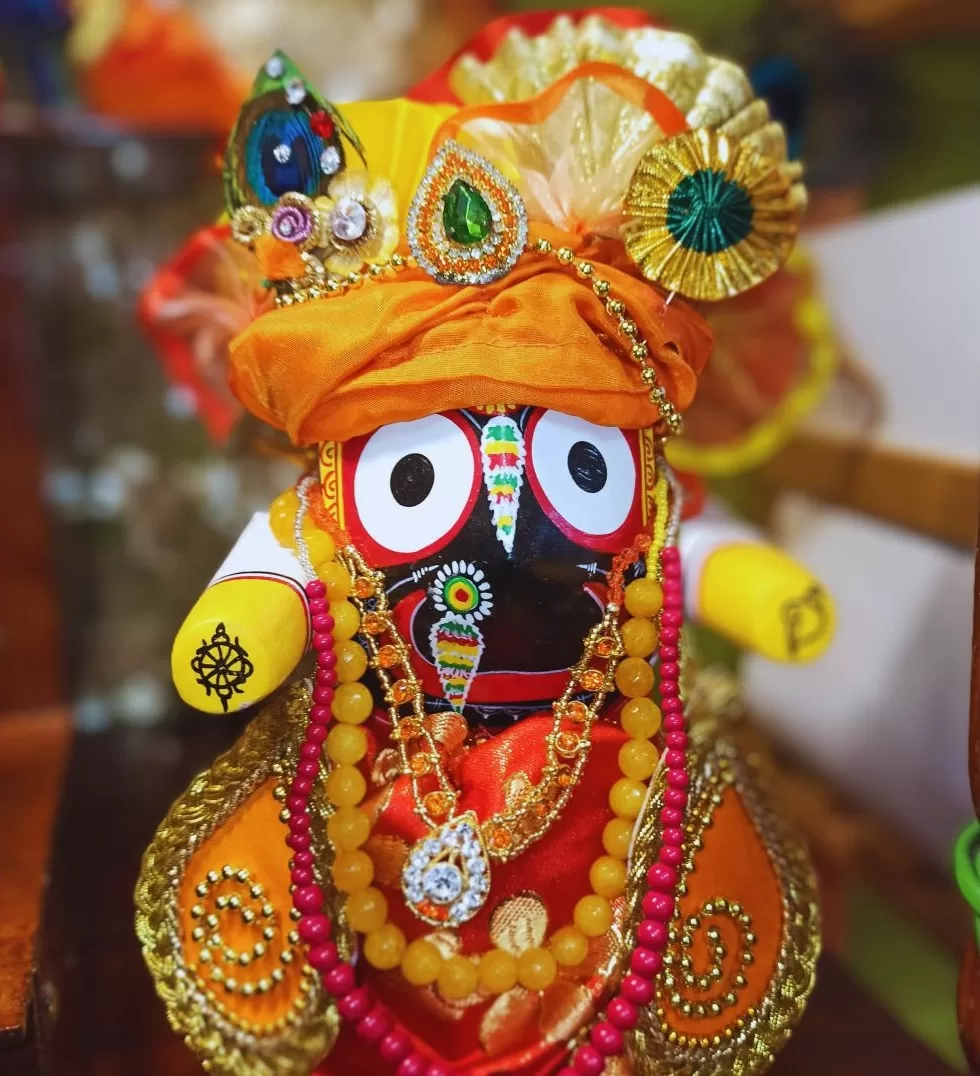
Hare Krishna, today article: Guru-tattva (1/3) is from Bhakti Pramode Puri Gosvami, disciple of Bhaktisiddhanta Prabhupada
Guru-tattva
By Srila Bhakti Pramode Puri Gosvami Maharaja
Srila Krsnadas Kaviraja Gosvami in Caitanya Caritamrta has written about the principle of Sri Guru. The Supreme Personality of Godhead Sri Krishna externally takes the form of the spiritual master to give mercy to all the devotees. The Supreme Lord, who is the receiver of all worship and adoration (visaya vigraha), instead now plays the role of Spiritual master as a servitor to the Supreme Lord (asraya vigraha).
Never does the spiritual master equate himself as the Supreme Lord to be served by one and all but reveals his identity as the servant of the servant of Lord Chaitanya (Krishna). Sriman Mahaprabhu has coined the verse: ‘gopih bhartuh pada kamalayor das das anu dasah’, I am the servant of the servant of Lord Krishna.
Though the spiritual master humbly thinks himself as the servant of Lord Chaitanya his sober disciples should understand him to be the transcendental expansion of Sri Chaitanya (Krishna), or His most confidential servitor. As Lord Krishna informs His beloved disciple Uddhava:
acaryam mam vijaniyan navamanyeta karhicit
na martya-buddhyasuyeta sarva-deva-mayo guru’
Oh Uddhava! The spiritual master is known to be My very form. At no time should one neglect or disrespect the Guru as an ordinary mortal by envy, nor should he be viewed as having any faults. For this reason the Guru is the sum total of the demigods.
Two important verses in regard of service to Guru are illustrated: sayam pratarupaniya bhaiksyam tasmai nivedayet yacchanyad-apy anujnatamupaunjita samyatah
The disciple, by collection of alms (begging) in the morning and evening, should first offer this to the spiritual master. Then, only after obtaining his permission can he partake of these cooked grains in a disciplined manner.
susrusamana acaryam sadopasita nicavet yajna-sayyasamasthanair natidure krtanjalih
One who is fixed in service to his spiritual master should humbly follow him while he is walking, to be vigilant while he is sleeping, at the time of his rest to massage his legs voluntarily and at the time of his sitting should wait nearby for his order with folded hands.
The Guru is the most beloved of Lord Mukunda. The evidence for this is illustrated in the following verses:
‘gurum-varam mukunda prestatve smara’ in ‘Manah Siksa’ by Srila Raghuantha Das, by Srila Jiva Gosvami in his ‘Bhakti Sandarbha’ (216/5)
suddha bhaktah sriguruh sri sivasya ca bhagavata
saha abheda drsthim tat priyatam matve naiva manyante’
and by Srila Visvanatha Cakravarti Thakura in his ‘Gurv astakam’ saksad dharitvena samasta sastrai uktas tatha bhavyate eva sadbhih kintu prabho yah priya eva tasya vande guroh sri caranaravindam
“I offer my respectful obeisances to the spiritual master who is the non-different expansion of the Supreme, as meditated upon by the saintly people and also acts the dearest servitor of the Supreme Lord. Furthermore the Guru can be termed as the non-different expansion of Sri Radharani.
Our most and compassionate spiritual master has referred to himself as Sri Varsabhanavi Dayita Das, meaning the one who is dearmost to Srimati Radhika engaged unalloyed in the service of Sri Krishna. he has revealed himself in his original identity as Nayana manjari, following in the footsteps of Srimati Radhika’s beloved servant Sri Rupa Manjari (Sri Rupa Gosvami). In this way he is glorified.
tevam gopika vrsayavestan ayantikehasi sevadhikarini guro nija pada padma dasyam pradaya kuru mam vraja kanane sri radhanghri-sevanarase sukhinim sukhabdhe
O Gurudeva! You are immersed in an ocean of bliss and you can award transcendental service. You are the gopika beloved of Srimati Radhika. Please bestow on me the shelter of your lotus feet, so that I can be ecstatically engaged in the transcendental service of the Queen of Vraja, Srimati Radharani.
His pranam mantras are:
namah om visnu padaya krsna presthaya bhutale srimate bhaktisiddhanta sarasvati iti namine sri varsavhanavi devi dayitaya krpabdhaye
krsna sambandha vijnana dayine prabhave namah madhuryajvala premadya sri rupanuga bhaktida sri goura karuna sakti vigrahaya namas tu te namas te gauracani sri murtaye dinatarine rupanuga viruddhapa siddhanta dvanta harine
Meaning : – “I offer my respectful obeisances unto his Divine Grace Bhaktisiddhanta Sarasvati who is very dear to Lord Krishna, having taken shelter at His lotus feet.”
“I offer my respectful obeisances to Sri Varsabhanavi Devi Dayita who is favored by Srimati Radharani and who is an ocean of mercy, delivering the science of Krishna.”
“I offer my respectful obeisances unto you, the personified form of Lord Caitanya’s mercy, who delivers the devotional service enriched with the conjugal love of Sri Radha and Krishna in the line of Srila Rupa Gosvami.”
“I offer my obeisances unto you who are the personified teachings of Lord Chaitanya the deliverer of the fallen souls. You never compromise with any teachings deviating from that as enunciated by Srila Rupa Gosvami.”
As Narottama das Thakura has expressed his obedience to the messages of Srila Rupa Gosvami, Srila Prabhupada has similarly shown the same mod of obedience to Srila Rupa Gosvami, praying for his service birth after birth. I too, in this vein, pray wholeheartedly to be the servant of my beloved spiritual master, birth after birth.
In Srimad Bhagavatam, Sri Kavi, one of the nine great rsis, explains to King Nimi:
“The Supreme Lord has given instructions in the most simple fashion by which even the most ignorant people can take such advantage of this knowledge. These sets of instructions are termed as ‘bhagavat dharma’. In the sincere following of these religious principles, the human being cannot be hindered by any impediments, so much so, as a man running with his eyes shut cannot slip and fall down. The living entity, by the influence of the external energy of the Lord, becomes forgetful of his original identity.
This results in the pure soul being bewildered by the attachment to the body, mind and intelligence and being absorbed in these false coverings become subject to fear. Therefore the discriminating and sober person should, by shelter of the spiritual master knowing him to be the Lord’s confidential associate, engage in unalloyed devotional service of the Supreme Lord as the way to counteract this fear.”
The main process of devotion is chanting of the Holy Names which can reveal the transcendental nature of the Lord’s birth and activities. Srila Prabhupada, informs us, that one of the nine Yogendra says:’ The mature disciple should inquisitively approach a bona-fide spiritual master of pacified urges and well versed in scriptures. He should by submission and inquiry, study the ancient doctrines from him. In Srimad Bhagavatam (11/3/22)
tatra bhagavatan dharman siksed gurvatmadaivatah amayaya anuvrtya yai tusyed atma ‘tmado harih
“One should always view the spiritual master as the expansion of Lord Hari and one’s best friend and well wisher. Only be obedient service of Srila Gurudeva without any hypocrisy can he be able to please Lord Hari in which case all the principles of ‘bhagavta-dharma’ will become automatically understood.”
Srila Prabhupada has written: -The disciple, after having accepted the shelter of the spiritual master, should not view the spiritual master in a material perspective but should engage wholeheartedly in his service. By the force of illusion, if the disciple demeans the position of the spiritual master or tries to act superior in relation to him, then very little fruit or gain is obtained, rather the reverse occurs after such acceptance of a guru.
The knowledge of being servant of the Supreme Lord by an aspirant, leads to service of the Lord. When the Lord, seeing such earnest striving, becomes pleased, one becomes qualified to be the servant of the spiritual master and by this relentless, faithful service to the Guru, the Supreme Lord’s mercy is attained. The verse below is relevant:
yasya deva para bhaktir yatha deve tatha gurau tasyaite kathita hy arthah prakasante mahatmanah
Meaning :- “One who has unflinching faith in the Supreme Lord and the spiritual master, all the purports of the scriptures become revealed.”
This means, all one’s misgivings and doubts are instantly vanquished at that time.. These stages are listed in the instructions of Srila Rupa Gosvami: Firstly, acceptance of spiritual master and then inquiring submissively from him, following which, one engages in devotional service in the footsteps of the pure devotees.
Consequently, one becomes entitled to hear the pure scripture called Srimad Bhagavatam and begins to do so. Gradually, the devotees become entrenched in the service of Lord Krishna, by deliberation of the purports of the verses of this scripture. At that stage they give up all types of fruitive work and become established as the servant of the Supreme Lord Krishna:
This is the message of the Ancient religion (Bhagavat-Dharma). Such a person is not confined by the dictates of fruitive work, dry knowledge, or other deviant behavior. In this world, to obtain a spiritual master who not only practices but propagates this Ancient religion is very rare.
On the disappearance of Lord Gaura-sundara His sublime teachings gradually have become distorted, together with the stress on pure devotion becoming diminished. By His sweet will, His merciful potency has appeared in the form of two effulgent stalwart leaders to carry out the rectification of the fallen people of Kali -yuga. They were Srila Bhaktivinoda Thakura and his ideal representative Srila Sarasvati Thakura.
The Six Gosvamis had condensed the messages of the Vedas, Itihasa, Purana, etc. in their writings, and these two ‘Acaryas’ fathered the relevant material from these works and published them in various languages like Bengali,, Hindi and English in the form of periodicals and journals. By their inspiration, many temples have been constructed with the emphasis on service to the Deity form of the Lord and the chanting of the Holy Names as the ideal process for this age of Kali.
Discourses on the Holy Books like Chaitanya Caritamrta are also being carried out daily in these temples. In addition Srila Prabhupada, by means of dioramas and exhibitions, has used scientific techniques to implement the preaching of Sriman Mahaprabhu’s message untiringly.
In spite of their great efforts to effect the propagation of the divine message of Sriman Mahaprabhu, the ordinary people in their fallen condition seem to relish the paths opposed to the mood of pure devotion, which has made the pure devotees become compassionate at the sight of such people wallowing in ignorance. The present times advertise many false gurus who by giving indulgence to the whimsical desires of their disciples attempt to obtain a large number of followers.
These so called magnanimous personalities, being respected as the self effulgent leaders for the present Age, have only succeeded in stifling the devotional mood of the general masses. In this way, these impostors have denied their followers of any success or hope of happiness.
The Supreme Lord is present internally as the Supersoul in the heart (Caitya Guru) and externally as the spiritual master to bless the fallen conditioned soul. (Srimad Bhagavatam 11/29/6) Uddhava speaks:
naivapanyanty apachitim kavaya tavesa barhmayasapi krtamrddam udah smarantah
yo’ antarbahis tanubhritam asubham vidhunvan na acarya caitaya vapusa svagatim vyanakti
Meaning:- “You are present in Your form externally as the initiating and instructing spiritual master giving guidance to Your disciples, with the help of model personal behavior and internally existing as the Supersoul in the heart (Caitya guru), warding off the attraction of your devotees towards sense-gratification together with enlightening them of their original position. The learned devotees, remembering Your grace, become overwrought with joy and are not able to repay their debt to you even in one life-span of Lord Brahma.”
Srila Visvanatha Cakravarti has explained this verse:
“If anyone says that the Supreme Lord is awarding the four-fold aims of life to his devout votaries is not free from limiting adjuncts but is conditional, the answer is no, not exactly that. Once cannot say this because even the very practice of devotion is only possible by His mercy alone, for the myriad ways the Lord helps the individual and promotes his welfare cannot be repaid.
The learned sages who are living long lives, like Lord Brahma, cannot repay their debt to Him even In the least and on remembering His grace become overcome by bliss. That is this beneficial help of the Supreme Lord? The Lord externally in the form of initiating and instructing spiritual master or Acarya, guides the aspiring soul by giving him initiation into the Holy Mantra and practical instructions on the practice of devotion, and internally as the Supersoul in the heart (Caitya Guru), He gives them the intelligence ‘aham dadami buddhi yogam tam’, (see Bhagavat-gita 10.10) b which they can attain Him.
In this way by giving the aspirant proper discriminative intelligence, He inspires the devotee to strive in his devotions to the point whereby he eventually achieves the transcendental association of the Lord in his original body. If the Lord in the heart does not help remove the obstacles present in the heart and inspire the spiritual aspirant to pure devotion internally, that candidate will never be successful even in millions of years of striving to achieve that stage.
As the internal ‘Caitya’ Guru, the Lord gives them fixed intelligence to proceed on. Further, He, as the external spiritual master, by the shelter of his lotus feet instructs the candidate on pure devotional practice by virtue of his personal model example. Therefore the spiritual aspirant, in following the footsteps of Sri Guru very rigidly and by persevering in such devotions, will result in pleasing the Guru. The spiritual master in being pleased, will automatically warrant the grace of the Supreme Lord.
This type of fortune is denied to one who does not take to the exclusive shelter of the bona fide spiritual master. In this context, the persons under the category of fruitive workers, dry scholars and ascetics are not ideal as spiritual masters. In taking to the shelter of such people, material enjoyment, liberation or perfection may be obtained.
But because in all these paths the gross and subtle desires to satisfy one’s own senses exist and not quite the pure desires for serving the senses of Lord Krsna, consequently pure devotion will never result. Fruitive work not done in relation to the service of the Lord instead increases the bondage of the living entity to the material world.
In the path of dry knowledge, the desire for devotion is absent, but that of liberation exists, which is even more dangerous than the material enjoyment sought by the fruitive workers. This class of people tries to eradicate all differences between the devotee, the practice of devotion and the Supreme Lord (knower, knowledge and known) in their deviant analysis.
When one accepts the monastic axioms like ‘aham brahamasmi’ or ‘tattva asi’, etc., and by impersonal knowledge tries to merge in the unqualified Brahman as one’s highest objective, then these practices are not conducive but rather destroy devotion to the very roots The devotee shuns away form such people because the aspirations of such people to merge altogether in the void, attaining impersonal liberation, is worse than death. The devotees of Lord Vishnu usually are desirous of obtaining the four fold liberations which are:
- (sarsti) equal opulence with the Lord
- (sarupa) have the same form of the Lord
- (samipya) residing near the Lord
- (salokya) staying in the same planet of the Lord
However, the unalloyed devotees of Lord Krishna reject all these types of liberation in favor of pure devotional service to the Lord. They will not even accept such liberation if given to them unasked. Evidence of this is found in the verses of Srimad Bhagavatam (1/20/31-34).
In the Srimad Bhagavatam, the spotless Purana, love of Godhead has been defined as the highest goal of life above the four-fold aims. Usually, the fruitive workers aspire for piety, wealth and satisfaction of their senses accordingly. The impersonalists try to merge in the unqualified Brahman for salvation, while the ascetic (yogis) also try to merge with the qualified form of the Supersoul in the heart. One of the invocatory prayers of Srimad Bhagavatam runs beginning with ‘Dharma projjita kaitava’. This has been explained by Srila Kavirja Gosvami saying:
ajnanatamer nama kahiye kaitvava (CC.)
Srila Sridhar Gosvami, in his commentary, has enlightened us about the word ‘pro’ as that by which even the very desire for liberation is rejected. Srila Krsnadas Kaviraja has named all that which misleads the pure soul of its constitutional function as servant of the Lord, to be cheating tendencies (kaitava).
Other than the original desire to satisfy the senses of Lord Krishna, all else comes under the realm of cheating tendencies and as ‘bad association’ which should be rejected. The only goal for the sincere aspirant is Lord Krishna and His devotional service, while other desires are listed as bad association. Consequently, piety, wealth, satisfaction of desires and liberation are all cheating tendencies-gross ignorance (ajnana tamah) of which liberation is the greatest cheating tendency.
The spiritual master by delivering transcendental knowledge awakens the disciple form his ignorant state. The aspirant, on receiving initiation (diksa), becomes aware of his own real nature, the truth of the Supreme Lord, the means of accomplishment and the goal. In this way, freeing himself from the clutches of the illusory energy by proper striving in devotional practice, he finally remains entrenched in steady devotion to Lord Krishna.
Uddhava, the jewel of the devotees, addresses Lord Krishna in this manner:
“O Lord! Your lotus feet are the resort of all saintly people and are the cause of unlimited bliss, while the other categories of aspirants, who are seeking dry knowledge, accumulations of pious work or mystic powers, do not take to the shelter of Your lotus feet and thereby become vanquished by Your external energy.”
“Oh ! Acyuta, You are the Absolute friend of all living entities. In Your incarnation as Lord Rama, Your lotus feet were given the greatest reverence by the demigods. They placed their jewel crown in adoration on Your lotus feet yet You only formed friendly relationships with the monkeys, what to speak of men or demigods?
You showed subservience to unalloyed devotees like Nanda Baba, the gopis, Vali, who all exhibited loving servitorship to You. This is not an amazing sight, for pure devotees who practice intense devotion to You are the object of Your grace and You are completely subjugated by them.
The categories of devotees who are completely devoid of desires for pious work, knowledge and mysticism only can conquer You. In Your expansion as Lord Rama, You established loving relations eagerly with the monkeys. In Vrindavana too, You dallying with these lower animals like the cows, exhibited Your affection for them.
An example being how you stole butter from Your house to feed the monkeys. What type of knowledge or mysticism have they practiced that You have become won over by them? On the contrary, amongst the Impersonalists, there is not even a trace of the existence of such delightful pastimes.
Hence, we, being Your loyal servants, do not accept all these false processes of knowledge and mysticism. Especially, those who have understood that unlimited mercy You have given to devotees like Prahlad Maharaja and Bali, can never be deviated from devotion to Your lotus feet in pursuance of any lesser goal like liberation.
Chandogya Upanisad states: acaryavan puruso veda (6/14/2). The living entity who has taken to the lotus feet of a self-realized soul can understand the Supreme Lord.
Who is Acarya? As Manu Samhita states:- The twice-born who performs the upanayan ritual on his disciple and teaches him the purports of the Vedas is called an ‘Acarya’ (realized spiritual master)
Achinoti yah ‘sastrartham acare sthapayatyapi Svayam acarate yasmad acarya stena kirtitah
One who has realized the conclusions of the scriptures and teaches these to others by dint of his own model behavior is the self-realized Guru (Acarya). In this context if some arrogant pundit, whilst browsing through the Vedas and not finding proper mention of Sri Krishna dismisses the Vedas, then he is not exhibiting the proper conduct of an Acarya for blaspheming the scriptures. The Lord Himself declares in Gita, “I am the knower, the compiler and the end of all the Vedas”.
The Gita, as written by Sri Vyasadeva, is the cream of the Upanisads and this purport of the Vedas contain two important verses, mahavakya, namely: man mana bhava mad-bhakto mad -yaji mam namaskuru and sarva dharman parityaja mam ekam saranam vraja, which is that ultimately :- One should surrender to Lord Sri Krishna with devotion for attaining the prime goal of life.
The genuine ‘Acarya’ explains the purports of the scriptures in terms of pure devotion, ‘acaryam bhaktisamsanat’ and this is the meaning of ‘Acarya”. Next, the meaning of the word ‘Guru’ is explained. ‘Gu’ means darkness of ignorance and ‘Ru’ means that which dissipates such darkness, or in other words, one who takes away the dense darkness of ignorance by giving transcendental knowledge to the disciple is called Guru.
The Guru has the Supreme Lord stationed in his heart and does not differentiate other living entities with himself. In this sense, he is most magnanimous, thereby achieving his qualification as ‘Guru’.
The spiritual master, having the form of the Absolute Truth firmly entrenched in his pure heart, is able to transmit pure knowledge to the disciple by initiation (diksa), without himself being reduced or minimized in any way. This is the inconceivable potency of the Supreme Lord. By this potency too, He can manifest in his absolute form both in the heart of the Guru and disciple at the same time.
In Srimad-Bhagavatam the sage Prabuddha says: tasmad gurum prapadyeta jijnasuh sreyah uttamam sabde pare ca nisantam barhmanyo pasam asrayam
To obtain his highest welfare, one should approach and take shelter of a self-realized spiritual master who is well-versed with knowledge of the scriptures and free from all vices like attachment and anger. The amassing of pious merit to enjoy in this life and hereafter is after all a temporary affair and opposed to the true goal.
! For more Biography look here!
!For more Articles look here!
