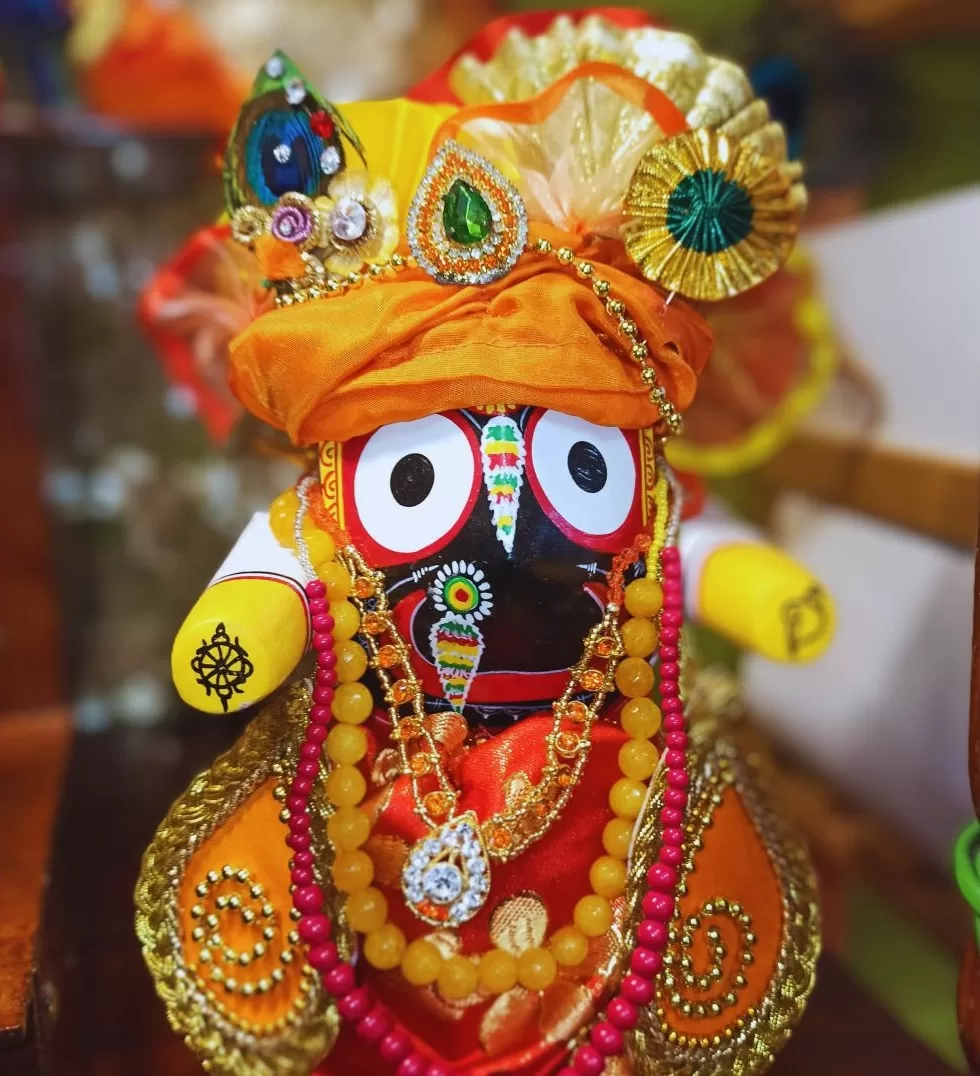
Hare Krishna, today article: Daivi-Varnasrama is from Bhaktisiddhanta Sarasvati Prabhupada.
Śrī Guru-Praṇāma:
oṁ ajñāna-timirāndhasya
jñānāñjana-śalākayā
caksur unmīlitaṁ yena
tasmai śrī-guruve namaḥ
“I offer my respectful obeisances unto my spiritual master, who with the torchlight of knowledge has opened my eyes, which were blinded by the darkness of ignorance.”
Two important verses:
suna suna nityananda, suna haridasa
sarvatra amara ajna karaha prakasa
prati ghare ghare giya kara ei bhiksa
‘bala krsna, bhaja krsna, kara krsna-siksa’
“Listen, listen, Nityananda! Listen, Haridasa! Make My command known everywhere! Go from house to house and beg from all the residents, ‘Please chant Krishna’s name, worship Krishna, and practise what Krishna teaches.’” (Sri Chaitanya-bhagavat, 2.13.8-9)
harer nāma harer nāma
harer nāmaiva kevalam
kalau nāsty eva nāsty eva
nāsty eva gatir anyathā
“In this age of quarrel and hypocrisy, the only means of deliverence is the chanting of the holy names of the Lord. There is no other way. There is no other way. There is no other way.”
Mahā-mantra Hare Kṛṣṇa:
Hare Kṛṣṇa Hare Kṛṣṇa
Kṛṣṇa Kṛṣṇa Hare Hare
Hare Rāma Hare Rāma
Rāma Rāma Hare Hare
Article: Daivi-Varnasrama
(by Srila Bhaktisiddanta Sarasvati Prabhupada)
From A Ray of Vishnu by Rupa-vilasa dasa
Interview in 1929 with Professor Albert Suthers of Ohio State University.
“On Varnasrama and the Caste System”
Professor Suthers: Do you recognize caste distinctions? The caste Hindus look down upon the other classes with an eye of contempt and neglect. Do you too do so?
Srila Sarasvati Thakura: As the judgment of the Vaisnava philosophy is favorable towards the service of god, the technologies giving expressions to it are also different from those of the ordinary judgments of moralists of other sects. You have already heard that the Vaisnavas have no regard for the morality or ethical principles of atheists. They do not also pay much respect to the reality of the moral principles of the atheists in whose judgments worship of God is only of secondary importance.
They (The Vaisnavas) say that the service of God or love of God is the principle matter. Other matters should be helpful and subservient to that principal matter. When the two things, viz., innate tendency and circumstances of man become ready to be helpful towards the principal matter viz., God’s service, then is established a good social order known as daivi-varnasrama (divine system of castes and stages of life). Till the natural tendency of the human soul is manifest, the violation of this order causes much disorder and difficulty both individually and aggregately.
This caste system follows man’s nature and predilection. It is scientific to ascertain one’s caste in accordance with one’s natural predilection. Much disturbance is created, both individually and aggregately, on account of the non-acceptance of this inviolable scientific principle of natural predilection as observed and promulgulated by our ancient sages of vast experience, and the wrong adoption of the seminal principle only, i.e. the principle of determining caste by birth alone.
It is due to the fact that this principle of caste determination was at one time perfect and nice at all points in India, that even (to) this day the Indians are able to stand erect with a challenging mood before the world on the glorious foundation of the past.
If we examine the present social system of the Europeans, we find that whatever beauty we find in that system has as its source the determination of the caste or social order according to natural predilection. There we find that a person having a martial tendency (i.e. that for the life of a ksatriya) joins the army; another with the tendency of a vaisya is engaged in improving commerce; those with the tendency peculiar to sudras serve others.
No society can work well, if it does not, more or less, adopt the caste system based on natural inclination in some form or another. Even among the European natives in marital relations and during social feasts a distinction is made between the higher and lower forms of society governed by natural predilection to which the participants belong.
Though the natural caste system is to a certain extent adopted by the European Society, it has not yet acquired scientific perfection. It can do so alongside of the progress in civilization and knowledge.
In India, however, this system attained perfection on the basis of the determination of the natural predilection. The great history of India, viz., the Mahabharata, gives thousands of instances to prove the fact. It is on account of the fact that in India such a system was based on a scientific foundation that all other nations of the world adored the Indians as their spiritual guides. Even the people of Egypt, China, etc., received instructions in all matters with their heads bent down before the Indians.
We find in the ancient history of India that formerly there was only one caste and that later on society became most scientifically divided into the castes of brahmana, ksatriya, etc., according to disparity in the instinctive inclination for the service of Godhead. The Acharya placed one (a person) in the higher or lower grade system according(ly) as the degree of liking for God’s service was high or low.
Those who were attached towards this service with the strongest devout ardor, and, as such evinced the greatest intelligence, became brahmanas. They formed the head of the huge body of the society. According to the guidance of the head were conducted the hands, the thighs and the legs, viz., vaisyas and sudras respectively.
Please consider this: It is this head of ours that occupies the highest place in our body, and it is the propellant of all our senses. What need is there to say more, when all the senses, viz., the eyes, the ears, the nose, the tongue and the skin are all combined in the head. It is there that these along with the mind, intellect and egoism, are all settled.
When any other limb becomes disordered, its work may be conducted in some other way; for example, when a hand is amputated, oftentimes its function is managed by means of fixing up an artificial hand in its place. But when the brain becomes defective or when the head is decapitated, none of the limbs like the hands, legs, etc., can work. In the same way, the head of the social body, which guides its intelligence indicates the faculty of the brahmana.
So prayer is offered for being directed with the mood of serving God in the Gayatri- mantra (Rig Vedic hymn) to be daily recited by the brahmana with a worshipful spirit. The brahmanas have no other intellectual aptitude than such an ardent mood of service to Godhead. One is degraded to a ksatriya, vaisya or sudra according to the degree of his fall from that ardent mood of divine service, under the guidance of some other motive.
The brahmanas represent the brain and the mouth. The function of the brain is to regulate all with the aptitude of devotion towards God, and that of the mouth is to propagate the accounts of everything; because they are the Goswamis or masters of the senses, i.e., servitors of God. They do not misappropriate anything to their own use, but they appropriate everything to God.
For this, all persons of society confide in them and choose them as their spiritual guides. They who, instead of accepting such a brahmana, rather bear a grudge against him, fall off from the path of good.
After this brain and mouth comes the consideration of the arms to which are compared the ksatriyas, then that of the thighs which the vaisyas represent, and then come the sudras, who, on account of their base character and unsteady mind, are likened to the feet. And those whose lives are altogether uncontrolled are known as antyajas (untouchables) and regarded as outside the group of the four classes as above.
The Vaisnava philosophy recognizes Daivi-varnasrama-dharma which implies classification according to the divine system by which men are divided into castes according to their natural predilection.
There arises no question of hating or disregarding any body according to the system of varnasrama recognized by Mahaprabhu Sri Caitanya Deva or according to the process of culturing devotion to God as shown by Him, which is ever beyond that system. In the teaching given by Him there is found instruction to show respect to every creature in its relationship with God.
The judgment of Sri Caitanya Mahaprabhu is far superior to the slight improvement of the condition of the lower castes as proposed by the modern social reformers, nay , it far excels even the impartial equality as taught in the Gita. The proposal of the worldly- minded moralists for slightly raising the status of the lower forms of society has some extraneous motive as its cause; there are various purposes hiding behind it, such as political objects, personal interests, motive for acquiring fame and such other ends.
These subordinate principles have given rise to attempts for uplifting the lower castes, which are of an extremely worldly character and clearly betray their hypocrisy. The instruction of the Gita to look on all as equal to the self from the principle that all are souls is several times more elevated than they , and is free from the worldly dirt. But the teachings of Sri Caitanya Deva is not merely prohibitive of worldliness and based on impartiality, but it is a positive one of the character of transcendentalism.
Sri Caitanya Deva wants to engage all jivas in the service of God and thereby to elevate them to the highest status. He converts a crow to Garuda (the prince of Eagles). The religion promulgated by Him in not meant for Bengal alone, nor India even, but for all countries, all villages, His is the universal religion for all creatures.
So has He said: “My name will be propagated in all towns, all villages that exit in the world.” His universal religion of Love attracted animals, trees, grass, shrubs, creepers and even the ferocious creatures like tigers, etc. from their outward identification to the inward one of the very essential constitution, having been spread among them too.
The religion as promulgulated by Him is that of the soul; and not that of the society, physical, mental and moral, and is not restricted to the usual form of devotion of the servant to the Majestic Lord. His religion discovers the innate nature of the jiva soul and is manifested in the unabated plenary love for God. According to Him, Krishna is the Absolute Personality, the Spiritual Despot. The religion of love consists in the full gratification of His Senses.
The jiva should be the fuel to the fire of the gratification of the Senses of the unrestrained Autocrat Whose will is law. It is the service of the Autocrat under the guidance of those (devotees) who are well-established in the eternal service of the gratification of the Senses of Krishna (Who is the very Figure embodying the succulence in fullness giving the utmost sensation of transcendental pleasure) that is the object to be accomplished by a jiva and also the means to that end.
The difference between the Vaisnava philosophy and all the other philosophies of the world lies in the fact that in the former both the object of accomplishment and the means leading to it are identical without any distinction. The means when purified and matured reveal themselves as the Object. According to the Gaudiya philosophy the chanting of the mellifluous Name of God constitutes both the end and the means for it. This doctrine concerning the Name of God is a main feature of this philosophy.”