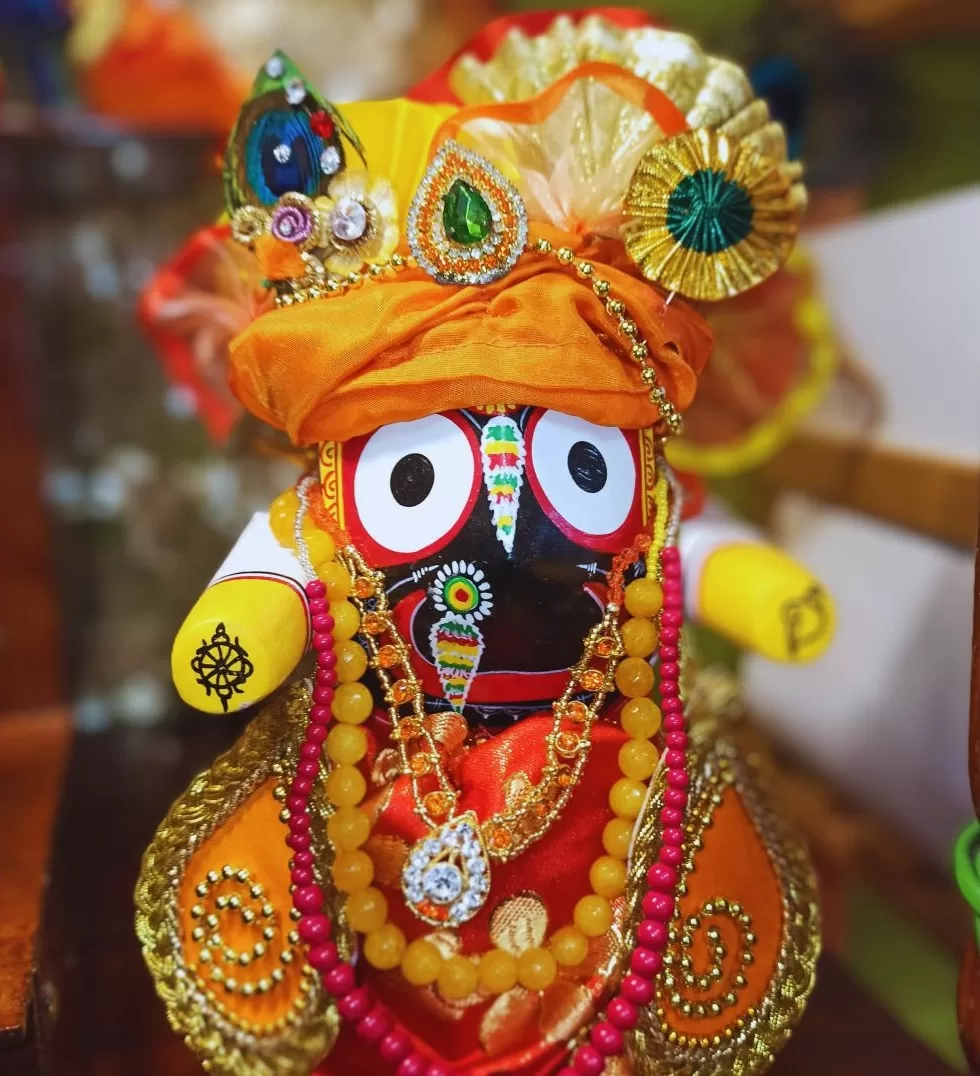
Hare Krishna, today article: Brahma’s Illusion (2/2) is from Bhakti R. Sridhar Maharaj
Krishna & Balarama
When Krsna and Balarama are playing with Their friends in the jungle, They generally play in two groups. Krsna is in one group and Balarama is in another. Krsna is considered to be less strong than Balarama. Balarama was the strongest person there, and the next strongest was Sridama, so Sridama used to play on the side of Krsna.
Whenever Balarama was defeated, He would become enraged. Krsna would diplomatically help His own team, and when Balarama saw that His own team was disloyal due to Krsna’s tricks, He would turn to His younger brother Krsna and say, “I shall punish You!” But Krsna would say, “No, You cannot punish Me; Mother Yasoda has entrusted Me in Your care. You can’t mistreat Me.”
One day, Balarama slapped Krsna, but Krsna went to Mother Yasoda and told on Him. Balarama was very disturbed and said, “I slap You once, and You complain to Your mother that I do not love You? Krsna, how could You do this?” At last Krsna was perplexed and accepted His defeat.
So krsna-lila moves in a crooked way (aher iva gatih premna. . .). This fundamental point, the foundation of our understanding about krsna-lila has been given by Rupa Goswami in this verse. He says, “Don’t be eager to find reason everywhere in the pastimes of divinity. They are naturally
crooked. In krsna-lila we shall find that although no party is defective, still, one will find fault with another and begin a quarrel. No defect can be found there. But still, for the necessity of lila, false defects are found, and some quarrel begins. This is the meaning of lila, pastimes: what we find here by necessity flows there automatically. We can’t try to apply our reason or our standard of measurement to the movements of the infinite.
And whatever gain we have made by connecting with that flow of lila will be lost in our attempts to measure it; that will be the only consequence of our analysis. So we should try to have a taste of lila with a submissive attitude. Sometimes reason, logic, and analysis are necessary, but only to preach to the people in general who have a lower understanding.
Only for the purpose of preaching to people addicted to reason do we have to take the help of reason. But when devotion becomes automatic, anuraga, then both reason and scripture are left in the subterranean position. There is no place for scriptural arguments there. To a certain extent, reason is necessary for our development up to vaidhi-bhakti, the elementary stages of devotion. But above that, it has no use.
Anuraga-bhajana is automatic; that is the nature of lila: aher iva gatih premna. Everything there moves by His sweet will. Sweet will means that it is not a fixed program. It moves in such a way that we can’t say, “It will pass by this road.”
When the Maharaja of Mysore used to drive into town, he would not speak to his driver, giving him directions which way to go, because if any fixed program were arranged, then his life might be in danger. So whenever he would come to a crossing in the road, he would touch his stick to a particular shoulder of the driver. If at the crossing, the Maharaja wanted to go to the right, he would touch the driver on his right shoulder. In this way, he would never disclose which way he would go, but only at the last moment he would beckon the driver to take a particular course.
So Krsna’s divine movements are kept in reserve by His sweet will: “All Rights Reserved.” We want to search for some law above His sweet will, but this is inconsistent. It is self-contradictory. On the one side we say that Krsna moves by His own sweet will, but on another side we try to find some law governing His movement. This is a contradiction. Lila moves by sweet will. When we say it is lila, then we can’t give any shape to that. We can say that it was shown in a particular place in a particular way. But we cannot be sure whether today the same course will be taken.
This is why we find differences in the explanations given about different lilas in different ages. Jiva Goswami has explained that the reason for different descriptions of the pastimes of the Lord in the Puranas is because at one time that lila was played in one way, and another time it was played in another way. So we find differences even in the explanations of the same pastime.
Scholars may challenge: “Why is it that somewhere in Padma Purana the lila is mentioned in this way, but the Bhagavata Purana reveals the description in another way? Why does Harivamsa differ from Mahabharata?” We say that in different kalpas, or ages, the pastimes are enacted in different ways.
In infinite ways a particular lila of the Lord may be represented within this world, because He is infinite, independent, and absolute. So leaving aside all doubts and suspicions, we shall be most generous in approaching the absolute, free from all inhibitions. We shall approach Him with that spirit, and try more and more to leave aside our past prejudices and precedents, the records of our past experience.
Is God Dead?
We shall approach Him remembering that He is still living. It is not a stereotyped thing. We should not expect only what was done once before. If we expect the same thing it will only reassure us by its repetition that He is not a living thing; that Divinity is under historical law. Should we think that in the past He showed Himself in a particular way, so He is compelled to show Himself in that way always? Is He not living today? Can He not show anything new?
At every moment, every second, He can show everything in quite a new way. So our heart should open wide when we approach the highest authority of the absolute plane of play. That means surrender must be increased to no limit. Surrender is limitless, and His play or lila is also limitless. With that sort of deep vision, we shall try to read His lila. So although Brahma and the other gods and gurus and the givers of many sastras may have given some description of His pastimes, we shall have to realize that Krsna’s pastimes are not bound by their descriptions. Krsna is not confined within a cage.
So for this reason, Sri Caitanya Mahaprabhu did not hesitate to give a description of the bewilderment of Brahma (brahma-vimohana-lila). Brahma was bewildered in krsna-lila in Vrndavana, and again when Brahma went to have an interview with Krsna in Dvaraka, we find the same condition. The boundary of the sweet will of the infinite is such that anything can be accommodated there, and even Lord Brahma, the creator of the universe, can be perplexed by Krsna.
All these pastimes are like so many lighthouses showing us which way to go. Brahma is our guru, but he was bewildered by Krsna. And Vedavyasa, the universal guru, was also chastised by Narada. Narada was put to the test many times. All these examples are showing us the way, they are pointing out the direction. It is said, srutibhir vimrgyam:
The authentic books about the revealed truth are only showing the way. They say: “Go in this direction. Where? We do not exactly know, but you may go in this direction.” They are only showing the direction. All the srutis, the guidance given by the scholars of revealed truth, give some direction: “Go this way, in this direction, and perhaps you may find it.”
Krsna says: Vedais ca sarvair aham eva vedyo: “All the Vedas are intended to reveal Me, the infinite.” They mean to show how the infinite is moving. If I analyze one atom within my fist, I can analyze it again and again and reanalyze it to no end. It is already within my fist, and yet it is infinite. So it has been said that we may get the maximum benefit by surrendering.
Krsna says, “Give up all your prejudices and the limitations drawn from the limited world and be open. Then it will be easy for the infinite to cast different shades of light on your soul and your knowing faculty. And then it will be easy for you also to cleanse your plane of understanding, cleanse your glass, the mirror of your heart.”
In connection with the infinite you will find that everywhere there is center, nowhere circumference. But to realize this, you must try to live in eternity, in Vaikuntha. Kuntha means “measurement.” Vaikuntha means “no crookedness, no limit, no measure.” That is Vaikuntha. When Krsna opened His mouth, Yasoda was astonished to find the entire universal creation.
Yasoda was nonplused. “What do I see? The whole universe? The infinite in the finite?” At that moment she almost fainted, but then her cat cried aloud. And Krsna, as if He was very much afraid of the sound of the cat, caught hold of His mother out of fear. Then at once, Yasoda’s apprehension disappeared. She thought, “Oh, no…He is my son! There is no representation of the infinite within Him; He is my son.” And she embraced Him.
When Brahma took away the cowherd boys and calves, he thought that he had created some want in the lila, but he came to find it flowing just as it had been. Not even the least part of it had been disturbed. Krsna had expanded Himself to become the calves and the cowherd boys. When Krsna Himself took the form of all the calves and cowherd boys, then the mothers felt an infinite type of affection, so much so that they could not understand, but were rather entranced, thinking, “How beautiful these boys are!” And the cows were also mad to show their affection to those calves.
Then, Brahma thought, “Have those cowherd boys and calves that I have stolen come here stealthily to join Him?” Again he went to see where he had hidden them. He saw, “No, the boys and calves are where I kept them in the caves of the mountain. They are there!” Again he returned to where Krsna was and saw everything continuing as it had been. At that time Brahma surrendered and was reassured. He spoke the following prayer:
naumidya te ‘bhravapuse tadidambaraya gunjavatamsa-paripicchala-sanmukhaya vanyasraje kavalavetravisana-venu- laksmasriye mrdupade pasupangajaya Srimad-Bhagavatam 10.14.1
“I offer my prayers unto You, O praiseworthy Lord who are the child of the cowherd Nanda. Your complexion is the dark blue color of a thundercloud and You are clad in silk garments that shine like lightning. Your charming face is adorned with gunja-mala ornaments, and Your hair is decorated with a peacock feather. You look beautiful wearing a garland of forest flowers, and that beauty is enhanced by the morsel of food in Your left hand.
You carry a buffalo horn and a stick for herding cows tucked beneath Your left arm. You hold a flute and other emblems, and Your feet are as soft as a lotus.” That is the general meaning of this verse. The internal meaning of this verse, however, is this: “O venerable one, we submit our prayers to You. Who are You? You are un- seeable, un-feelable, unknown, and unknowable.
Your complexion is the color of a black cloud, and therefore You are very difficult to see, but You can be seen because of Your yellow garb.” Yellow is Radharani’s color. So only by the help of Krsna’s potency can it be ascertained who He is. Tadit means lightning. By the help of lightning we can see a black cloud at night. So although Krsna is unknown and unknowable, His potency can reveal Him to us. Brahma says, “You are the venerable entity I have come to know.
Now I bow down to You. Your body is like that of a black cloud, and that is some mystic representation. Black generally cannot be detected. But Your dress of yellow color helps us to know what You are. It is carrying some similarity to the yellow dress of Narayana. Your black body and yellow dress hints towards the personification of Narayana. You are unknown and unknowable Yourself. But Your yellow dress – Your potency – makes You known to us.
And You come down to our level as if You were one in our position. You are dressed as a cowherd boy, playing in the jungle with a lump of foodstuffs in Your hand. That deceives us in ascertaining who You are. And You adore ordinary things. Even the garland that You wear is collected from ordinary jungle flowers. Your taste appears to be for lower things.
“And all these signs are misleading us. You take a morsel of food in Your hand and run after cows. That is a sign of being low-class. The higher-caste people like brahmanas and ksatriyas cannot move like this or behave in such a way with their food. The instrument you carry – a bamboo flute – is also unsophisticated. And Your stride is short. All this is misleading us to have a lower conception of You. You are hiding Yourself, so how can we understand You? What fault is there on our part, then, for not recognizing Your supremacy? It is difficult to accept that You, Krsna, are the master of everything.
“You have so many plain ornaments. We don’t find anything that is gorgeous or filled with splendor here in Vrndavana. We are accustomed to find those things in Vaikuntha. But this is new. You have come here to show Your playful pastimes. Here in Vrndavana we have come across a new conception. And it is wonderful, plain, and charming. Plain, yet most attractive.
“With simple ordinary things You have decorated Yourself, but You are so extraordinarily charming. It is impossible to understand and to describe. Generally in this world, the position of cowherd boys is of no real significance. They represent the lower section of society. But here in Vrndavana, such a position is so wonderful and charming that we find You all-attractive – hypnotizing us.
“And Your movement is very slow but sure. Your movement is such that You don’t care for anything else in this world. Though You are in a lower position, Your posture is such that apparently You don’t care for anything in this world. In You we find the highest conception garbed in a very plain way – but a very wonderful way. In connection with You, things of ordinary value become charming.
Although I am the Creator and have created everything, I fail to understand this sort of creation. I am proud that I have created so many things in the world, but I am overwhelmed to see the beauty of the environment here in Vrndavana. Here Your movement is slow, but sure and beautiful.
You may be the son of that human being who keeps the cows; this is not a very high status in society or in the scriptures, but it is the nature of Your personality that whatever You do, You make it hold the highest position. What is this! Whoever You may be, my vanity is defeated. I take refuge at Your holy feet – I surrender. Please help me to understand what You really are.” In this way, Brahma surrendered.
And so, Krsna is beyond the understanding even of the creator of the universe. He is infinite. And He is infinite not only in the consideration of space, but also in the consideration of time – He is infinite in every sort of consideration. Infinite. His infinite potency is represented in consciousness, in existence, and then in dealings of love.
Absolute Sweetness
The scriptures give us three conceptions of the infinite: Brahman, Paramatma, and Bhagavan. The Brahman conception is the all-comprehensive infinite. Whatever we can conceive is within it.
Paramatma is the smallest of the small: anor aniyan. Whatever you can conceive of that is small, it is smaller than that. And the Bhagavan, or personal conception of Godhead, is of two types: one is as the master of infinite majesty and power, and the other is of absolute sweetness.
Jiva Goswami has given the essential meaning of Bhagavan in his Bhakti-Sandarbha. He says, bhagavan bhajaniya-sarva-sad-guna visistha. By Bhagavan, he describes this aspect of infinite: bhajaniya, worshipable. When we come in touch with Him, then we want to surrender ourselves for His satisfaction – that type of infinite. There are various types of infinite.
The highest conception of the infinite is bhajaniya guna visistha: He is so beautiful and attractive that He is attracting all to surrender to Him. No other conception of the infinite, neither infinite space, nor time, nor anything else can approach this highest conception of the infinite: the all-attractive infinite. All the other aspects of the infinite – infinite time, infinite space, infinite power – are external. But infinite love which attracts love and self-surrender is the highest type of infinite. And that is Krsna.
Attraction is the most fundamental element everywhere. All else can be eliminated and forgotten if we come in touch with attraction and love. Everything can be ignored if we are in connection with love. The fulfillment of our existence, of all existence, of everything, is in love. Love is the principle in the center which is the only fulfillment of all existence. The very gist of existence is there; it can’t be ignored or challenged by any other forms or aspects of our substantial existence. It is unchallengeable and absolute.
Whatever we may experience, the most central need for fulfillment remains: love. The absolute king of everything is love. Nothing can stand in comparison with it. Coming in clash with the principle of love, all will have to accept defeat. Mahaprabhu pointed out that this is the most substantial thing in this world.
Madhvacarya, in his conception of how one should see the acarya, the spiritual master, could not harmonize Brahma’s bewilderment. After all, he is the sampradaya guru, the foremost guru of the tradition, the Brahma-Madhva-sampradaya. So Madhvacarya omitted these two chapters on the illusion of Brahma from Srimad-Bhagavatam. But Mahaprabhu did not.
He accepted Sridhara Swami’s edition, which is in accordance with the suddhadvaita philosophy of Visnuswami. The Visnuswami sampradaya are followers of ragamarga, spontaneous devotion. Sridhara Swami included those two chapters with his commentary, and Mahaprabhu accepted that, and it is corroborated in Caitanya-caritamrta. Madhvacarya could not accommodate the idea that guru may be seduced. He could not tolerate that guru may not know everything, may not be omniscient, but Mahaprabhu could.
! For more Biography look here!
!For more Articles look here!
