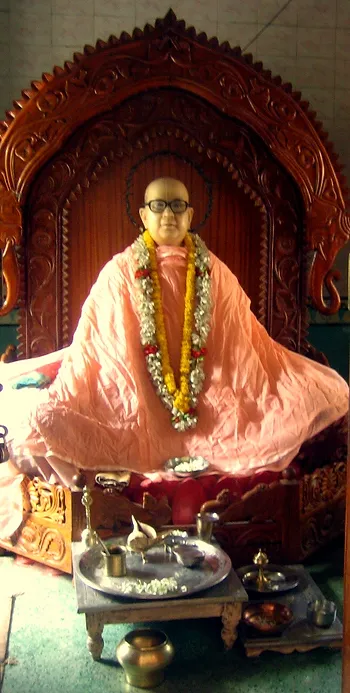
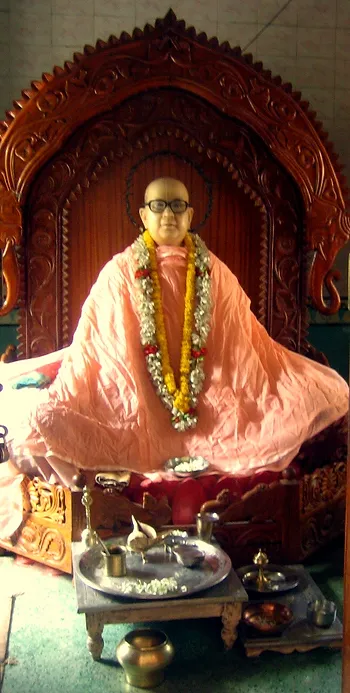
Hare Krishna, yesterday (18.2) we have appearance day of one of disciple Bhaktisiddhanta Prabhupada: Bhakti Sāraṅga Gosvāmī Mahārāja.
Today we have here 2part of Biography.
His presence of mind
Before Śrīla Prabhupāda sent Śrī Atulacandra Bandhopādhyāya abroad to preach, he asked Ernst-Georg Schulze, a German disciple of his whose initiated name was Sadānanda dāsa, “What title should I give Atulacandra when I send him to preach in the West? I need to give him a title that properly conveys his superiority to all the preachers I have sent until now.”
Śrī Sadānanda Prabhu suggested the title ‘Missionary-in-Charge,’ which Śrīla Prabhupāda liked. He then gave this title to Śrī Atulacandra Prabhu and sent him to preach abroad.
Śrī Atulacandra Prabhu did not accept even one paisā from the maṭha for his overseas preaching. The donations he collected abroad funded the entire venture.
One day, the housekeeper where he was staying informed him, “A large envelope with your name on it has come, but it is too big to fit in the letterbox. It is hanging out. You best retrieve it now.”
When Śrī Atulacandra Prabhu opened the letter, he found that the king of Bardhamāna had sent him a check in his name. Although he did not have an English bank account, he decided to go to the bank anyway.
At the bank, the manager told him, “We cannot cash your check unless we get a signature from someone who can verify your identity.”
It just so happened that a photograph of Śrī Atulacandra Prabhu shaking hands with the Marquis of Zetland had been published in the newspaper that day. Śrī Atulacandra Prabhu saw a newspaper lying on the manager’s desk, took it, and opened it to the page with his picture. He showed it to the manager and asked him, “Who is the person in this photograph?”
The manager read the title on the bottom of the photograph. “Indian monk A.B. Gosvāmī and Marquis of Zetland,” he said.
“Am I not the very same person?” Śrī Atulacandra Prabhu questioned. The manager looked at the photo and back at him a few times. “So?” Śrī Atulacandra Prabhu prodded. “What do you say?”
“It is definitely you.”
“Then you yourself can verify my identity and sign.” The manager did just that. Such was Śrīla Gosvāmī Mahārāja’s presence of mind.
Maintaining faith in disheartening situations
After Śrīla Prabhupāda’s disappearance, the Sārasvata Gauḍīya mission faced a host of disturbances. During that time, a certain distinguished personality made the following comment about a particular disciple of Śrīla Prabhupāda: “I do not trust him when he says hā (yes), nor do I trust his brother when he sarcastically says hū (yes). The mouths of the fathers of those who have faith in their hā’s and hū’s will be full of these two brothers’ stool.[2] They are cheating us. We should teach them a lesson.”
Śrīla Gosvāmī Mahārāja replied not ferociously, but peacefully, according to his tranquil nature. He said, “Bhagavān is all-knowing, and He always guides and protects His devotees. If while being cheated by the Vaiṣṇavas we maintain faith in them nevertheless, even at the cost of detriment, that faith will be the genesis of our future happiness.”
Acquiring land in Māyāpura
From the very beginning, Śrīla Gosvāmī Mahārāja was entirely disinterested inprocuring land and building a maṭha in Māyāpura. He would repeatedly say, “Already in Śrīdhāma Māyāpura are Śrīla Prabhupāda’s Śrī Caitanya Maṭha and Śrī Mādhava Mahārāja’s Śrī Caitanya Gauḍīya Maṭha. What, then, is the necessity for me to toil to build another place? I do, however, want my godbrothers to accrue as much land as possible, because otherwise, undesirable people will create establishments there in the future and try to tarnish the sanctity of the dhāma.”
He would also say, “I will provide mygodbrothers with as much money as they need to purchase and develop land. But with this, they must accept the responsibility of properly maintaining their establishments.”
Śrīla Gosvāmī Mahārāja possessed incredible foresight; today, many undesirable factions have established themselves in Śrīdhāma Māyāpura and engage in many activities opposed to the cultivation of bhakti.
Śrī Śrīmad Bhakti Rakṣaka Śrīdhara Gosvāmī Mahārāja was insistent that Śrīla Gosvāmī Mahārāja establish a maṭha in Śrīdhāma Māyāpura, and so Śrīla Gosvāmī Mahārāja, yielding to the request of his godbrother, purchased a plot of land there. On the day the foundation was to be consecrated by performing an auspicious cornerstone laying ceremony beneath the shade of an acacia tree there, Śrīla Bhakti Sāraṅga Gosvāmī Mahārāja did not conduct the ceremony himself, but had Śrīla Śrīdhara Gosvāmī Mahārāja do it.
Our Śrī Caitanya Gauḍīya Maṭha provided the mṛdaṅgas, karatālas and āsanas for that ceremony. I consider myself supremely fortunate and blessed to have witnessed and heard the heartfelt kīrtanas sung by those who had taken shelter of Śrīla Prabhupāda, their exemplary and genteel interactions, and the profound hari-kathā they spoke that day. Afterward, devotees distributed nothing more than a light, hollow sugar candy called batāsā as prasāda, but no one was dissatisfied; everyone was quite pleased.
The simple end to the grand festival brought to mind a verse I had learned when I was a child:
ajā-yuddhe ṛṣi-śrāddhe
prabhāte meghā’mburā
dāmpatye kalahe caiva
babhārambhe laghu-kriyā
The sparing of rams, the service rendered by saints, the sound of thunder in the mornings, and the squabbles between a husband and wife are loud in the beginning and quiet in the end, accomplished ultimately by the smallest of gestures.
Although I had always felt that this verse was not applicable in modern times, I realized it was most certainly relevant to Śrīla Gosvāmī Mahārāja’s feast that day.
An example of his humility
While Śrīla Gosvāmī Mahārāja’s maṭha in Śrīdhāma Māyāpura was under construction, he stayed in Guru Mahārāja’s bhajana-kuṭīra in our Śrī Caitanya Gauḍīya Maṭha. He was highly punctual; he would come and go at exactly the same time every day. One day, for some reason, he arrived at our maṭha five minutes earlier than normal. Before entering Guru Maharaja’s bhajana-kuṭīra, he asked us in all earnestness, “Prabhus, today I have come five minutes early. May I come inside the maṭha, or should I atone for my unpunctuality by waiting outside?”
Accept only that service which you can properly manage
When Śrīla Gosvāmī Mahārāja would host festivals in his maṭha, he would invite only one or two devotees from each maṭha. He would explain, “By his own conduct, Śrīla Bhaktivinoda Ṭhākura has taught that, as etiquette dictates, we must invite only as many Vaiṣṇavas as we are capable of serving at one time without losing a respectful attitude. If we invite too many devotees, we run the risk of making offenses due to our inability to attentively serve every one of them in a befitting manner.”
His deep respect for the dhāma
When Śrīla Gosvāmī Mahārāja would walk from Śrī Caitanya Gauḍīya Maṭha to his maṭha, his servant Śrī Gaura dāsa Prabhu and I would support him from either side. One day, as we were leaving Śrī Caitanya Gauḍīya Maṭha, we saw Nīlu, Śrī Yogapīṭha’s generator room guard, driving a new bicycle rikśāw, a vehicle that had been only recently introduced in Śrīdhāma Māyāpura. Seeing this, Śrī Gaura dāsa Prabhu asked Śrīla Gosvāmī Mahārāja, “Mahārāja-jī, would you like to go by rikśaw?”
Śrīla Gosvāmī Mahārāja replied gravely, “Me, on a rikśaw in the holy dhāma? Never. This will never happen. I know well that you people will all ride in cars in the future, but you will not get a license to do so from me.” It is a fact that in his entire life, he never sat in a rikśaw or car in the dhāma. When travelling to the dhāma in a car or rikśaw, he would stop at the limits of the dhāma and start walking.
Śrī Gaura dāsa Prabhu said, “Mahārāja, we are afraid you might fall and injure yourself if you walk all the time.”
Śrīla Gosvāmī Mahārāja joked, “Ah, that is your problem, not mine.”
Later, when he reached his maṭha, he loudly called to another of his dear servants, Śrī Vana-bihārī Bābā, “O Vana Bābā! This Gaura has just about killed me today. He made me walk all the way here. I am so worn out.”
His relationships with his disciples were always sweet and humorous.
Everything is justified in service
Once, Śrīla Gosvāmī Mahārāja and his servant Śrī Gaura dāsa Prabhu came to our Māyāpura branch of Śrī Caitanya Gauḍīya Maṭha to visit the gośālā, which I managed in those days. Śrīla Mahārāja saw two healthy, happy calves there and asked me, “How old are these calves?”
“Mahārāja-jī, they are about one year old,” I replied.
Without hesitating, he offered this advice: “If you turn them into oxen[3], you will be able to get a great amount of work out of them.”
When Śrī Gaura dāsa Prabhu heard this, he said, “Mahārāja! Would you have dared to even suggest such a thing, let alone do it, had you been living with your family?”
“No,” Śrīla Gosvāmī Mahārāja replied. “I would have been declared an outcaste and removed from our society. But I am no longer a brāhmaṇa; I am a transcendental mleccha, a divine outcaste of sorts. If an activity befitting a mleccha is performed with the intention of serving śrī guru, Vaiṣṇavas and Bhagavān, it is considered spiritual, not mundane. Everything is justified in service.”
Remembering Śrī Kṛṣṇa and His associates in all situations
One time, Śrīla Gosvāmī Mahārāja asked me, “What is your name?”
“Narottama dāsa Brahmacārī,” I replied.
When he heard this, he was reminded of Śrīla Narottama dāsa Ṭhākura. He said, “Your name is Narottama? Then you are my master, my Prabhu.”
In Śrī Caitanya-caritāmṛta (Ādi-līlā 4.85), Śrīla Kavirāja Gosvāmī has mentioned, “Ĵahā ĵahā netra paḓe tāhā kṛṣṇa sphure,” which when applied to this situation means “Wherever a perfected personality casts his eyes, Kṛṣṇa manifests to him.” The word kṛṣṇa in this verse refers to Śrī Kṛṣṇa accompanied by His associates. Therefore, when Śrīla Gosvāmī Mahārāja heard that my name was Narottama, he immediately became immersed in remembering Śrī Kṛṣṇa’s intimate associate, Śrīla Narottama dāsa Ṭhākura.
This is the specialty of Vaiṣṇavas. Ordinary persons can never imagine, even in dreams, the transcendental consciousness in which Vaiṣṇavas remain situated.
Honoring all prasāda with equal reverence
When Śrīla Sāraṅga Gosvāmī Mahārāja sat to honor prasāda, he would do so only after first mixing together all the preparations on his plate—everything from karelā (bitter melon) to sweet rice. The first time I saw him doing this, I was still new to the maṭha and I therefore lacked understanding of vaiṣṇava-siddhānta. I told him, “Mahārāja, you will not be able to relish the original, individual tastes of these preparations if you mix them all together.”
Śrīla Gosvāmī Mahārāja replied, “Why should I indulge the desires of this wicked and insignificant tongue of mine, which measures a mere two-and-a-half inches? Do you not recite this verse before accepting prasāda?
mahā-prasāde govinde
nāma-brahmaṇi vaiṣṇave
svalpa-puṇyavatāṁ rājan
viśvāso naiva jāyate
Skanda Purāṇa (Utkala-khaṇḍa)
Those who have very few pious activities to their credit can never develop faith in mahā-prasāda, in Śrī Govinda, in the holy name of the Lord, or in the Vaiṣṇavas. *
“And what has Śrīla Bhaktivinoda Ṭhākura written about mahā-prasāda?
śarīra avidyā-jāla, jaḓendriya tāhe kāla,
jīve phele viṣaya-sāgare
tā’ra madhye jihvā ati, lobhamaya sudurmati,
tā’ke ĵetā kaṭhina saṁsāre
O brothers! The material body is a web of ignorance and its inert senses are the cause of its ruination, for they throw the soul into the ocean of material enjoyment. Among the senses, the tongue is the greediest and wickedest; it is very difficult to conquer it in this world. *
kṛṣṇa baḓô dayāmaya, kôribāre jihvā jaya,
sva-prasād-anna dilā bhāi
sei annāmṛta pāo, rādhā-kṛṣṇa-guṇa gāo,
preme ḍākô caitanya-nitāi
Kṛṣṇa is so merciful that He has given us His own food remnants to help us conquer the tongue, O brothers. Honor these nectarean foods, sing the glories of Rādhā and Kṛṣṇa, and with prema call out, “Caitanya! Nitāi!” *
“In other words,” he explained, “śrī krsna-prasāda is just like nectar. To discriminate between preparations is improper. We should not think, ‘I want less karelā and more sweet rice,’ or, ‘I do not want this item, please serve me more of that one.’ ” He then quoted Śrī Caitanya Mahāprabhu, who said:
dvaite bhadrābhadra-jñāna, saba manodharma
ei bhālô, ei manda—ei saba bhrama
Śrī Caitanya-caritāmṛta (Antya-līlā 4.176)
In this world of duality, conceptions of ‘auspicious’ and ‘inauspicious’ are all functions of the mind. It is delusional to think “This is good and that is bad.”
Śrīla Gosvāmī Mahārāja concluded his point by saying, “It is therefore better for us to honor the items on our plate with equal reverence, considering them all to be prasāda.”
If someone would ask him how he liked the prasāda he was served, he would always answer, “It was very good. They prepared it very well.” But if he heard a devotee complain that a dish had not been properly prepared, he would say, “Go and call the cook at once. He must be punished for being inattentive in his service to Bhagavān. He should be suspended from his service for two or three days and instructed to atone for his misdeed by constantly weeping and chanting harināma. Bring him here at once, so that I may reprimand him.”
His words were not merely lip service; he set a precedent by actually punishing those who were inattentive in their service.
Śrīla Gosvāmī Mahārāja would often mention, “I have not come to the maṭha to serve Bhagavān; I have come to serve Vaiṣṇavas. In this world, we receive many opportunities to serve Bhagavān, but the opportunity to serve Vaiṣṇavas is exceedingly rare. It is much more spiritually beneficial to serve Vaiṣṇavas than Bhagavān, for by doing so, one learns how to properly serve Bhagavān and gradually develops a true, lasting taste for such service. Engaging in the direct service of Bhagavān without first serving Vaiṣṇavas does not ensure one’s spiritual benefit.”
When Śrīla Gosvāmī Mahārāja manifested an illness pastime, I bought him a portable commode made of cane, an item that was available in Navadvīpa and Kṛṣṇanagara in those days. When Śrīla Gosvāmī Mahārāja saw it, he told me, “I will never use this. A Vaiṣṇava would have to clean it every time I use it. I cannot bear to think about that. Throughout my life, I have never considered any Vaiṣṇava to be my servant. I have always regarded everyone, newcomers and seniors alike, as worthy of my service.”
No matter what I said to him, I could not convince him to use it. Finally, I constructed a commode out of bricks with my own hands, which he happily accepted.
Explaining the need for new maṭhas and deities
Someone once asked Śrīla Gosvāmī Mahārāja during one of his preaching tours, “What is the need to build new temples and maṭhas in India, when there are already so many? And why install new deities when there are currently so many deities being neglected?”
Śrīla Gosvāmī Mahārāja replied, “The root cause of India’s troubles is overpopulation. This is evident by the fact that the government has created various initiatives to keep the population under control. Those who have fewer children, for example, receive ample assistance from the government. If overpopulation is a national crisis, why do childless couples make efforts to have children of their own?
Would they not be as content with adopting an orphan? No, they would not. The degree of affection one may possess for another person’s child can never match the affection one would have for one’s own. Similarly, the attachment one may have to a temple, maṭha or deities established by others is far exceeded by the attachment one has to one’s own.”
Once, Śrīla Gosvāmī Mahārāja fell ill in Śrīdhāma Māyāpura and needed to be taken to Kolkata for medical assistance. I accompanied him and the devotees who were engaged in his personal service on part of their journey. We first took him across the Gaṅgā by boat to Svarūpa Gañja, and then boarded a bus to Kṛṣṇanagara, where I arranged for them to take a train to Kolkata. I also explained to his sevakas how to reach Dr. N.R. Sena Gupta, a reputable doctor in Kolkata.
After Śrīla Gosvāmī Mahārāja recovered and returned to Śrīdhāma Māyāpura, he told me, “I was fully conscious the whole time you took me from the ghāṭa to Svarūpa Gañja, and then to Kṛṣṇanagara. But I remained quiet, thinking that I should let the Vaiṣṇavas do as they felt was appropriate.”
I was astonished as Śrīla Gosvāmī Mahārāja went on to recount the day’s events in such sharp detail. I was reminded of Śrīla Vṛndāvana dāsa Ṭhākura’s words in Śrī Caitanya-bhāgavata (Madhya-khaṇḍa 9.240):
ĵatô dekhô vaiṣṇavera vyavahāra-duḥkha
niścaya hi jānihô sei parānanda-sukha
Know well that whatever suffering a Vaiṣṇava may appear to experience is actually spiritual happiness.
I was amazed: although he appeared severely unwell outwardly, he was fully aware internally. Perhaps it is with reference to such instances that the scriptures state, “vaiṣṇava cinite nāre devera śakati—even the demigods are incapable of understanding the divine habits and activities of Vaiṣṇavas.”
His astounding life teachings
We have received the following teachings from the exemplary life of Śrīla Gosvāmī Mahārāja:
Devotees need not be concerned with experiencing opposition, nor should they worry about adverse circumstances. Bhagavān is like an affectionate parent for His devotees; He always protects them.
The process of bhajana cannot develop if corrupted by a propensity for sense gratification. A person attached to gratifying his senses never attains true welfare. It is only when we remain supremely satisfied with whatever prasada Bhagavān mercifully arranges for us that we will attain perfection in our sādhana.
Fully attentive and dedicated service to Śrī Hari, guru, and Vaiṣṇavas is the true expression of deep-rooted love for them.
The Disappearance of Pūjyapāda Gosvāmī Mahārāja
Composed under the editorship of Śrī Śrīmad Bhakti Pramoda Purī Gosvāmī Mahārāja
The principal pillar of Śrīla Prabhupāda’s preaching mission
Tridaṇḍi-svāmī Śrīmad Bhakti Sāraṅga Gosvāmī Mahārāja, was one of the foremost pillars of Śrī Śrīmad Bhakti Siddhānta Sarasvatī Gosvāmī Prabhupāda’s preaching mission, which aimed to spread the message of Śrī Caitanya Mahaprabhu to the entire world. Thus, he fulfilled his beloved śrī gurupāda-padma’s most cherished desire.
A model of humility and a fearless guru-sevaka
Pūjyapāda Gosvāṃī Mahārāja was a prominent member of the Śrī Viśva Vaiṣṇava Rāja Sabhā[4], the chairman of the weekly Gauḍīya magazine’s editorial board, a humble model of guru-sevā and the greatest of speakers. Now, he has attained the eternal shelter of the gentle lotus feet of his śrī guru, who propagated throughout the world the glories of Śrī Gaura’s sacred abode, name, and most cherished desire. Through his divine conduct, pūjyapāda Mahārāja demonstrated a fearless example of service to śrī guru until the very last moment of his physical presence. If we can attain the fortune of following him, to even a fractional degree, then our lives will be blessed beyond all fortune.
His unpretentious, genuine and exemplary character
Pūjyapāda Gosvāmī Mahārāja was the foremost assistant of śrī gaura-karuṇā-śakti—Śrīla Prabhupāda, who was Śrī Gaura’s potency of compassion—in fulfilling the most cherished ambition of Śrī Gaura. By the desire of Gaura-sundara, that great servant of śrī guru who possessed the most unpretentious, genuine and exemplary character appeared in the world with great nobility. Today, he has concluded his magnificent vow of service and bid farewell to the mundane realm.
kṛpā kôri’ kṛṣṇa more diyāchilô sāṅga
svatantra kṛṣṇera icchā, hôilô saṅga-bhaṅga
Mercifully, Kṛṣṇa gave me his association. By Kṛṣṇa’s independent will, our exchange has ended.
Excerpts from articles published in
Śrī Caitanya-Vāṇī (Year 4, Volume 4)
[1] Lit, ‘people of Hari.’ Mahātma Gandhī used this term to describe members of the various labor communities (washermen, drain cleaners, street sweepers, leather workers, etc.), who are generally considered untouchable outcastes.
[2] In other words, the two brothers’ association is so harmful that it affects not only a person who associates with them, but that person’s father, as well. Just as good association delivers one’s forefathers, bad association adversely affects them.
[3] Castrated bulls trained for use as service animals.
[4] An informal, worldwide organization founded by Śrīla Jīva Gosvāmī. The words viṣva-vaiṣṇava-rāja refer to Śrī Caitanya Mahāprabhu, and sabhā refers to those devotees who follow His teachings.
:::::::::::::::::::::::::::::::::::::::::::::::::::::::::::::::::::::::::::::::::::
A glorification of Goswami Maharaja written in 1929 by Sri Bhaktisiddhanta Saravati Thakura titled, “A Genuine Goswami”:
A Genuine Goswami
In the great land of Bharata, from distant Kashmir near the high peaks of the Himalayas to the banks of the Indian ocean, who does not know Bhakti Saranga Prabhu?
Sri Bhakti Saranga Prabhu is the brightest jewel in the lineage of Sri Nityananda Prabhu. His detachment is the full manifestation of the path preached by Sri Nityananda. Although he adheres to the scripturally ordained duties of a householder, he is a genuine goswami and naturally detached from everything unrelated to Krsna. Every quality-appreciating servitor in Sri Caitanya Matha and the twenty-eight primary mathas of Sri Gaudiya Matha greatly respects him.
Every Gaudiya preacher and the numerous supporters of the tridandi preachers from the ocean to the Himalayas throughout the land of the Aryans and the south know of Sri Bhakti Saranga Prabhu’s eloquence and capability in Sanskrit, English, and Bengali.
Nearly every single fortunate resident of Gauda has seen, more or less, His holy character, his pure heart’s ecstasy, his earnestness for Krsna, and his profound love for Sri Gaurasundara.
With his assiduousness, his constant, all-rounded endeavours from dawn until midnight for the benefit of the society of Gaudiya Vaisnavas, his unparalleled spirit of dedication to Krsna and His devotees, he is fulfilling his name ‘Atula’ [‘unparalleled’].
He has wiped away the moon’s imperfections and replaced them with the immense light from the moon of krsna-prema’s sole path. Thus, by reproaching even the pleasant, shining moon, his position as the unparalleled moon (‘atula-candra’) amongst Gauracandra’s exclusive followers has been realised.
He is the teacher (‘upadhyaya’) of worshippable (‘vandya’) Vaisnavas. He is the sole reformer of the rsi’s laws. His heartfelt endeavours are the enlivening energy of Sri Caitanya Math’s Institute for Spiritual Education (Para-vidyapitha). He is a genius amongst the goswamis, and himself is a genuine goswami. The pure devotees have heard that he is renowned to be ‘Bhakti-Saranga’ (‘the embodiment of the essence of devotion’) on account of his expertise and excellence in devotion. Seeing the beauty of the holy lotus feet of this great transcendentalist, the world of pure Vaisnavas is enchanted.
He is the secretary of the Sri Visva Vaisnava Raja Sabha. He is one of the editors of Sri Gaudiya Matha’s Srimad Bhagavatam. He is an exemplar in the world of the pure Vaisnavas, a follower of the Sri Rupanuga Vaisnavas, and thus worshippable to the world.
(Translated from the Bengali article published in the 7th February 1929 issue of the daily Nadia Prakasa)
! For more Biography look here!
!For more Articles look here!